
Hot-Dip Galvanized Tube Rack Base: Internal Zinc Coverage, Drainage Openings and Clean Finishing
derack
Technical solution: inside a hot-dip galvanized tube rack base — internal zinc coverage, four-directional galvanizing and drainage openings, socket corner notches, identification plates and final zinc-dross removal across a batch of nearly 200 pieces.

Hot-Dip Galvanized Tube Rack Base: Internal Zinc Coverage, Drainage Openings and Clean Finishing
A production review of two hot-dip galvanized tube-rack base models, 13013801 and 13013802, manufactured at the Hebei factory for a European customer. A batch of nearly 200 pieces is examined for internal zinc coverage inside hollow sections, four-directional galvanizing and drainage openings, corner notches that keep zinc out of the plug-in sockets, front and rear identification plates, safety labels on both sides, and final removal of residual zinc dross before packing and container loading.
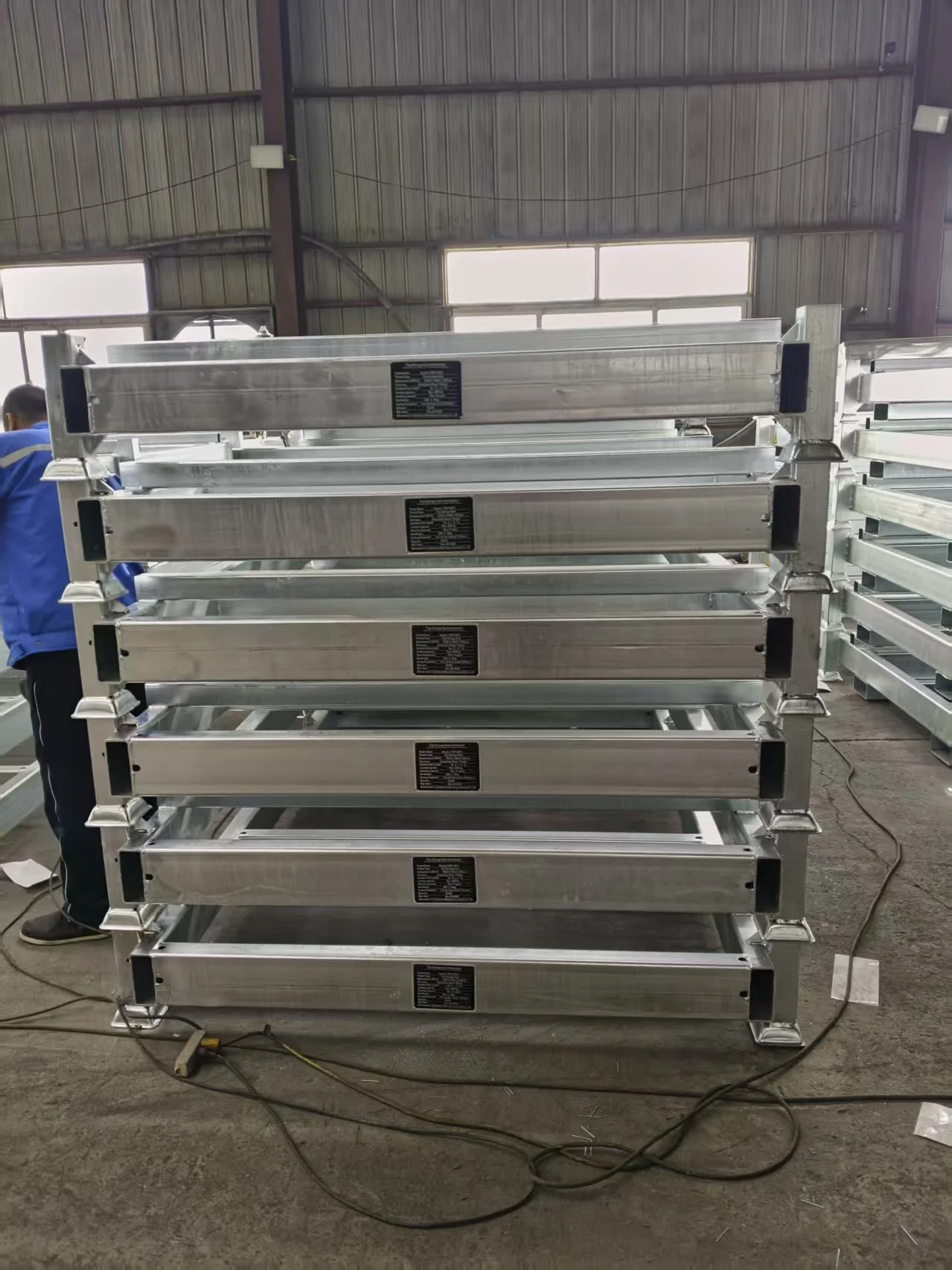
Inside a Hot-Dip Galvanized Tube Rack Base: Internal Zinc Coverage, Drainage Openings and Clean Finishing
The surface finish of a galvanized rack is only one part of the product.
For a hollow-section tube rack, engineers must also consider what happens inside the base members:
whether the internal steel receives zinc coverage;
whether zinc and water can drain away;
whether residual zinc could interfere with the plug-in columns during assembly;
whether the customer’s identification and safety requirements have been applied correctly;
and whether the finished surface has been properly cleaned before shipment.
This production review examines two hot-dip galvanized tube-rack products manufactured at the Hebei factory:
Product No. 13013801
Product No. 13013802
Using production photographs and video, the review focuses on the rack base after galvanizing and examines five functional production details:
internal zinc coverage within the hollow steel sections;
dedicated galvanizing and drainage openings;
corner notches that prevent zinc from being trapped in the plug-in sockets;
customer identification plates and safety labels;
improved surface cleanliness and final removal of residual zinc dross.
The batch contained nearly 200 pieces. Although the exact dimensions, load ratings, coating requirements and container count were not disclosed, the production images demonstrate why a functional galvanized base requires considerably more attention than simply completing the external zinc coating.
A galvanized rack is not finished when the outside looks bright. Internal coverage, drainage paths, clean sockets, correct labels and the removal of residual zinc all determine whether the base will perform correctly in service.
1. Production Review at a Glance
| Item | Recorded Detail | Significance |
|---|---|---|
| Product codes | 13013801 and 13013802 | Two models covered by the production review |
| Production location | Hebei factory | Location where the rack bases were manufactured and inspected |
| Main component reviewed | Tube-rack base after hot-dip galvanizing | The base is the structural and functional foundation of the product |
| Coating process | Hot-dip galvanizing | The fabricated steel component is immersed in a molten zinc bath |
| Internal protection | Zinc enters the hollow tube cavities and coats their internal surfaces | Protects the internal steel if rainwater enters a hollow section |
| Galvanizing opening | Process openings with access in four directions | Permit zinc circulation and the removal of excess material |
| Service drainage | The same openings provide a route for trapped rainwater to escape | Helps prevent moisture from remaining inside the tube |
| Socket drainage | Relief notches are visible at the four base corners | Prevent residual zinc from collecting inside the upright sockets |
| Identification plates | Two plates per product: one at the front and one at the rear | Carry the customer’s company information and product information |
| Safety labels | Applied to both sides of the product | Reflects the European customer’s emphasis on hazard identification |
| Batch size | Nearly 200 pieces | A relatively large order for large-format rack bases |
| Container requirement | A significant number of containers would be required | The exact number was not stated in the source material |
| Surface appearance | Brighter and cleaner than earlier examples | Associated with improved control of process-opening locations and quantities |
| Post-galvanizing treatment | Residual surface zinc dross removed with sandpaper | Workers clean the completed components after they return from the galvanizing plant |
| Dimensions and load ratings | Not disclosed | Must be obtained from the released engineering documentation |
| Zinc-layer thickness and galvanizing standard | Not disclosed | Must be obtained from the approved coating specification |
The source describes the batch as “nearly 200 pieces.” It does not clarify whether every counted item represents a complete rack set or one separately packed base component. The final packing list should be treated as the definitive quantity.

2. Why the Base Deserved a Detailed Inspection
The base supports the rest of the rack, but it also contains the details that determine whether the product can be galvanized correctly and assembled successfully.
A conventional inspection of the external finish would not reveal whether:
zinc entered the hollow tube cavity;
the internal surface received adequate coverage;
the process openings allowed zinc to flow out;
rainwater could later drain from the tube;
zinc remained trapped inside the column socket;
the customer’s identification information appeared in the correct locations;
the relevant safety warnings were displayed;
or residual zinc dross had been removed from the finished surface.
The production review therefore moved beyond the general appearance of the rack and examined the base as a functional assembly.
| Inspection Subject | Functional Question |
|---|---|
| Inside of the hollow base member | Is the internal steel protected by zinc? |
| Galvanizing process openings | Can zinc enter and leave the cavity freely? |
| Base-corner notch | Can residual zinc drain away from the plug-in socket? |
| External zinc surface | Is the finish clean and free from retained residue? |
| Identification-plate locations | Can the customer and product information be read from both ends? |
| Safety labels | Are the relevant warnings visible on both sides? |
| Complete production batch | Is the same manufacturing quality maintained across nearly 200 pieces? |
The galvanized base is not simply a coated support. It is a hollow structural component that must also function correctly as a drainage path and as a socket for the plug-in upright.
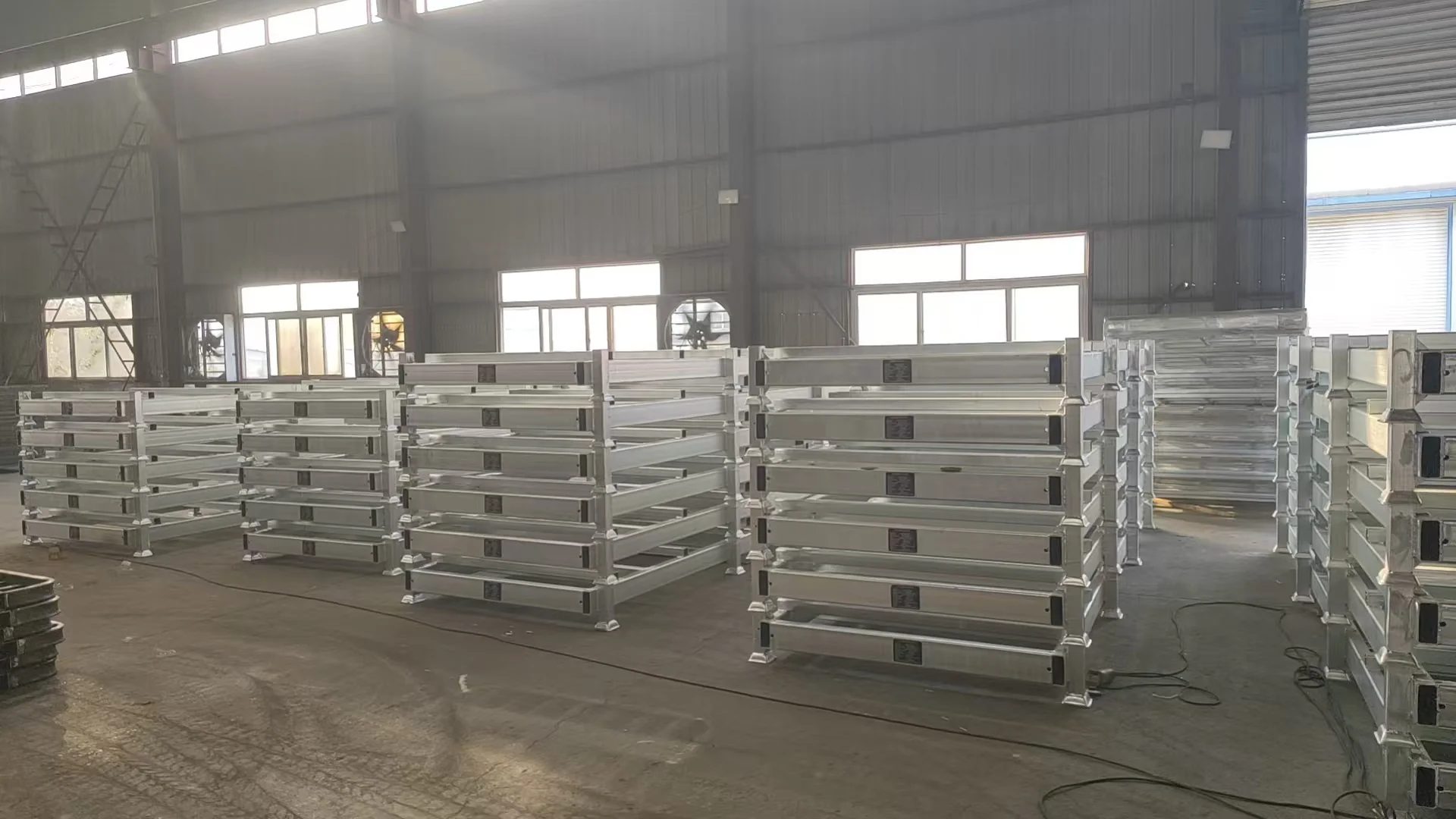
3. Hot-Dip Galvanizing Protects the Steel Inside and Outside
Hot-dip galvanizing is fundamentally different from applying a zinc-rich coating with a brush or spray gun.
The fabricated steel component is immersed in a molten zinc bath. Zinc contacts the external steel surface and forms a protective metallic coating. For a hollow section, zinc can also enter the internal cavity and coat the internal steel.
3.1 What the Production Review Demonstrates
| Process Element | Presentation Observation |
|---|---|
| External zinc coverage | The complete outer surface of the rack base receives zinc during immersion |
| Internal zinc coverage | Zinc enters the hollow tube, and the presenter states that the internal cavity receives a zinc layer |
| Corrosion objective | The coating protects the underlying steel from rusting |
| Water-entry scenario | If rainwater enters a tube, the internally coated surface is intended to resist internal corrosion |
| Functional importance | Internal coverage is essential for a rack intended for outdoor or moisture-exposed service |
3.2 Why Internal Coverage Matters
The external appearance of a hollow tube can look completely satisfactory while its internal surface remains vulnerable.
| Condition | Consequence |
|---|---|
| External zinc only | Water entering the cavity can reach unprotected internal steel |
| Internal zinc coverage present | The internal surface has a corrosion-resistant metallic barrier |
| Closed or poorly vented cavity | Zinc cannot enter and drain properly, making complete internal coverage difficult |
| Properly designed process openings | Zinc can circulate through the cavity and cover the internal surface |
| Subsequent rainwater entry | The internal zinc layer continues to protect the steel |
This is why a galvanized tube rack should not be evaluated only through its exterior finish.
The corrosion-protection system includes the inside of the hollow section. A bright outer surface does not prove that the internal steel has been properly protected.

4. Multipurpose Galvanizing and Drainage Openings
One of the most important details visible in the base is the galvanizing process opening.
The source describes the opening arrangement as providing access on four sides—up, down, left and right. Its function changes after installation, but the same geometry remains useful during both manufacturing and service.
4.1 During Hot-Dip Galvanizing
When the component enters the molten zinc bath, the openings provide paths for zinc to move into and out of the hollow tube.
| Function During Galvanizing | Result |
|---|---|
| Zinc entry | Allows molten zinc to reach the internal cavity |
| Air-venting path | Helps trapped air escape instead of preventing complete flooding |
| Zinc circulation | Supports contact between the molten zinc and the internal steel surface |
| Drainage | Allows excess zinc and processing liquid to leave the cavity |
| Internal coverage | Supports the formation of a zinc layer on the internal steel |
| Excess-material control | Reduces the likelihood of retained zinc remaining inside the tube |
4.2 During Outdoor Service
The same openings provide a drainage path after the rack has been installed.
| Function in Service | Result |
|---|---|
| Rainwater entry | Water can enter through an upper opening or joint |
| Internal accumulation | Water collects temporarily at the bottom of the tube |
| Drainage route | Water exits through the lower openings |
| Corrosion reduction | Reduces the duration for which water remains against the internal steel |
| Functional continuity | One geometric feature serves both the manufacturing process and the service environment |
4.3 Why Opening Location and Quantity Matter
The presenter associated the improved external finish with better control of the number and position of the galvanizing openings.
| Process-Control Factor | Effect if Poorly Controlled | Effect of the Improved Arrangement |
|---|---|---|
| Opening position | Zinc may escape around unsuitable areas or remain trapped | More controlled zinc flow and drainage |
| Opening quantity | Insufficient openings can restrict circulation or drainage | Better internal access and fluid movement |
| Residue retention | Excess zinc or zinc dross may remain around the component | A brighter, cleaner external surface |
| Internal fit | Retained zinc may interfere with a plug-in column | Easier and cleaner socket engagement |
| Visual quality | Residue can make the component appear uneven or unfinished | More consistent batch appearance |
This explains why the openings are functional product features, not simply holes added to assist the galvanizing plant.
The position and quantity of every process opening affect the coating, drainage, assembly and final appearance. They should be treated as controlled design features.
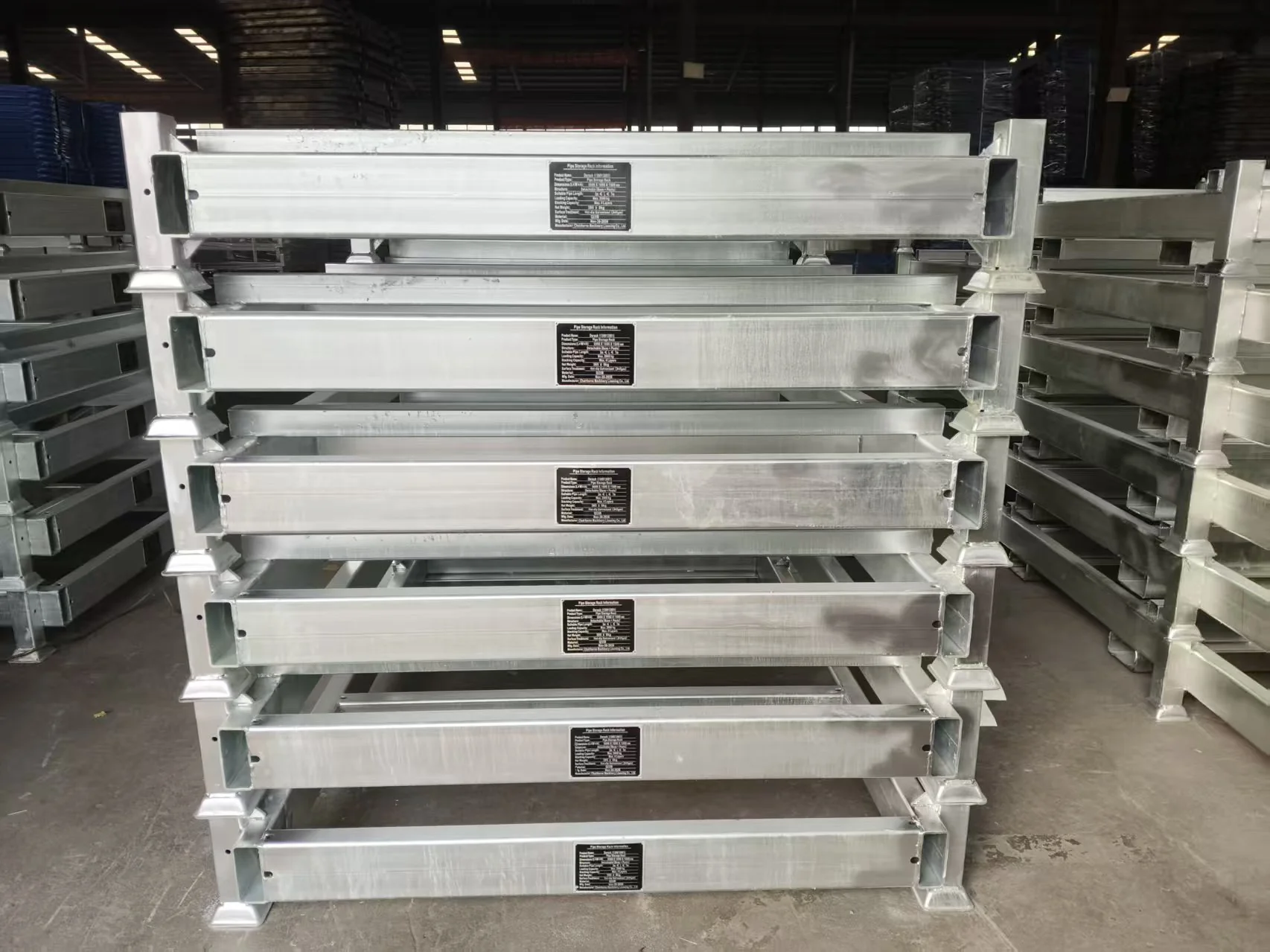
5. Corner Notches Prevent Zinc from Blocking the Plug-In Sockets
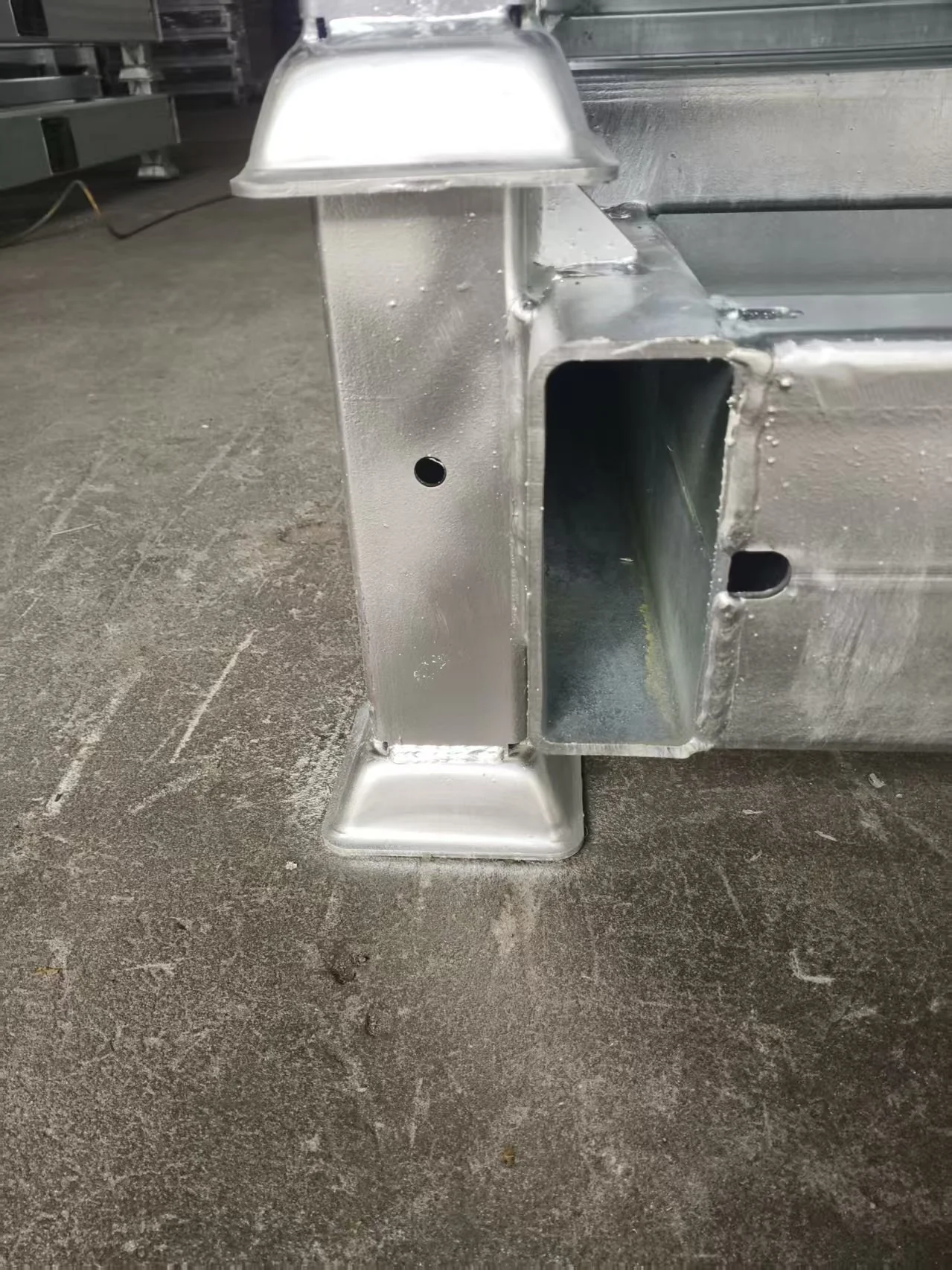
The production images also showed a notch at each of the four corners of the base.
These corners contain the base upright sockets into which the rack’s plug-in columns will later be inserted.
5.1 The Assembly Risk
If molten zinc or solid zinc residue remains inside a socket, the inserted column may not move freely.
| Condition | Possible Consequence |
|---|---|
| Zinc remains inside the base socket | The column binds during insertion |
| Solidified zinc dross occupies part of the socket | The column may stop before reaching its full seated position |
| Severe interference | The column may be impossible to insert without force or modification |
| Incorrectly seated column | Reduced engagement and an incomplete load-transfer condition |
| Notches provide an escape path | Excess zinc drains away from the socket before assembly |
5.2 The Functional Logic
| Production Step | Contribution of the Corner Notch |
|---|---|
| Component enters the zinc bath | The notch provides another drainage path around the socket area |
| Excess zinc drains | Reduces the amount retained inside the upright opening |
| Component cools | Residual material is less likely to form an obstruction at the critical socket |
| Plug-in column is installed | The column enters a cleaner, less obstructed socket |
| Final assembly | Supports consistent engagement and smoother installation |
The corner notch therefore protects an assembly function that may not be visible from the outside of the completed rack.
Galvanizing quality must include the functional interfaces. A perfectly coated socket that traps zinc is not a satisfactory component.

6. Customer Identification and Safety Labeling
This European customer required more than a structurally acceptable product. It also required a clear identification and safety-labeling system.
6.1 Identification Plates
The customer specified that the following information appear on a metal identification plate:
the customer’s company information;
the relevant product information;
two plates on each product;
one plate at the front;
and one plate at the rear.
| Identification Requirement | Recorded Arrangement | Purpose |
|---|---|---|
| Company information | Included on the identification plate | Identifies the product owner or customer |
| Product information | Included on the identification plate | Supports product identification and traceability |
| Number of plates | Two per product | Allows identification from both operating ends |
| Front plate | One plate fitted at the front | Visible during normal forward access |
| Rear plate | One plate fitted at the rear | Maintains identification when viewed from the opposite end |
The information layout, language, size and attachment method were not disclosed in the source material and should be established on the released identification drawing.
6.2 Safety Labels
In addition to the identification plates, safety labels were attached to both sides of the product.
| Requirement | Presentation Detail |
|---|---|
| Customer market | Europe |
| Customer priority | Strong emphasis on safety communication |
| Label location | Both sides of the product |
| Content | The relevant hazards associated with this type of rack |
| Purpose | Make handling and operating risks visible in the work area |
| Exact label count and artwork | Not explicitly stated in the source material |
The source did not reproduce the individual hazard symbols or warning statements. The final label artwork should therefore be selected from the customer’s approved risk assessment and the applicable European product-safety requirements.
The nameplate identifies the product. The safety labels communicate how it must be handled. Both are part of the delivered product, not optional packaging items.
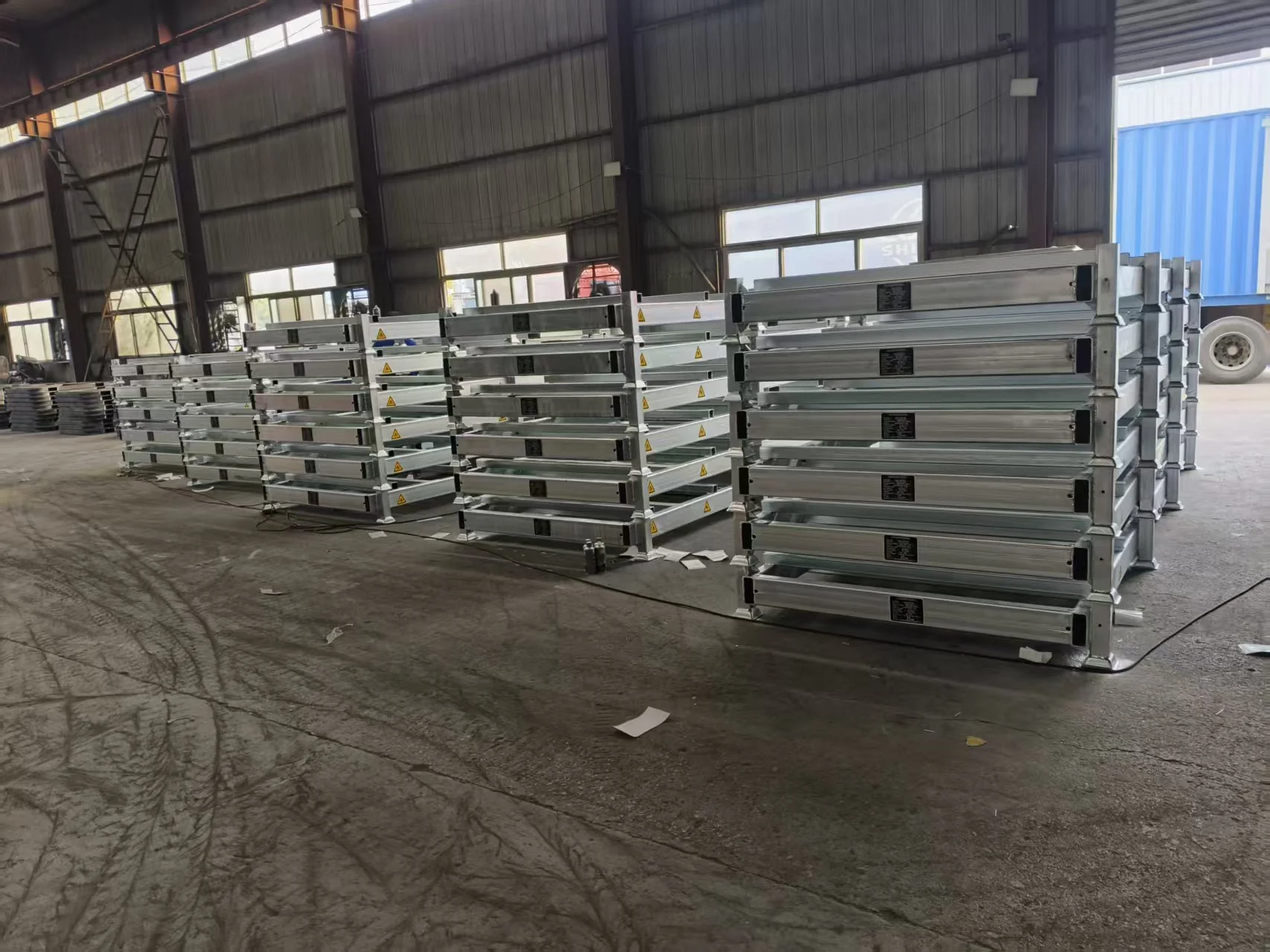
7. A Large Batch of Nearly 200 Pieces
The order contained nearly 200 pieces.
Because the racks were relatively large, the order required a considerable number of containers. The source did not disclose the exact container count or the number of pieces loaded into each container.
| Batch Characteristic | Recorded Detail | Commercial Significance |
|---|---|---|
| Total quantity | Nearly 200 pieces | A relatively large production order |
| Product size | Described as a large-format rack model | The assembled dimensions influence packing utilization |
| Shipping requirement | A significant number of containers | Freight becomes an important part of the delivered cost |
| Exact container count | Not stated | Must be confirmed through the approved packing and loading plan |
| Pieces per container | Not stated | Depends on the final packed dimensions and loading method |
| Production evidence | Images showed the bases stacked after completion | Demonstrates the scale of the completed batch |
The side view of the stacked bases also provided a useful overview of the finished galvanized components before shipment.

8. A Brighter and Cleaner Galvanized Surface
Compared with earlier examples, the completed bases in this batch appeared noticeably brighter.
The presenter attributed this improvement primarily to better control of the galvanizing process openings—their positions and the number of openings used.
8.1 Why Earlier Examples Look Less Clean
| Earlier Condition | Result |
|---|---|
| Process openings poorly positioned | Zinc did not drain as intended |
| Insufficient or unsuitable opening quantity | More residue remained around the component |
| Zinc accumulating externally | Excess zinc and zinc dross remained on the visible surface |
| Inconsistent cleaning | The completed product appeared duller and less uniform |
| Improved opening control | Better drainage and a visibly cleaner external finish |
The improved appearance should therefore not be viewed as a purely cosmetic result. Better process control supports both appearance and functional performance.
8.2 Hot-Dip Galvanizing Compared with Electro-Galvanizing
The source contrasts the appearance of the thick hot-dip coating with the more reflective appearance associated with cold or electro-galvanized products.
| Characteristic | Hot-Dip Galvanized Finish | Cold/Electro-Galvanized Appearance Discussed in the Source |
|---|---|---|
| Visual character | Heavy, substantial and less mirror-like | Finer and more reflective in the examples compared |
| Coating thickness | Described in the source as relatively thick | Described in the source as comparatively thin |
| Corrosion protection | Presented as stronger | Presented as weaker in the stated comparison |
| Surface character | May retain zinc dross or crystallization patterns | Typically presents a smoother, more reflective finish |
| Process residue | Requires removal of residual zinc dross | Has different residue and surface-cleaning characteristics |
| Manufacturing requirement | Requires controlled openings, draining and post-process cleaning | Requires different surface preparation and coating control |
The comparison is presented as an observation from the production review rather than as a universal performance guarantee. Actual coating thickness and service life must be established through the specified galvanizing standard and test records.
A hot-dip galvanized finish should not be expected to look like a decorative chrome-like coating. Its appearance is functional, and its performance depends on the controlled multilayer zinc system.

9. Final Removal of Residual Zinc Dross
Even after the bases returned from the galvanizing plant with a bright overall finish, some surface zinc dross remained.
The production team used sandpaper to grind these remaining areas.
| Stage | Recorded Condition | Treatment |
|---|---|---|
| Return from galvanizing plant | The overall surface was already bright | Product reviewed for residual zinc residue |
| Surface inspection | Localized zinc dross remained | Problem areas identified for manual treatment |
| Manual finishing | Workers used sandpaper | Residual zinc dross was ground away |
| Final inspection | Cleaner and more uniform visible surface | Confirmed the appearance of the finished component |
| Assembly and shipment | Completed bases were stacked | Prepared for further assembly, packing and container loading |
This final treatment demonstrates why the production sequence cannot end immediately after the component returns from the galvanizing plant.
A bright average surface does not mean that every local area is clean. Final inspection and residue removal are necessary for a consistent finished product.
10. Production Quality-Control Matrix
The following matrix summarizes the functional checks established or implied by the source material.
| Production Stage | Check | Acceptance Evidence | Basis |
|---|---|---|---|
| Before galvanizing | Process openings are present and unobstructed | Pre-galvanizing photographs or inspection checklist | Functional requirement stated in the source |
| During galvanizing | Zinc enters and drains through the hollow cavity | Galvanizing operation record | Functional requirement stated in the source |
| After galvanizing | Internal and external zinc coverage is present | Coating inspection and photographs | Functional requirement stated in the source |
| After galvanizing | Four-directional openings remain clear | Visual inspection | Functional requirement stated in the source |
| After galvanizing | Base-corner notches are open | Visual inspection | Functional requirement stated in the source |
| After galvanizing | Base sockets contain no retained zinc or obstructing dross | Fit-up check with a representative column | Assembly function stated in the source |
| After galvanizing | External surface is free from excessive residue | Surface inspection record | Stated production requirement |
| After cleaning | Sanded areas remain smooth and free from unacceptable damage | Visual inspection | Stated production requirement |
| During assembly | Identification plates are fitted at the front and rear | Label checklist and photographs | Customer requirement |
| During assembly | Safety labels are fitted on both sides | Label checklist and photographs | Customer requirement |
| Final inspection | Batch appearance is consistent across the completed units | Batch inspection photographs | Production-review evidence |
| Before shipment | Nearly 200 pieces are correctly stacked and packed | Packing list and loading photographs | Batch and shipping preparation |
The source did not specify opening diameters, zinc-layer thickness, coating standards, label artwork or a formal socket-fit tolerance. Production acceptance must use the released technical documents.

11. Seven Lessons from This Production Review
1. Inspect the Inside of a Hollow Steel Product
An attractive external finish says little about the condition of the internal cavity. The internal zinc layer is part of the corrosion-protection system.
2. Galvanizing Openings Are Product Features
The openings allow zinc to enter and leave the tube during manufacturing and provide a drainage route during service. Their positions and quantities therefore affect the finished product.
3. Protect the Functional Interfaces
The base sockets must remain free from trapped zinc. Even where the external coating is excellent, an obstructed socket can prevent correct assembly.
4. Product Identification and Safety Are Separate Requirements
The nameplate identifies the customer and product. The safety labels communicate the relevant operating hazards. Both are required on the delivered rack.
5. Process Improvements Can Be Seen in the Finish
Better control of process-opening positions and quantities was associated with a noticeably brighter surface and less retained residue.
6. Final Cleaning Must Follow Galvanizing
Residual zinc dross may remain on an otherwise bright component. Local inspection and careful finishing are necessary before packing.
7. Scale Increases the Value of Consistent Manufacturing
A batch of nearly 200 pieces is not an opportunity for unit-by-unit improvisation. The product design, opening layout, labeling, inspection and cleaning process must be repeatable.
12. Where These Practices Apply
| Application Area | Relevance |
|---|---|
| Outdoor tube and pipe racks | Internal coverage and drainage support long-term moisture protection |
| Plug-in rack bases | Socket notches and zinc-drainage control protect column installation |
| Hollow-section storage products | Process openings are required wherever internal zinc coverage is needed |
| Export manufacturing | Consistent finish, labels and packing reduce batch-level quality variation |
| Large production batches | Standardized openings and inspection become essential for repeatability |
| Customer-specific identification | Front and rear nameplates support traceability from either end |
| Safety-regulated markets | Clearly positioned hazard labels support responsible use |
Conclusion
This production review demonstrates that a hot-dip galvanized tube-rack base contains several functional details that are easy to overlook.
Internal Zinc Coverage
The steel components are immersed in molten zinc, allowing both their external surfaces and internal cavities to receive zinc coverage. This protects the internal steel if rainwater later enters a hollow section.
Four-Directional Galvanizing and Drainage Openings
The base includes openings that allow zinc to enter and leave the tube during galvanizing. The same openings provide a route for rainwater to drain after installation.
Corner Notches at the Base Sockets
Notches at the four base corners help prevent zinc from collecting inside the upright sockets. Without these drainage paths, retained zinc or zinc dross could cause the plug-in columns to bind or fail to seat correctly.
Customer Identification and Safety Labels
The European customer required two identification plates—one at the front and one at the rear—plus safety labels on both sides of every product.
A Large Production Batch
The order included nearly 200 pieces of two models, 13013801 and 13013802. The rack’s size created a significant container-shipping requirement, although the exact loading plan was not disclosed.
Improved Surface Cleanliness
The brighter finish was associated with better control of the galvanizing process-opening positions and quantities. The source also presented the thick hot-dip finish as more substantial and more corrosion-resistant than the cold- or electro-galvanized examples discussed.
Final Zinc-Dross Removal
Although the bases returned from the galvanizing plant with a bright overall appearance, residual zinc dross remained in some areas. Workers removed it with sandpaper before the components were stacked and shipped.
The product is protected by more than a visible zinc coating. It is protected by a complete internal-and-external coating system, controlled drainage paths, clean sockets, correct labels and a finished surface from which residual zinc has been removed.
Send your rack drawings, load ratings, market and coating specification. We will review the hollow-section design, galvanizing and drainage opening layout, socket notches, identification plates and safety labels, then confirm the batch, inspection and packing plan for your project. Send your rack requirements