
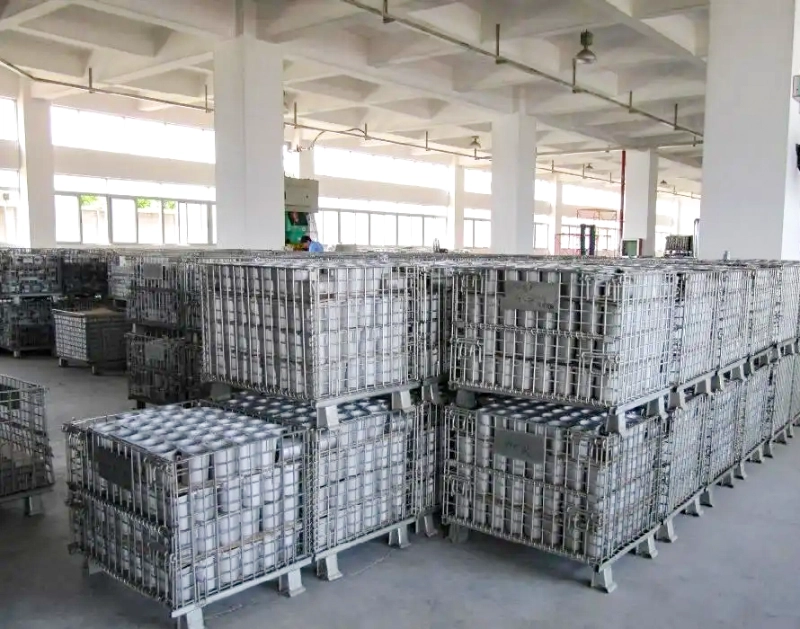
Most stacking errors begin with a correct number used in the wrong place. A quotation or technical sheet lists 1,000 kg or 1,400 kg per cage. The planner fills every level of a four-high stack to that value, and the bottom cage is then expected to hold two or three more fully loaded cages — a duty that was never checked, and in one of our own project records is less than half of what that reading would allow.
A single-cage load is not the load a stack puts on a cage. This page keeps the two quantities apart, follows the path the upper weight actually takes through a wire mesh container, lists the inspection points that should stop a stack instead of extending it, and shows how to read a limit that was written for another project. The numbers used here are project and comparison records, not a general rating for the product line.
Two Numbers That Look Interchangeable and Are Not
The first quantity is the per-cage load: the content weight one cage is documented to carry while it stands on a floor, on a pallet or on the forks. It describes one cage with its own contents, and it says nothing about what happens when a second cage is placed on top of it.
The second quantity is the upper-tier load, sometimes written as the stacked load or the combined payload through the bottom unit. It is the total weight of everything standing above one cage — the cages themselves, their contents, and any uneven concentration inside them. This is the number that governs the cage at the bottom of a loaded stack.
One project record makes the gap visible. For a 1,000 x 800 x 840 mm cage with 6 mm wire, the same document states 1,400 kg per cage and, separately, a limit of 2,000 kg total for the upper cages when the units are stacked four high. Reading the first figure as the second would put 4,200 kg through a bottom cage documented for 2,000 kg. A 1,050 x 1,050 x 1,000 mm record shows the same pattern at a lower level: 1,000 kg per cage, but no more than 1,200 kg of upper cages above the bottom unit.
The rule that follows is short. The bottom cage in a loaded stack is governed by the sum of the levels above it, never by the rating of any single one of them.
Where the Upper Weight Actually Goes
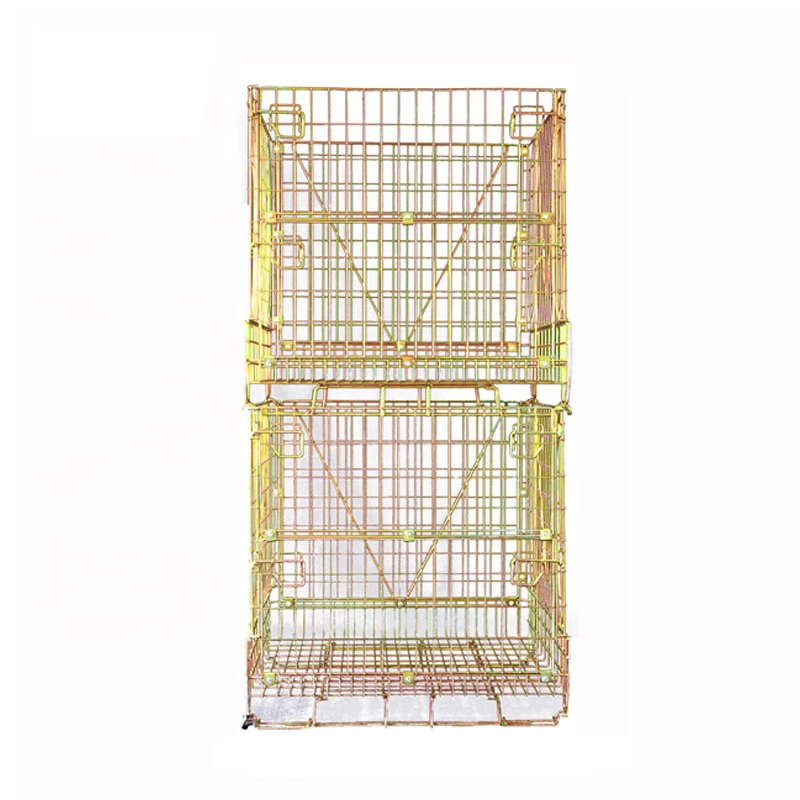
A stacked wire mesh container does not pass load down its side walls evenly. Each cage above stands on four formed stacking feet at its base corners. Those feet are meant to sit inside the mating seating area on the top of the cage below, so the weight of the level above arrives at four contact areas, not as a uniform band around the perimeter.
From there the path is: corner feet, top mesh and its perimeter members of the cage below, the side mesh panels in compression, the base frame with its channel reinforcements, the base feet, and finally the floor. Two consequences matter on a real floor. First, four contact points concentrate force, so a foot that misses its seating area pushes weight straight into unsupported mesh instead of into the frame. Second, the side mesh becomes the element that deforms first when the combined load is too high — which is exactly the failure the upper-tier limits are written to prevent, and the reason a square-tube frame rather than a mesh body is the usual answer once the load exceeds the mesh cage envelope.
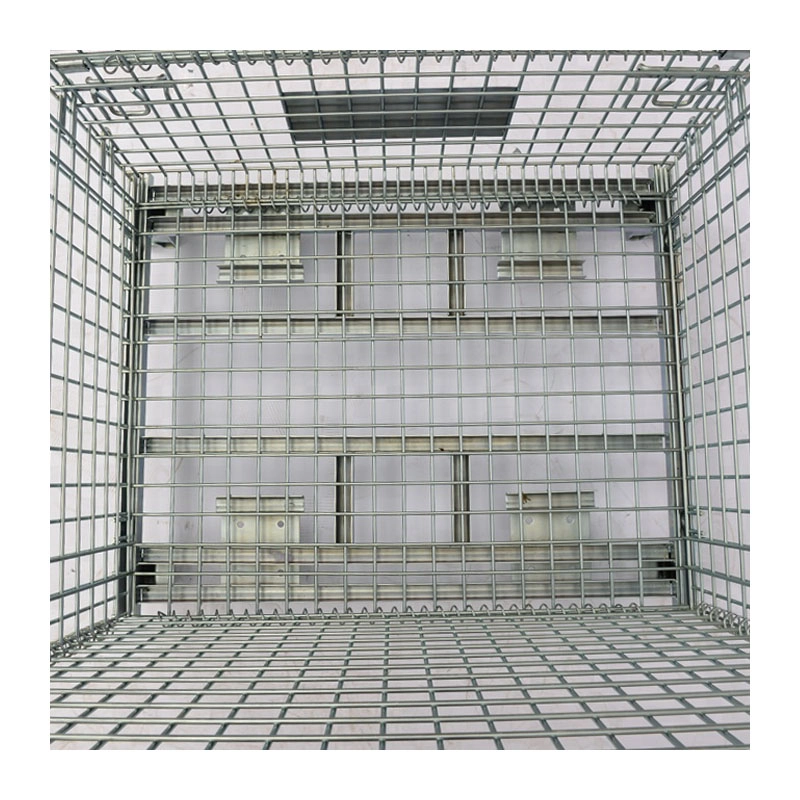
The base is what resists that downward load in bending. Our image records show longitudinal U-channel reinforcement under the floor of the cage, but the photographed samples do not agree on how many channels are present, and reinforcement is a per-project design item. Do not count visible channels in a photo and treat that count as the specification for your order; take it from the approved drawing.
Three Project Records, Read as Boundaries
The three documented configurations below are often quoted in enquiries as if they described one product. They do not. Each line was written for one cage size, one wire diameter and one reinforcement set, and the stacking column answers a different question in each case.
| Documented configuration | Per-cage load | Stacking statement in the same record | What the stacking number governs |
|---|---|---|---|
| 1,000 x 800 x 840 mm, 50 x 50 mm mesh, 6 mm wire, 42 kg tare | 1,400 kg | Up to 4 tiers, with the upper cages limited to 2,000 kg in total | Everything standing above the bottom cage, combined |
| 1,050 x 1,050 x 1,000 mm, 50 x 50 mm mesh, 6.0 mm plus or minus 0.1 mm wire, 53 kg tare | 1,000 kg | Up to 4 tiers, with the upper cages limited to 1,200 kg in total | Everything standing above the bottom cage, combined |
| 800 x 1,200 x 890 mm, 50 x 50 mm mesh, 5.8 mm wire, 47 kg tare, 190 mm folded height | 1,000 kg, listed as a dynamic load figure | Risk note recommends no more than 4 tiers and no more than 500 kg in each upper cage | Each individual upper cage, not the combined total |
The third record is the one most often misread, in both directions. Its 500 kg is a per-upper-cage recommendation from a risk assessment, so three loaded upper levels at the cage figure of 1,000 kg each would be three times the recommended value; but because the number is written per level, it must not be silently converted into a combined 500 kg allowance either. The first record has the same trap in reverse: 2,000 kg applies to the upper cages together, so two upper levels at 1,000 kg each sit inside it while three do not.
Our product-comparison material adds a third way of writing the same idea. For the mesh-panel collapsible cage it puts the recommended single-unit working limit at approximately one tonne and states that the combined payload carried through the bottom unit of a loaded stack should stay within that approximate guideline. That is a selection guideline taken from a presentation, not a certified rating, and it is deliberately lower than two of the three project per-cage figures above. Which is the point: the per-cage number and the stack number are read from different documents, and the stack number is the smaller of the two.
How to Read a Limit That Belongs to Another Project
Before any stack figure taken from a catalogue, a previous order or a similar project is applied to your cages, four things have to be settled:
- Which quantity is the number? Per-cage content weight, the combined weight of the upper cages, or the payload through the bottom unit are three different duties.
- Is it static or dynamic? One of our records labels its per-cage figure as a dynamic load, which is not the same allowance as a cage standing still at the bottom of a stack.
- Is it per upper cage or for all upper cages together? The two readings differ by a factor of three or four on a full stack.
- Was it written for a loaded stack or for empty units? Folded and empty cages are stacked and shipped in columns that say nothing about loaded stacking.
Then check that the configuration matches: cage size, wire diameter, base reinforcement and stacking feet are all per-project items, and a figure written for 6.0 mm wire around a 1,050 mm square does not transfer to a 5.8 mm wire cage of another size. Treat every other project number as a boundary to work inside, not as an entitlement to copy.
Stop-and-Reinspect Points Before the Next Cage Goes Up
These are the conditions our own risk notes and handling guidance point at. Any one of them means the stack should not grow until the cage has been taken out and checked.
- A corner foot that is not fully inside its seating area, or that rests on an opening in the mesh instead of the seating surface.
- Visible bowing of the top frame, the base frame or the lower part of any side mesh panel in the stack.
- Side mesh out of plane, or a cage that no longer lines up squarely under the one being placed on it.
- Bent, torn or partly separated base feet, or fresh cracks and rust streaks at welds near the feet and bottom channels.
- A stack that rocks or shifts as the forks are withdrawn, or contents that move when the load is released.
- Damage from an impact — fork contact with a corner, a gate frame or a base member — even when the cage still stands.
- Contents whose weight is no longer known, for example mixed parts, additions made after loading, or a cage filled without a record.
- The drop gate open or unlatched under a loaded upper cage; it is a hinged panel, not a fixed frame member, so close and latch it before the upper cage lands.
The response is the same in each case: stop adding material, release the upper levels in reverse order with the handling equipment rather than by hand, keep people clear of the stack while it is being taken down, and have the cage re-checked before it re-enters service. Loads also need to be distributed sensibly inside each cage — the same total weight concentrated on a small footprint is not the same duty as the same weight spread across the base, and a load that is off-centre raises the force on one foot pair.
Questions We Are Asked About Stacked Wire Mesh Containers
Is a 1,400 kg per-cage figure also a 1,400 kg stacking limit?
No. In the same 1,000 x 800 x 840 mm record the per-cage figure is 1,400 kg while the upper cages are limited to 2,000 kg in total. Using the per-cage figure as the stack figure would allow 4,200 kg through the bottom unit. Check which of the two the document states before you load a second level.
How does the weight of the upper cages reach the bottom one?
Through the four formed stacking feet of each cage above, into the top mesh and perimeter of the cage below, then down the side mesh and the base channel frame into the base feet and the floor. Because the transfer happens at four contact areas, a foot that misses its seating area, or a load piled to one side, concentrates force into mesh that was not designed to take it locally.
When should a stacked cage be taken out of service?
At the first sign of the conditions listed above — a foot that does not seat, bowing in the top or base frame, side mesh out of plane, bent or torn feet, fresh weld cracks, a stack that rocks, or an impact. Unload from the top down, isolate the cage and have it checked before it is used again.
Why do two projects give different upper-tier limits for the same looking cage?
Because the limits were written for different configurations and they answer different questions. One states a combined limit for the upper cages in total, another states an allowance for each upper cage, and the cage size, wire diameter and base reinforcement differ between them. Ask which document your number came from, and which duty it describes.
Send the Drawing, the Load Map and the Stack Condition
A stacked condition can only be reviewed against inputs, not against a product name. To have one checked, send the approved drawing or the current cage dimensions; the content weight per cage and how that weight sits inside it, including any concentrated or off-centre load; the number of levels you intend and which level will carry what; how the cages are handled and whether they leave the site or stay in the plant; and photographs of any cage that is already deformed or that you are unsure about. With that set we can say which of the documented upper-tier limits applies to your configuration, and where the mesh cage is the wrong container for the stack you are planning.
Two related reads from this site go deeper on the boundary itself: the one-tonne practical load boundary for mesh-panel wire cages explains why that figure is a working limit rather than a certified rating, and the product identification guide covers the square-tube alternative when the combined stacked load goes beyond what a mesh body should carry.
Need a Custom Storage Solution?
Speak directly with our technical engineers. We offer free structural designs, heavy-duty catalog evaluations, and quick B2B price quotations.
Request a Quote Now →