

Three different problems keep arriving as one question. A parts buffer that keeps collapsing at the end of the aisle, a delivery packing cost that grows every time freight rates move, and a warehouse full of empty containers waiting to go back. In each case the buyer asks the same thing: cage, frame box, carton, plastic tote, closed bin or a change to the process? The catalogue price rarely answers it. The number of times the same container will be loaded, moved and returned answers it first.
A collapsible wire mesh container is one option in that field, not the default. This article lays out the six routes a purchasing or warehouse team usually compares, the load and stacking conditions that eliminate some of them immediately, and the points where a mesh cage is the wrong purchase even though it looks like the cheapest equipment on the page.
Start with the cycle count, not the product name
A one-way shipment and a returnable loop consume the same container in completely different ways. Disposable packaging is paid for on every consignment and disappears at the destination. A returnable container is paid for once, then carries freight, handling, storage of empties and inspection costs across every cycle. The crossover point between the two sits in the expected cycle count, so count it in writing before comparing any quotation.
| Expected use pattern | What the cost profile looks like | Direction usually worth pricing |
|---|---|---|
| One trip, goods stay at the destination | Purchase cost is consumed in a single delivery; nothing returns | Carton, wooden crate, or a low-cost one-way container |
| Two to ten cycles, informal return | Purchase cost spread over a few trips; return discipline is loose | Mesh cage or plastic tote, depending on load and part size |
| Ten-plus cycles in a regular loop | Handling, inspection and replacement start to dominate the arithmetic | Square-tube frame box for heavier loads; mesh cage for light, visible, bulk loads |
| Open-ended, permanent position | Service life and deformation resistance control the total cost | Frame box, closed steel bin, or a fixed-location racking arrangement |
Four inputs decide which row a project belongs to: maximum weight per container, whether units are stacked while loaded, the number of return trips expected in a year, and how the empty containers travel back. Without those four numbers, a comparison is a preference, not a calculation.
- Maximum normal weight, including the heaviest permitted mix of parts in one container.
- Loaded stack condition: how many loaded units high, and what the bottom unit must carry.
- Expected cycles per year, and who owns the return leg of each cycle.
- Which handling equipment touches the container: forklift, pallet jack, casters, overhead lift.
When a carton or a wooden crate is already enough
Single-trip delivery is the condition where disposable packaging still wins. If the goods leave the plant once, are unpacked at the destination and never come back, the cost of a steel container is spent on durability that nobody collects. Cartons suit moderate weights, dry goods and destinations with an active recycling route. Wooden crates add rigidity and accept heavier, irregular shapes, at the price of weight, moisture management and phytosanitary treatment paperwork for many export destinations.
Both stop being adequate when the same goods need a second, third and tenth trip, when the packing is reopened repeatedly for line-side picking, when the crate itself becomes the storage position inside the plant, or when the goods are too heavy for the board and timber sections to survive forklift handling. Cartons also fail a specific test that matters here: nobody can see the parts inside them. A mesh container exists partly because that visibility removes a counting step.

What the fold actually saves on the return leg
The economics of a collapsible container live in its empty state. A loaded container occupies roughly the same trailer volume whatever its construction, so the difference appears when containers travel back or are stored empty. Our project record 13967 lists a folded height of 190 mm and a ten-cage folded stack block of 1240 x 1240 x 1600 mm. Project 15059 records 250 cages per 20 ft container and 638 per 40 ft high cube; project 15217 records 150 per 20 ft. The product-comparison material behind these pages cites approximately 360 collapsible mesh cages against approximately 160 square-tube frame boxes in a 40 ft container, before any packing plan.
Those numbers are project references and presentation figures, not guaranteed loading quantities. Real counts move with the exact folded dimensions, bundling method, container internal height, palletisation and the restraint plan the carrier accepts. The point they establish is structural: a container that folds flat changes freight allocated per delivered unit, and that change can be large enough to matter more than the ex-works price difference between two products.
Where a reinforced frame box or a closed container is the better purchase
Reuse frequency alone does not decide the construction. In the mesh-bodied design the load path runs through the mesh panels, their edge members and the base frame; in a square-tube frame box, square-tube members and square-tube stacking uprights carry the load. That single difference produces the whole performance split: higher load capacity, better loaded stacking and more tolerance of repeated handling on the frame side, against lower unit weight, a lower folded profile and much better container utilization on the mesh side.
The practical working boundary recorded in our comparison material is approximately one tonne per mesh cage, stated as a recommended operating limit rather than a certified rating. Above roughly one tonne, for repeated heavy turnover, or where loaded units are stacked near that boundary, the frame box is the direction. Note that the individual project records of 1000 kg, 1400 kg and 1000 kg belong to their own drawings and must not be merged into one universal specification.
| Option | Load and stacking behaviour | Empty and return behaviour | Where it fits |
|---|---|---|---|
| Collapsible mesh cage with base reinforcement | Effective up to roughly one tonne per unit as a working limit; combined payload above the bottom unit governs a loaded stack | Folds to a low flat profile; high units per container | Visible bulk parts, WIP buffering, delivery staging, volume export where freight per unit matters |
| Square-tube frame folding box | Square-tube uprights carry stacked load; built for heavier and variable loads | Folds, but the tube frame keeps folded height high; fewer units per container | Repeated turnover, loaded stacking, long-term handling positions |
| Carton or wooden crate | Limited rigidity in repeated handling; no reliable loaded stacking of heavy goods | Consumed on use; no return leg | Single-trip delivery, dry goods, low to moderate weight |
| Plastic tote or pallet box | Light to moderate loads; accepts washing; deforms or creeps under sustained heavy loads and long outdoor exposure | Nests for a modest space saving, not a flat fold | Small parts, clean-room and food-adjacent handling, moderate reuse |
| Fully enclosed steel bin | Rigid and closed to dust, rain and casual access; heavier empty weight per usable volume | Depending on design, nests, folds partially or does not collapse at all | Dust-sensitive, security-sensitive or weather-exposed goods where visual control is not needed |
| Process change or fixed storage position | Racking or a fixed floor position carries the load instead of the container | No return leg at all, but a permanent footprint | Stable inventory held at one site, where containers should never be circulating in the first place |
A loaded stack is one structure, not several containers
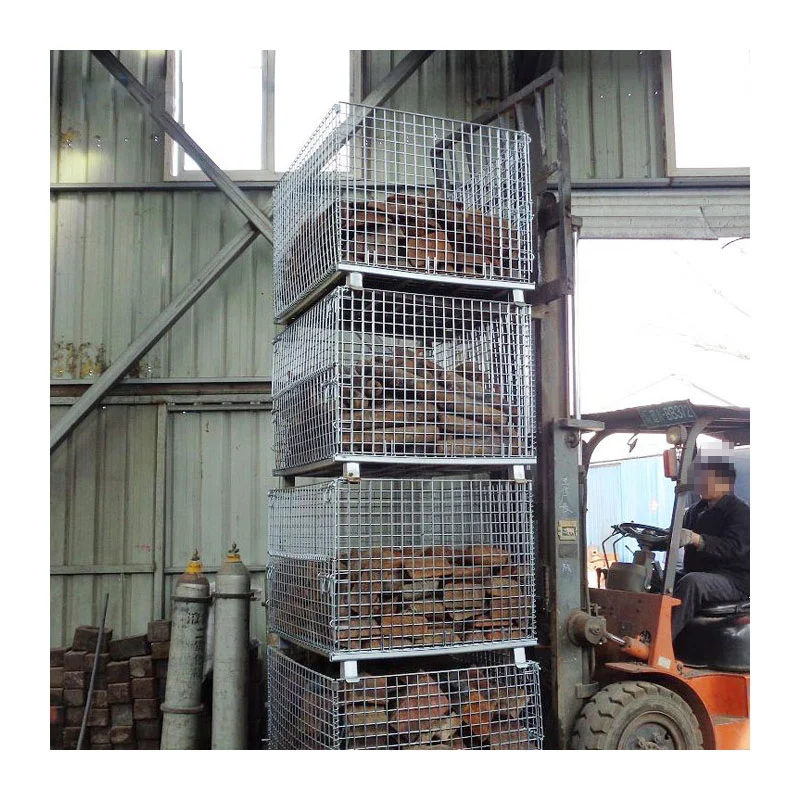
The most expensive selection error in this product family is applying a single-unit load figure to every level of a stack. A three-high loaded stack does not give the bottom container three times the capacity; it makes the bottom container carry everything above it. Three levels at 300 kg each put 600 kg through the bottom unit, which stays inside the approximate one tonne guideline. Three levels at 600 kg each put 1,200 kg through it, which does not, and the side mesh is the element that deforms first.
Operating limits in this family are project-specific. Our 13967 risk note recommends a maximum of four tiers with no more than 500 kg in each upper cage, which is a recommendation for that configuration rather than a general stacking standard. Before any loaded stack is planned, confirm the combined payload above the bottom unit, the approved number of tiers, even load distribution, and the seating of the stacking feet.
Visual control, containment and protection are three separate requirements
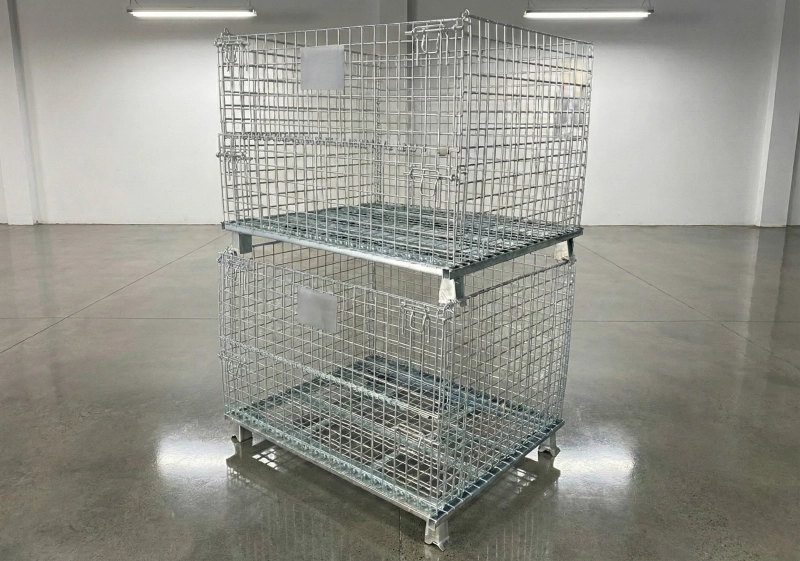
Visibility is the reason many plants choose mesh in the first place: the 50 x 50 mm grid lets an operator read the contents from the aisle and eliminates a counting step. That same grid is a containment problem for small or precisely machined parts, which can slide against wire and drop through an opening. A polypropylene hollow-board liner converts the same container into a protected enclosure, and the liner options in our documentation cover scratch, dust and small-part loss.
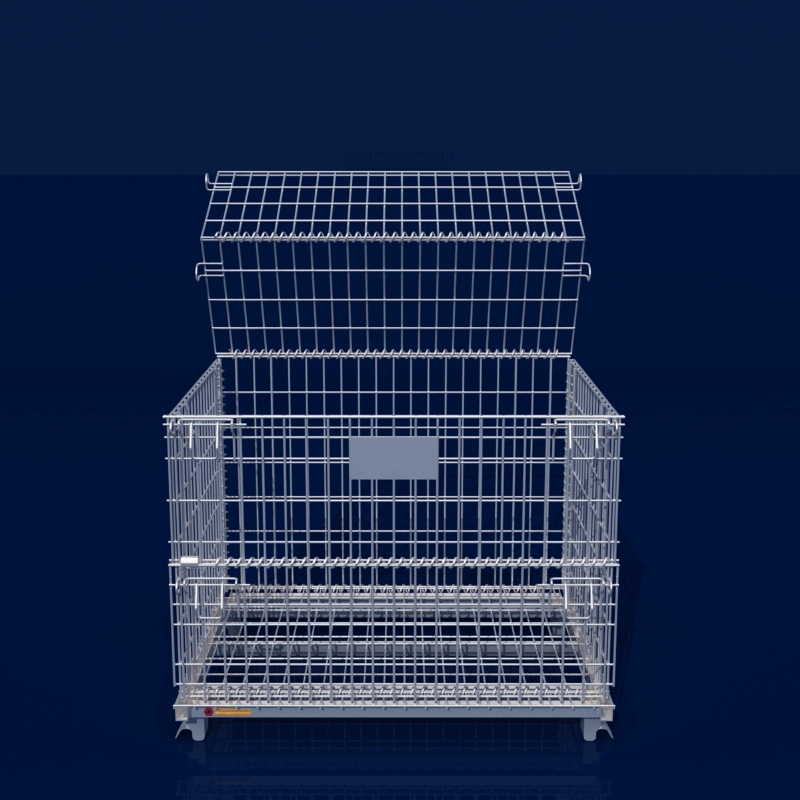
Access is the third requirement. A half-drop gate lets an operator reach lower-level parts without unloading the container from the top, which shortens a picking cycle that would otherwise involve a forklift and a full transfer. Where goods must be closed against loss or spillage, a lid turns the same cage into a lockable unit; where dust, rain or casual access is the dominating risk, a fully enclosed steel bin is the honest answer and a mesh cage should not be quoted for it.
Compare delivered cost per usable unit, not unit price
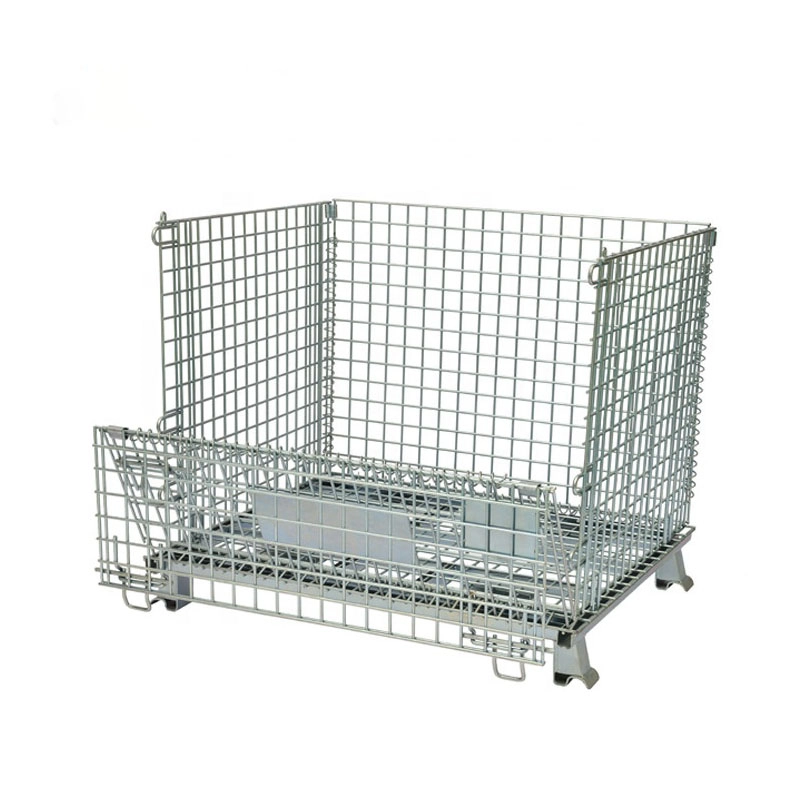
Our comparison material is explicit on this point, and it cuts against the easy sales line: the collapsible mesh cage is recorded as having the higher ex-works unit price of the two foldable products, and the square-tube frame box the lower one. Any page that claims the mesh cage is simply cheaper per container is contradicting its own source. What the same material does show is that total delivered cost per usable unit can land lower for one-way and volume work, because far fewer containers are needed for the same order, less weight is moved, and replacement exposure is bounded by a short cycle count.
A defensible comparison therefore uses four cost lines rather than one: ex-works price, freight allocated per delivered unit, handling and inspection cost per cycle, and expected replacement cost across the planned number of cycles. The result is a cost per usable unit or a cost per use, and it is the only figure that answers whether equipment should replace packaging at all.
| Cost line | What to collect for each option | Why it changes the ranking |
|---|---|---|
| Ex-works unit price | Quoted price per container at the agreed specification | Favours disposable packaging and lighter constructions, and is the least informative line on its own |
| Freight per delivered unit | Units per container from an approved loading plan, plus inbound and return freight | Frequently reverses the unit-price ranking on export orders |
| Handling and inspection per cycle | Lift equipment used, picking access method, inspection time, empty storage footprint | Decides whether the container shortens or lengthens the cycle |
| Replacement exposure | Recorded cycles and failures for the actual construction, not a catalogue life figure | Converts a purchase price into a cost per use |
No uniform service life, payback period or saving percentage applies across these options. The figures move with load, handling roughness, finish selection and how disciplined the return loop is, which is why they belong in the buyer’s own calculation rather than in a supplier’s promise.
Send four numbers and the comparison gets decided for you
Send the goods weight per container, the expected reuse count, the stacking condition and the transport mode, and a scheme comparison comes back with the fields that actually drive the choice: the recommended construction, the governed load limit for the approved drawing, the stacking arrangement, the folded or nested empty volume, the container utilization for the destination, and the handling interface. That set of fields is what separates a quotation from a guess, and it is the same set that keeps a wrong-product order from reaching the drawing stage.
- Goods weight per container, plus the heaviest permitted mix.
- Expected reuse count and the return route for empty units.
- Loaded stacking: tiers, upper-cage payload, and whether the stack is ever transported loaded.
- Transport mode and destination, so units per container can be planned rather than assumed.
Related reading on this site: how the one tonne practical load boundary is applied to mesh-panel cages, how to separate a mesh cage from a square-tube frame box before a quotation is issued, and the conditions under which limited-reuse mesh cages stop being the right container.
Frequently asked questions
Is a collapsible wire mesh container suitable for a returnable loop?
Yes, within its load range. A mesh cage returns flat, which is its main advantage on a loop, and it is used in documented projects for parts circulation, line-side buffering and delivery staging. The loop becomes uneconomic when loads sit near or above roughly one tonne, when loaded units are stacked beyond the combined payload the bottom unit can carry, or when the handling is rough enough that mesh deformation appears within the expected cycle count. In those cases the loop should be priced with a square-tube frame box instead.
Where does a carton or wooden crate stop being enough?
It stops being enough at the second or third trip, at the point where the container becomes a storage position inside the plant, and whenever the packing has to be reopened repeatedly for picking. It also stops being enough when the goods cannot survive the reduced rigidity under forklift handling, or when the destination paperwork for timber makes a wooden crate slower than the delivery it protects. If the goods move once and never return, a carton or crate is usually the correct answer and should not be replaced with equipment.
Is the lower unit price the same as the lower delivered cost?
No. Our own comparison material records the collapsible mesh cage as having the higher ex-works unit price of the two foldable products, while noting that total delivered cost per usable unit can be lower for one-way and volume applications because of container utilization, unit weight and bounded replacement exposure. The reverse holds for frequent turnover, where a longer-lived construction distributes its higher purchase price across many cycles. The two figures should be calculated separately, with the expected cycle count written down before either is quoted.
Need a Custom Storage Solution?
Speak directly with our technical engineers. We offer free structural designs, heavy-duty catalog evaluations, and quick B2B price quotations.
Request a Quote Now →