
A plant that already owns a cantilever rack rarely wants to hear that it has to buy a new rack. The usual question is narrower: can the frames standing in the aisle be re-used for cable drums instead of long material? The honest answer is that the accessory is simple and the qualification is not. A cable reel support is a tube and a pair of brackets; the decision that decides whether the project works sits in the bolted connections, the arm positions and the base of the rack that is already there.
This is a pre-engineering checklist, not a generic bill of materials. It sets out what has to be inspected on the existing structure, what the recorded retrofit accessory actually contains, and which existing racks should be left alone. The recorded dimensions belong to one enquiry and cannot be copied onto another frame, because the interface that has to be matched is your rack’s, not ours.
Why a cantilever retrofit starts as an interface audit, not a component order
A cantilever rack is built to take long goods lying across horizontal arms. The load path is familiar: material rests near the arm root, the arm carries it in bending back to the upright, and the upright carries it to the base. A cable drum is a different object. It hangs on a spindle or sits on two support points through its centre bore, so the weight arrives as two concentrated bearing reactions at a bracket pair, and if the reel is rotated for cable withdrawal, those brackets also see drag and side thrust from the rotating drum.
That change of load path is why the retrofit order is the last step, not the first. The support tube, the bracket and the reel diameter only become meaningful once three things on the existing frame are known: whether there is a sound place to bolt to, whether the two support points can be set at a spacing that suits the reel, and whether the upright-plus-base assembly is still stable when the arms stop carrying and the brackets start carrying. Where any of the three is unconfirmed, the correct status is open, not assumed.
It is also worth separating two intents that look alike on an enquiry. Storing a reel means the whole drum is lifted in and out by forklift. Drawing cable from a reel in place means the drum stays on the rack and rotates. The second intent adds bracket rollers and needs a confirmed fork clearance and support geometry, because the reel may have to come out of the rack and go onto a trolley later. A rack that only has to hold a drum is a smaller requirement than a rack that has to let a drum turn and be removed.
Interfaces and connections that must be rechecked on the existing frame
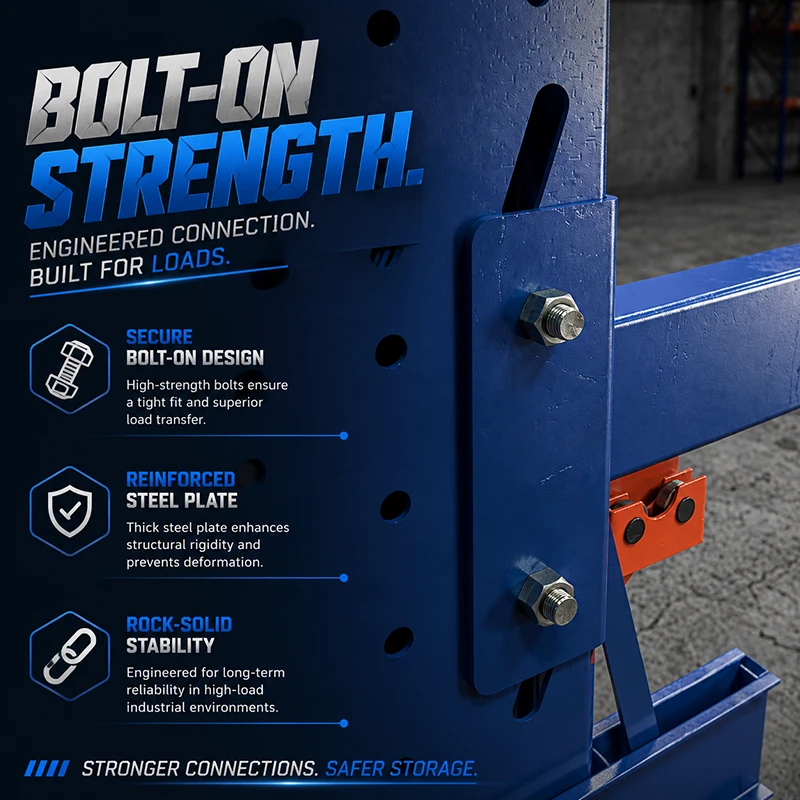
The bracket in the image above is a bolted detail: a thick plate, two bolt groups, a punched upright. That is the pattern any retrofit has to reproduce, and it is also the pattern that most often fails inspection on an older rack. The checks below are the ones that decide feasibility before dimensions are discussed.
| Check | What has to be confirmed | Why it blocks the order |
|---|---|---|
| Upright profile | Section type, flange width, whether the face is punched and at what pitch, plate thickness at the mounting face | A bracket designed for a punched adjustable upright cannot be bolted to a plain channel or a closed tube without a new interface plate |
| Hole pattern | Actual hole diameter, spacing and remaining edge distance at the intended support height | Slotted or reamed holes, or holes too close to the top of the profile, change the fixing and the position |
| Arm attachment zone | Whether the arms are welded or bolted, and whether the same zone is needed for the bracket | Cutting welded arms off a loaded upright is a structural change, not an accessory fit |
| Bracket spacing | Centre distance between the two support points against the reel bore length and drum width | The support tube has to reach across the reel; a frame spacing wider than the drum changes the whole assembly |
| Support height | Available adjustment range on the upright for the drum diameters in the inventory | A reel that will not clear the level below it makes the position unusable even if the bracket fits |
| Forklift interface | Approach side, aisle width, and the clearance needed to insert a drum or lift it out | A bracket that fits but cannot be loaded is an installation failure discovered on site |
None of these can be settled from a photograph of the rack in the aisle. They are settled from the upright section, the measured hole pattern, the arm spacing and a dimensioned sketch of the bay being converted.
What project 15778 records, and what it leaves open
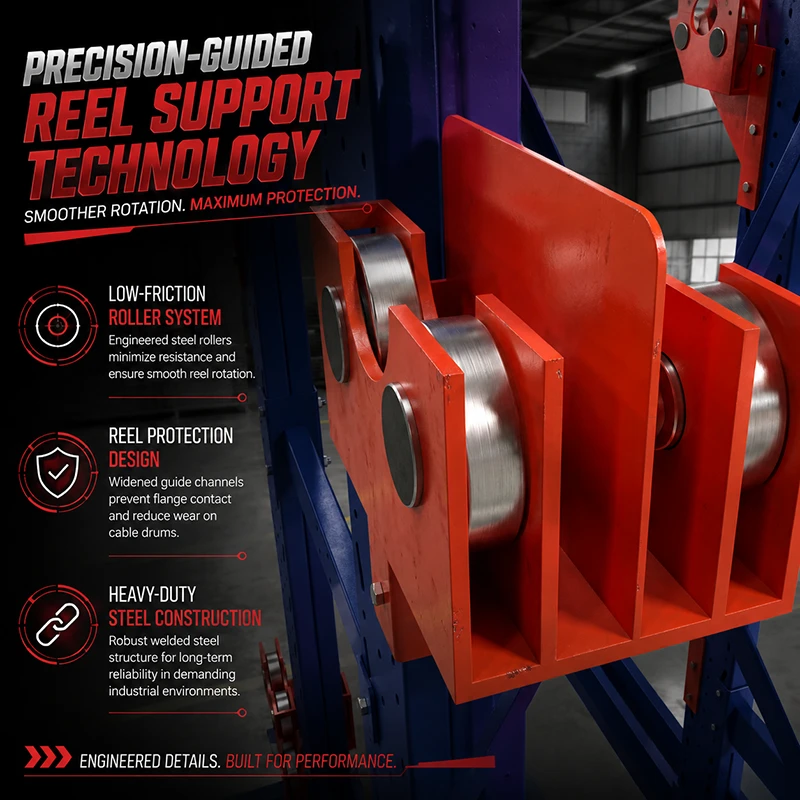
The retrofit accessory enquiry recorded as opportunity 15778 is the reference case for this article. Its recorded values are the ones below. They are enquiry-stage figures for one scope, and the connection dimensions were explicitly left open pending confirmation of the existing rack.
| Recorded item | Value in the record | Status |
|---|---|---|
| Support tube | Ø60 mm | Recorded |
| Support bracket extension | 500 mm | Recorded |
| Reel diameter served | Up to Ø1,000 mm | Recorded, conditional on the existing rack connection being verified |
| Reference quantity | 20 or 100 pieces | Recorded as a quantity option in the enquiry |
| Set weight | About 32 kg per set | Recorded as a reference weight |
| Connection dimensions | To be confirmed against the customer’s frame | Open |
Read that table as a record, not as a specification. The Ø60 mm tube and the 500 mm extension are the geometry that was discussed for that frame and that reel range; they are not a universal adapter. If your upright is a different section, if your bores are different, or if your drums are heavier or larger than Ø1,000 mm, the tube, the bracket and possibly the frame itself are a new engineering question. Nothing in this record states a rated load, a steel grade or a safety factor for a retrofitted rack, and no such figure should be taken from it.
Stability and base conditions to verify before any load goes on
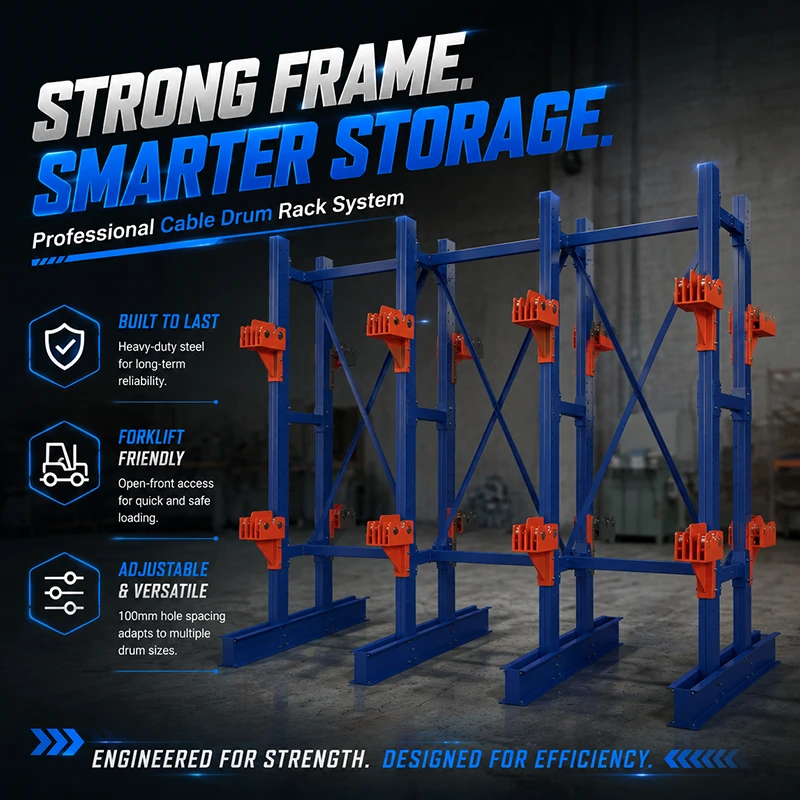
A cantilever rack is stable in service partly because the stored material sits low and near the upright. A drum on brackets sits where the bracket puts it, often further out and sometimes only on one face. The stability review therefore looks at the whole unit, not the bracket.
Check the base: base plate size and thickness, anchor type and condition, and whether the anchors were ever designed for a pull-out load rather than a compressive one. Check the upright: straightness, corrosion at the base, weld condition at the column-to-base joint, and any deformation from previous handling damage. Check the frame set: whether the unit stands alone or is tied to a run, whether bracing exists on the loaded face, and whether removing arms reduces the frame’s ability to resist the eccentric load that a reel on a 500 mm extension creates.
Then check the operating conditions. An eccentric load on a single-sided unit behaves differently from a double-sided one loaded symmetrically. A rack in an open yard adds rain, drainage and corrosion to the review, and the finish question has to be answered as part of the retrofit rather than after it. A floor slab of unknown thickness or a rack standing on patched concrete is a base condition, not a detail to resolve at installation.
Existing racks that should not be retrofitted
The default position is that an existing cantilever rack is not a cable drum rack. The cases below are the ones where the retrofit should be declined or replaced rather than engineered around:
- Racks with no verifiable interface: no drawing, no measured hole pattern, or an upright section that cannot be identified, so the bracket fixing cannot be designed.
- Racks with a rated capacity, arm load or upright load that is unknown and cannot be recovered, where no engineer can state what the frame may still carry.
- Racks showing deformation, bent arms, cracked welds, section loss at the base, or anchor distress: a retrofit adds a new load path to a member already carrying damage.
- Light shelving, storage shelving or furniture-grade frames that were never built as industrial cantilever structure, regardless of how similar the shape looks.
- Racks where the reel sizes in the inventory exceed the recorded range for the accessory, in particular drums above the Ø1,000 mm reference, or drum weights that the existing frame and brackets were never assessed for.
- Racks where the support points cannot be placed to suit the drum width and bore length, so the reel would sit off-centre or overhang the bracket.
- Racks where the aisle or fork approach cannot deliver a drum to the bracket, or where the reel cannot be removed and transferred without a clearance that has not been confirmed.
- Racks in long-term outdoor service where no corrosion-control specification is agreed for the new brackets, the tube and the existing frame.
- Installations where cable has to be drawn at controlled tension or speed: that is payout equipment, not a storage retrofit, and a roller bracket does not provide braking or tension control.
What a retrofit review needs from your site
A review can only run on documents and measurements. The inputs below are what turns a question into a scope:
- Upright section drawing or a measured sketch: flange width, plate thickness, hole diameter and hole pitch, plus the height range where brackets would be fixed.
- Bay layout: number of frames, spacing between uprights, whether the unit is single-sided or double-sided, and how the unit is anchored.
- Reel list: outside diameter, drum width, centre bore, weight and quantity for every reel size to be stored.
- Handling data: forklift type, aisle width, approach side, and whether reels are stored whole or rotated for cable withdrawal.
- Site conditions: indoor or outdoor, floor type, and any existing corrosion or damage noted during the inspection.
With those five inputs, the retrofit can be either designed, or declined for a stated reason. Without them, the only defensible answer is that the connection dimensions remain open, which is exactly the status recorded on opportunity 15778.
Retrofit planning questions buyers ask
Can any cantilever rack be converted to cable drum storage?
No. A retrofit is viable only when the upright interface can be measured and matched, the support points can be set to suit the reels, and the existing frame and base are still structurally sound for a new eccentric load. Where the interface or the frame condition cannot be established, the rack should not be converted.
Can the Ø60 mm tube and 500 mm bracket extension from project 15778 be applied to our rack?
Only as a reference. Those dimensions were recorded for one enquiry, where the connection to the existing frame was still to be confirmed. They are not a universal fit and should not be ordered for a different upright, a different drum width or reels larger than the Ø1,000 mm reference without a fresh interface check.
Does a retrofit carry the same capacity as a new cable drum rack?
Capacity has to be established for the retrofitted assembly, and the retrofit record itself contains no rated load, steel grade or safety factor. Where a rack has to carry a defined load with documented figures, a purpose-built frame with the reel positions designed in is the more defensible route than modifying an existing structure.
Where the retrofit decision belongs
Treat the retrofit as a survey before it becomes a purchase. Measure the upright, record the hole pattern, photograph the base and the anchor, list the reels with diameters and weights, and note how the forklift reaches the bay. If those measurements confirm a workable interface and a sound frame, the accessory is a small part of the project. If they do not, the same effort has saved a rack from being loaded beyond what it was built for. The Steel Pallet cable drum rack range, including the retrofit support components described here, is specified per project from exactly this kind of input.
Serve una Soluzione di Stoccaggio Personalizzata?
Parli direttamente con i nostri ingegneri tecnici. Offriamo progetti strutturali gratuiti, valutazioni di cataloghi per carichi pesanti e preventivi B2B rapidi.
Richiedi un Preventivo Ora →