

Two collapsible container quotes can carry the same unit price and still land 30 percent apart on landed cost per unit, because the number that decides how many pieces fit in a 40 ft container is not the assembled size. It is the folded height, multiplied by every folded unit you stack on top of the next one. Export traders, forwarders and in-plant logistics teams who plan by container count instead of by catalogue page tend to find this out late, usually after the booking is already made.
This article breaks down what folded height actually does to container quantity, how much gap there is between a collapsible wire mesh container and a square-tube frame box, and how to decide between stretch film plus strapping and a wooden crate without guessing at either cost.
How Folded Height Converts Into Container Quantity
Container planning is a height exercise first and a footprint exercise second. The usable cargo height of the box, divided by the folded increment each additional unit adds, gives the number of units in one column. Columns across the floor footprint give the number of bundles or crates. Multiply the two and you have the piece count you can quote against a freight rate.
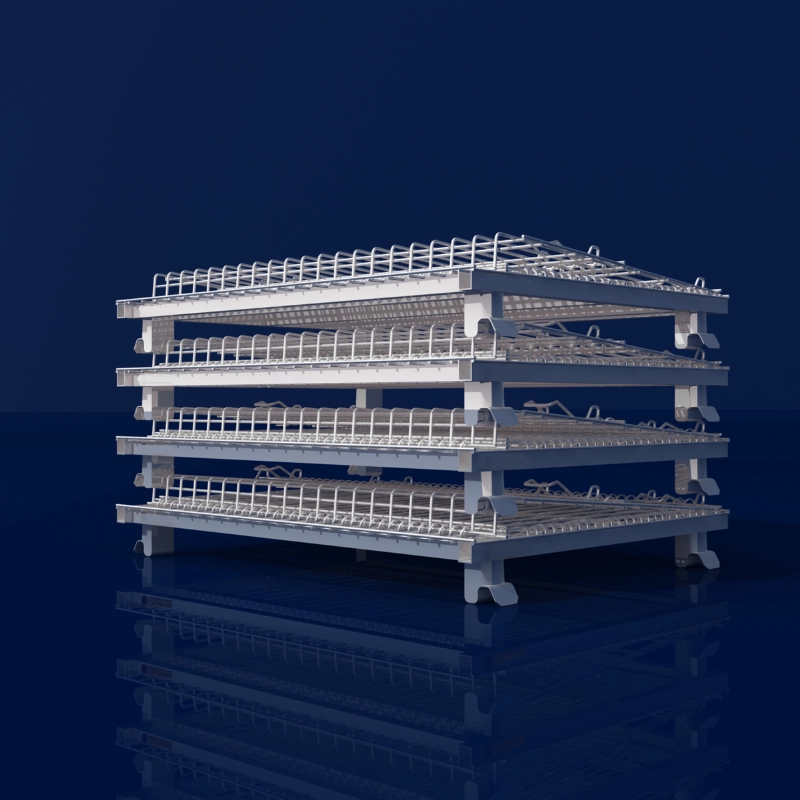
The planning number is not the catalogue folded height. Folded cages nest into one another, so the first unit in a stack consumes its full folded height while the tenth unit consumes a smaller increment. One recorded project shows how the two figures sit side by side: a 800 x 1200 x 890 mm variant with 50 x 50 mm mesh, 5.8 mm wire, 1,000 kg capacity and 47 kg tare is recorded at a folded height of 190 mm, with ten folded cages per stack and a listed stack size of 1240 x 1240 x 1600 mm. That is one project record, not a series-wide specification; the folded increment that matters to your booking has to come off your own approved drawing.
Two things routinely distort the calculation. First, accessories: a lid, a set of casters or a PP liner changes the folded geometry, and a cage quoted with casters does not fold to the same height as the bare unit. Second, the packing itself: film, strapping and any edge protection sit inside the same height budget, so packaging decided after the loading plan can quietly remove a bundle from the container.
Mesh Cage Versus Square-Tube Frame Box: Where the Folded Height Gap Comes From
A wire mesh container folds flat because the side and end panels hinge down onto the base frame. The spiral hinges allow the mesh panels to lie almost parallel to the deck, and the formed stacking feet sit inside the outline rather than above it. What remains in the stack is the depth of the base frame, one panel layer and the wire thickness, which is why a galvanized cage folds low enough to stack in tall, tight columns in empty storage.
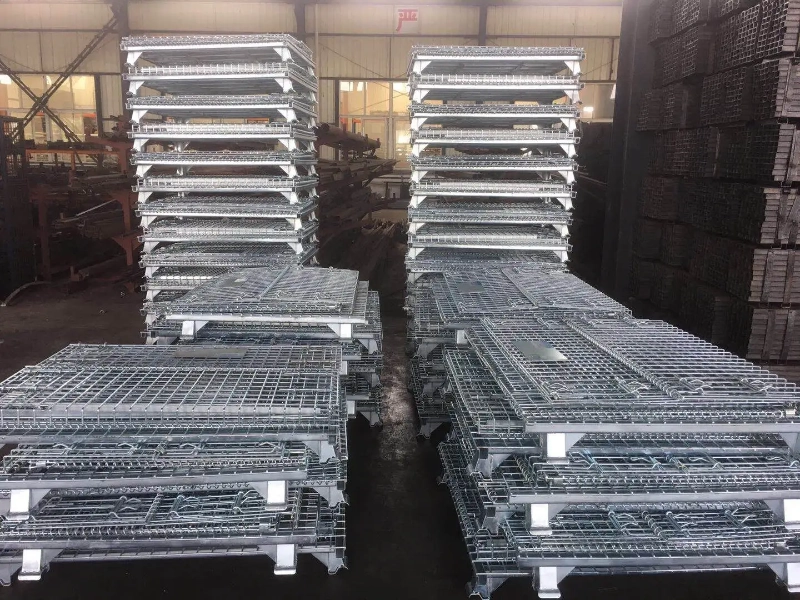
A square-tube frame box starts from a different structure. Its panels are stiff tube frames with a deeper deck, and the folding sequence stacks frame on frame rather than laying panels into the base. Each folded unit therefore costs noticeably more height, and the gap compounds with every unit in the column.
To show the scale of that compounding, this article uses a demonstration comparison: with the same floor footprint and the same usable cargo height in a 40 ft container, a low-folding collapsible mesh cage lands at roughly 360 pieces while a square-tube frame box lands at roughly 160 pieces. These are demonstration reference values for planning discussions, not a measured loading result and not a booking commitment; the real count depends on your drawing, your packing method and the box you are quoted. For reference, recorded project variants of this cage carry their own container figures, such as 638 pieces in a 40 ft HC for a 1000 x 800 x 840 mm project and 150 pieces in a 20 ft for a 1050 x 1050 x 1000 mm project, each tied to that project’s drawing and packing plan.
The commercial consequence is straightforward: folded height is a freight multiplier. On the same order volume, the container that folds flatter halves the number of boxes or bundles you pay for, and the return leg behaves the same way, because empty containers moving back through the network are priced on volume, not on value. If you are weighing this against other differences such as reuse count and load behaviour, a side-by-side breakdown of the collapsible mesh cage and the square-tube folding box is a useful starting point.
Choosing the Packing: Film and Strapping, Wooden Crate, or a Hybrid
Packing is not a separate purchasing decision. It sits inside the same height budget as the folded cage, so the option you choose changes the piece count you just calculated.
Option 1: Stretch film plus plastic strapping
The lowest-cost method and the one that consumes the least height. Bundled folded cages are strapped into a block, film is wrapped over the panels, and the bundle is lifted and loaded as one unit. It holds the folded panels down, keeps hinges from springing in transit and protects the galvanized surface from scuffing and dust. It does not provide a sealed moisture barrier, and it assumes the receiving plant can unload and de-strap safely. For industrial buyers with their own handling equipment this is normally the sensible default, and it is also the configuration that suits a returnable loop where the same cages come back.
Option 2: Wooden crate
A crate protects the bundle edges against impact and point loads, which matters on multi-leg routes with transhipment, and it lets you control stack height more precisely. The trade-off is paid twice: once in money, and once in the height budget. Every crate panel adds thickness that a strapped bundle does not have, so a fully crated shipment can lose a bundle per container compared with the same quantity strapped and filmed. Crating also adds tare and handling steps, and wood packaging is subject to plant-health requirements in many destination markets, so confirm the buyer’s expectations before specifying it. As a cost reference, a project reference price for crating of 90 CNY per square metre is used internally to compare packing options; it is a reference point for discussion, not a fixed quotation, and it does not cover fabrication differences, quantity effects or destination rules.
Option 3: Hybrid
The common compromise is film and strapping on all bundles, with edge boards or a partial crate on the outer modules only. This protects the faces that take impact while keeping the interior bundles at their full strapped stack density. It is often the right answer for mixed ocean and inland routes, where damage risk is concentrated at the loading faces rather than through the whole stack.
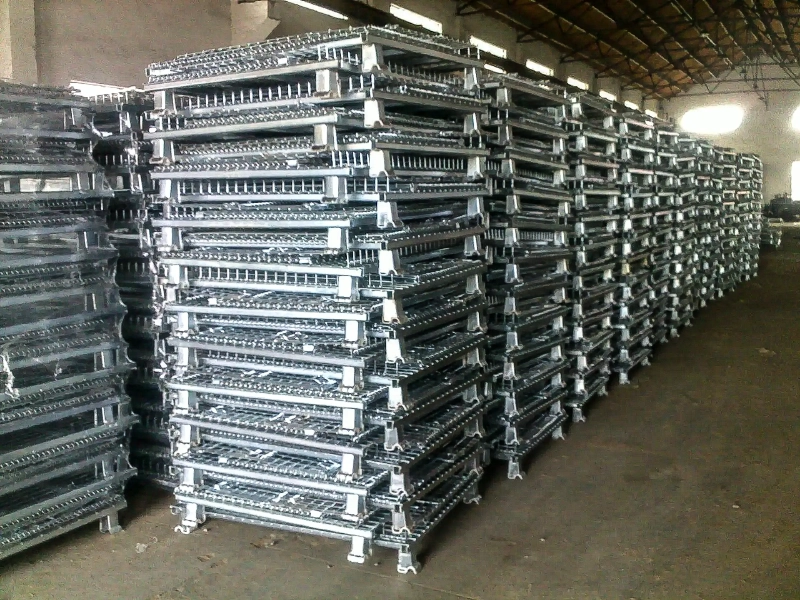
A practical rule: measure the packaging allowance in millimetres per bundle, then re-run the piece count. If you are comparing packing costs against container counts for a repeat order, the arithmetic behind reuse cycles and container economics follows the same logic.
When a Lower Folded Height Does Not Solve the Freight Problem
Folded height is decisive only in the scenarios where it is decisive. These are the conditions where it should not be the leading argument:
- The containers are not coming back. If the customer keeps them on site as permanent industrial storage cage capacity, the return leg does not exist, and only the inbound shipment benefits from the lower fold.
- The parts need a sealed barrier. Film and strapping will not replace moisture-barrier packing; if barrier protection is the requirement, the packing decision is made by the barrier, not by the folded height.
- The square-tube box’s rigidity is the reason the load survives. On heavy point loads or irregular castings, extra container cost can be cheaper than deformation and rejected parts.
- Lids, casters or dollies are part of the specification. These variants change the folded geometry, so the flatter fold has to be re-measured with the accessories installed.
- Annual volume is small. At low volumes the engineering and drawing effort needed to shave millimetres off a folded height will not pay back within the order.
Before You Quote a Container: Seven Checks
- Folded height taken from the approved drawing, in the exact delivery configuration, with lids, casters or liners fitted.
- Measured folded increment per additional unit in the stack, not the standalone catalogue height.
- Usable cargo height and door opening of the container, minus the allowance for film, strapping, edge boards or crate panels.
- Base frame footprint and foot overhang against the floor plan, including the strap routing.
- Whether the destination requires wood packaging and its heat-treatment evidence, before a crate is quoted.
- Ownership and loop count on the return leg, since that is where folded height converts into money.
- Handling interface on the folded bundle: forklift operation and pallet jack handling entry must both work on the strapped block, not only on the assembled cage.
Domande Frequenti
Does the 190 mm folded height apply to every size of this cage?
No. That figure comes from one recorded project: a 800 x 1200 x 890 mm variant with 50 x 50 mm mesh, 5.8 mm wire, 1,000 kg capacity and 47 kg tare, listed at a folded height of 190 mm with ten folded cages per stack and a stack size of 1240 x 1240 x 1600 mm. Other drawing variants differ in height, wire and base structure, and the orientation and terminology of that project record still require drawing confirmation. Ask for the folded height of the specific drawing you are being quoted.
Can you confirm roughly 360 or 160 pieces for our order?
Those two figures are demonstration reference values used here to show how far apart the two folded box types can sit under the same footprint and cargo height. They are not a measured loading result for a specific order. The confirmed piece count comes from your drawing plus an agreed packing plan, and it belongs in the packing section of the quotation so that the forwarder is quoting against the same number you are.
Is the 90 CNY per square metre crating figure the price for our shipment?
No. It is a project reference price used to compare packing options, not a fixed quotation. Actual crating cost depends on panel design, quantity, wood treatment requirements and destination rules, and it should be quoted against the packing drawing rather than estimated from a per-square-metre figure.
What if our parts also need protection inside the cage?
Packing protects the container; it does not protect the parts from the container. Where components can rub against the mesh or fall through a 50 x 50 mm opening, a PP hollow-board liner is the documented variant that answers that requirement, and it must be taken into account when the folded stack is measured.
Serve una Soluzione di Stoccaggio Personalizzata?
Parli direttamente con i nostri ingegneri tecnici. Offriamo progetti strutturali gratuiti, valutazioni di cataloghi per carichi pesanti e preventivi B2B rapidi.
Richiedi un Preventivo Ora →