
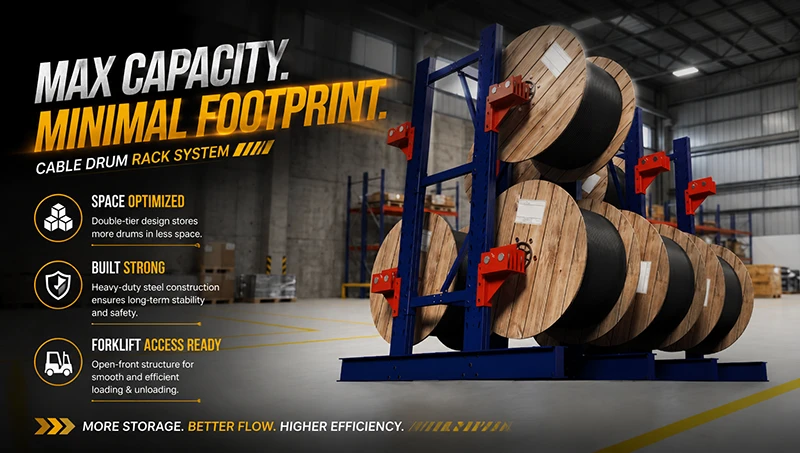
An industrial cable store rarely holds one drum size. A single reel list can carry small wire drums, mid-size power cable reels and large transmission drums in the same hall, and every one of them needs a defined location, a forklift approach and a bracket that actually touches the drum where the drum can take the load. The reel list, not the frame catalogue, is the design document here. Sorting that list into diameter groups is the step that decides how many levels a bay gets, how many reel positions a frame unit holds and how many frames the aisle has to accommodate.
One project record makes the point. Opportunity 14844 arrived as 22 rows of cable reels with unit weights of roughly 500–3,000 kg and outside diameters between Ø737 mm and Ø2,007 mm, with drum dimensions in the listed 610–1,118 mm range. The resulting design was not one universal bay. It was split into two rack groups: a two-level group with four reel positions per frame unit and a single-level group with two reel positions per frame unit, both reference designs about 3,002 mm high. Everything below is quoted as that project record. It explains the method; it is not a Carack rated capacity or a standard reel-size range.
How the Diameter Range Was Split into Two Rack Groups
The split started from the reel list and read three attributes per row at once: outside diameter, drum width and unit weight. Diameter sets the vertical space a reel needs and the distance between its two support points; width sets how far the drum projects from the frame and therefore how deep the bay and the aisle have to be; weight is what the bracket, the support arrangement and the base have to survive. With the listed diameters spanning roughly 737 mm to 2,007 mm, one shelf pitch could not serve every row. The smaller reels in that list fit into a bay stacked two levels high, while the largest rows consume the level height with a single drum. That reading produced the two groups: two-level bays at four reel positions per frame unit for the drums that stack, and single-level bays at two reel positions per frame unit for the drums that do not.
What does not travel with the numbers is the mapping itself. Which diameter lands in the two-level group and which in the single-level group is fixed per project, on the approved drawing, after the reel list is final. A new list with a different diameter spread is re-grouped from the start — an 800 mm drum in one warehouse is not automatically a two-level drum in the next one, because the drum width, the unit weight and the level clearance required by its neighbours all change with the inventory.
Main Frames, Auxiliary Frames and Which Structure Depends on Which
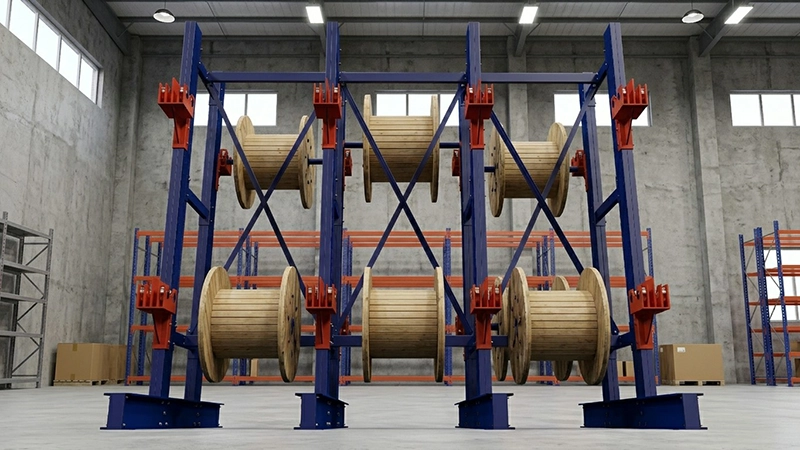
A Carack bay is not one welded block, and this matters the moment a layout grows past a single unit. The main frame is the self-supporting structure carrying the uprights. An auxiliary frame is a bolted-on extension that relies on the main frame’s upright for its support — it is not an independent unit and cannot be planned as one. A multi-bay run is therefore written as one main frame plus a stated number of auxiliary frames, and the count of each is what the layout, the quotation and the packing list must show separately. Frame-level reference weights in the 14844 record were 638 kg main / 368 kg auxiliary for the first group and 690 kg main / 360 kg auxiliary for the second group; those figures are transport and handling indications for those two frame types, not a weight catalogue to apply elsewhere.
The dependency has two practical consequences. First, every bay count question has to be asked as “how many main frames and how many auxiliary frames”, because the auxiliary frames add positions without adding an independent support structure. Second, the base and anchoring checks concentrate on the main frame that carries the run, and the aisle dimension is set by the assembled run, not by an individual frame width.
Marking Hole Pitch and Position Counts as Project Boundaries
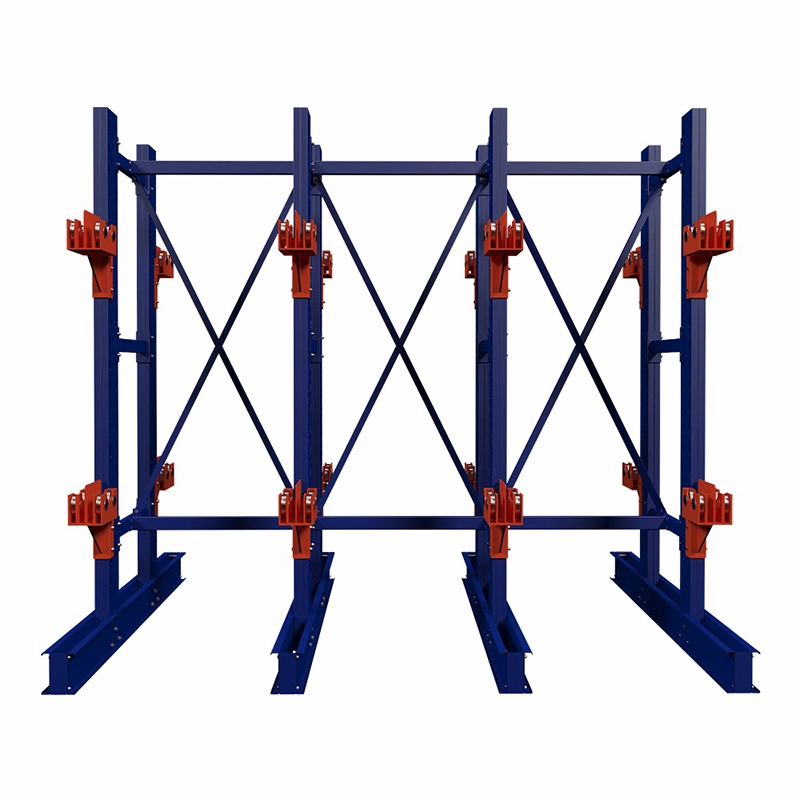
The dedicated upright profile used on these rack designs carries installation holes at 100 mm intervals, as recorded in the project documentation. That figure describes an adjustment increment — how finely a support bracket height can be set — and nothing more. It is not a load rating, and it is not a claim that any drum fits any hole. The hole positions actually used, the bracket height for each level and the resulting clear height above each support are confirmed on the approved drawing for the specific order. The same boundary applies to position counts: four reel positions per frame unit in the two-level group and two per frame unit in the single-level group are counts that belong to the stated drum set, not a capacity a buyer can carry to a different warehouse.
The way to keep that boundary visible is to label it on the document instead of in a footnote. A reel-group worksheet should carry, per group: the group identifier, the diameters included, the drum width range, the number of levels, the reel positions per frame unit, the main and auxiliary frame counts, and the aisle allowance. Where a 100 mm hole interval or a positions-per-frame figure appears, it should sit next to the words “project reference — re-confirm for this order”. Shared without its group and its diameter set, a position count will be read as a rating, and a hole pitch will be read as a guarantee.
When Group-Based Planning Is Not the Right Answer
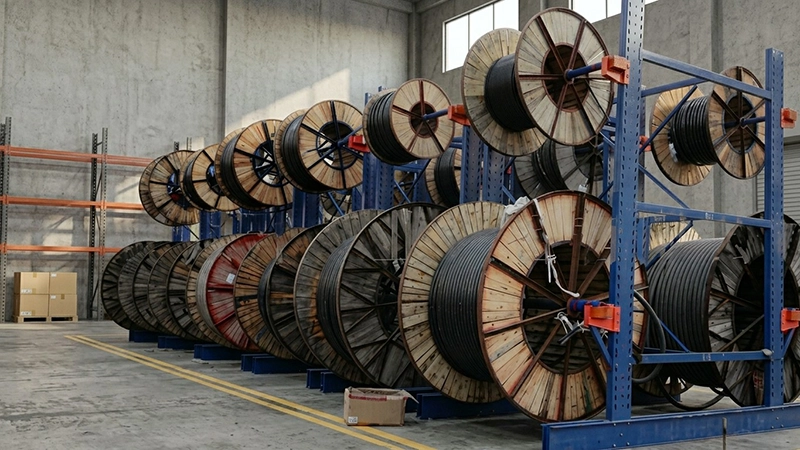
Diameter grouping earns its keep when the inventory is wide and reasonably stable. It is the weaker choice in several conditions, and they are worth naming before a layout is drawn. If one diameter dominates the store, a single-level bay with a settled bracket height is simpler than a two-group arrangement that no one will use. If the mix changes week to week across the whole range, re-grouping per order becomes administrative load, and a bay pool with adjustable support heights — accepting fewer guaranteed positions — may suit better. If the buyer needs a certified load capacity per bay, stop: no universal rated load, steel grade or safety factor is published for Carack, and the numbers must come from engineering for the specific configuration. If reels are lifted out of the rack onto a trolley, rotating support is not enough — the fork clearance and support geometry have to be confirmed, and that check is separate from grouping. And if the rack stands outdoors, grouping is secondary to the finish and drainage specification.
What to Send With a Reel List
- Every reel row with outside diameter, drum width, centre bore or through-shaft detail, unit weight and quantity — not a summary “mixed drums”.
- The diameter spread in the store today and the spread expected after the next stock cycle, so the grouping is not built around a temporary inventory.
- Handling method per reel: whole-reel removal by forklift, removal onto a trolley, or cable drawn off with the reel in place.
- Available floor area, aisle width and the forklift model, because the second row often disappears once the aisle is subtracted.
- Indoor or outdoor position, and the corrosion-control expectation if the racks sit in an open yard.
- Whether a documented capacity per bay is a contractual requirement; that answer changes the whole quotation route.
FAQ
Should reels be grouped by diameter or by weight?
Both belong on the group sheet, but they answer different questions. Diameter and drum width decide the level structure and the number of positions per frame unit; weight decides the bracket and frame configuration that has to be engineered for that level. In the 14844 record the list carried 500–3,000 kg and Ø737–2,007 mm together, and the design response was the two-group split described above. A list sorted only by weight would not tell a planner whether a reel fits two levels.
Are the recorded 100 mm hole pitch and position counts valid for my project?
They are the project record, not a specification you can transfer. The 100 mm installation-hole interval describes the adjustment increment on that upright profile, and the counts of four positions per frame unit (two-level group) and two positions per frame unit (single-level group) belong to that drum set. For a new reel list, the hole pattern actually used, the level heights and the positions per frame unit are re-confirmed on the approved drawing before production.
Can an auxiliary frame be ordered as a standalone rack?
No. An auxiliary frame relies on the main frame’s upright for support, so a run always starts from a main frame and extends with auxiliary frames. That is also why a bay count has to be quoted as main frames plus auxiliary frames rather than as a total number of frames.
Group-based reel storage is a planning method, and the cable drum rack product page sets out the frame, level and support-bracket options it is built from. Send the reel list in the form above and the grouping, level plan and frame count can be checked against your own inventory instead of a generic shelf height.
Serve una Soluzione di Stoccaggio Personalizzata?
Parli direttamente con i nostri ingegneri tecnici. Offriamo progetti strutturali gratuiti, valutazioni di cataloghi per carichi pesanti e preventivi B2B rapidi.
Richiedi un Preventivo Ora →