
For manufacturers exporting goods, the wooden crate is a familiar solution: you build a single-use package, fumigate it when required, load the goods, and accept that the packaging usually leaves with the shipment. The cost is not only represented by the timber. It also includes treatment, handling time, risk of damage, disposal, and empty packaging that cannot make an efficient return trip.
A Mytrack collapsible cage changes the game. It is a reusable steel stacking structure designed for repeated export flows, not a universal substitute for every crate. The practical question is whether your product, loading method, destination country regulations, and shipment frequency justify a returnable packaging cycle.
Where does a collapsible cage save compared to a wooden crate?
A wooden crate is normally purchased for a single outbound shipment. The operational brief uses 90 yuan per square meter as a design reference for wooden crate packaging; this is not a fixed quote. For a fair comparison, add the crate surface area, nails and labor, fumigation or treatment, export documentation, disposal, and any rework after damage. A crate may still be suitable when the shipment is occasional, the goods require fully enclosed packaging, or the buyer will not return the packaging.
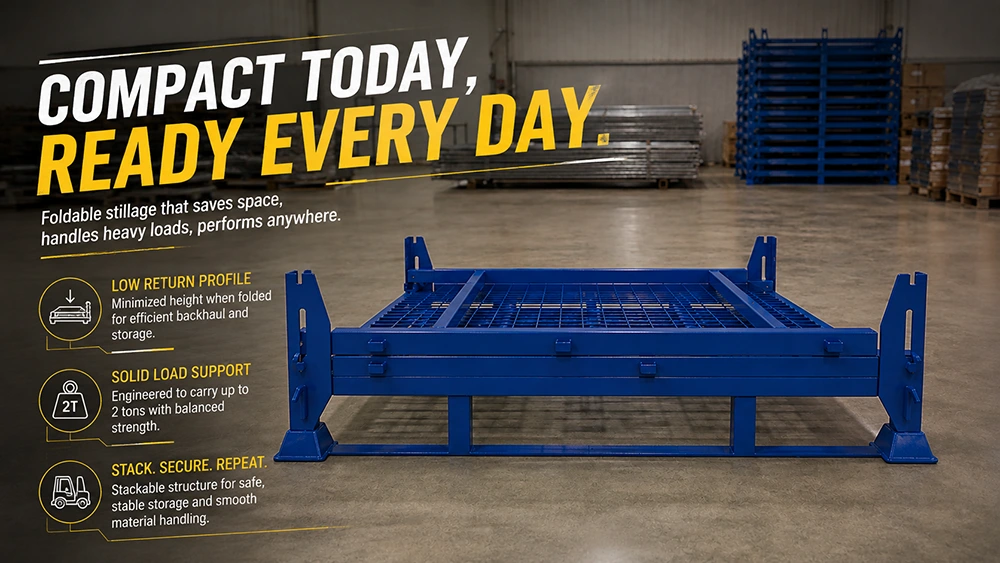
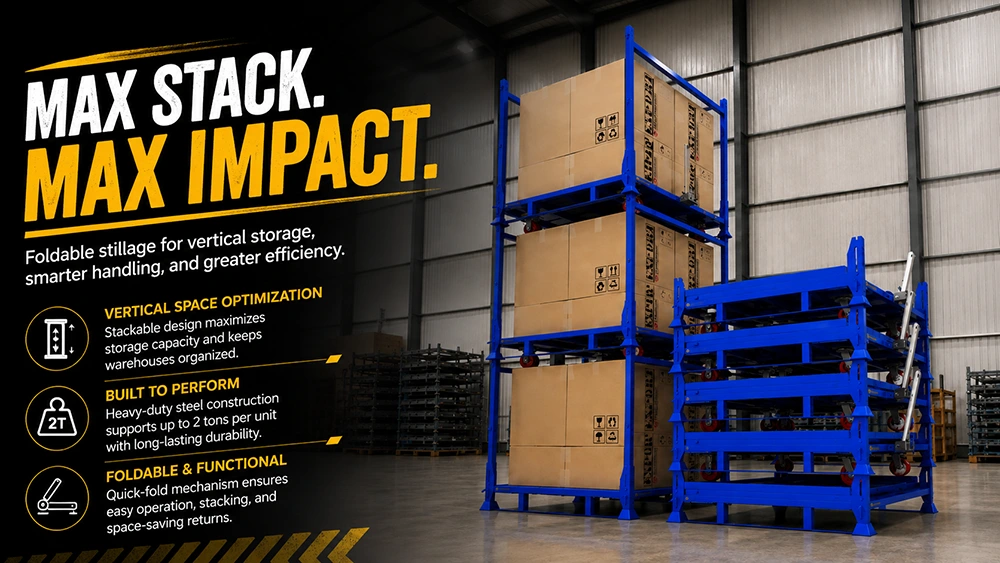
Mytrack creates value differently. Its blue powder-coated steel frame features a mesh deck, four stacking posts, reinforced base elements, and forklift access. The collapsible post design reduces the height of empty units, while the stackable shape supports vertical storage when the cage is loaded. Indexed product images show a 2T load capacity on the relevant configuration; verify the rated capacity, dimensions, load distribution, and handling method for the actual order before purchase.
Can Mytrack eliminate fumigation?
It can often remove the wooden packaging fumigation step because the main frame is steel rather than untreated wood. This does not mean that every export shipment is automatically exempt from all packaging regulations. Destination country requirements, wooden inserts, pallets, blocking materials, dunnage, and the goods themselves must still be verified. If wood remains in the load plan, the relevant wooden components may require treatment or marking.
The practical check is simple: ask your freight forwarder or customs broker whether a steel cage with the proposed internal protection is acceptable for the destination and mode of transport. Mytrack does not replace all crate functions. Fragile surfaces may still require cardboard, foam, rubber, strapping, or a custom cover. The advantage is that these protective materials can be designed around a reusable load frame, rather than rebuilding the entire structural box for each shipment.
How do you calculate the return trip?
Do not only compare the purchase price of a wooden crate with the purchase price of a collapsible cage. Calculate the entire packaging cycle:
- Wooden crate route: outbound crate cost + treatment and documentation + loading labor + damage or disposal cost + replacement crate for the next order.
- Collapsible cage route: cage purchase or rental + internal protection + outbound transport space + return transport or repositioning cost + depreciation for inspection and repair.
- Break-even point view: divide the landed cost of a crate by the number of completed export cycles, then add the cost of returning one empty collapsible unit in each cycle.
- Capacity view: count how many collapsible cages can share the return vehicle or container footprint, rather than assessing a single empty frame in isolation.
For example, if 20 cages return folded in the space previously occupied by a much smaller number of rigid cages, the return transport allocation per unit can drop significantly. The actual result depends on dimensions, carrier rates, route balance, load limits, and how promptly the consignee returns the frames. Request a model based on shipment frequency rather than assuming a universal percentage saving.
When is the reusable cycle a good solution?
- Repeated export routes where the consignee can store and return empty cages.
- Manufactured products that require forklift handling, repeatable positioning, and vertical stacking during production or shipment.
- Long or irregular loads that are difficult to secure on standard flat steel pallets, provided that load support and the anchoring system are confirmed.
- Operations seeking to reduce single-use packaging waste, treatment coordination, and empty return volume.
Questions to resolve before changing the packaging
Will Mytrack always be cheaper than a wooden crate?
No. For a single shipment with no return route, a crate may have a lower initial outlay. The collapsible cage case becomes more compelling when the same unit completes multiple export cycles and the folded return density can be exploited.
What information is needed to calculate a return trip?
Fornite frequenza annuale delle spedizioni, destinazione e Incoterm, dimensioni e peso del prodotto, requisiti di protezione, schema di carico su container o camion, tempi di restituzione del destinatario e attuali costi di trattamento e smaltimento della gabbia. Questi dati determinano se sia più indicata una gabbia pieghevole, un rack di impilaggio fisso o un metodo misto gabbia più telaio.
Il costo della gabbia di legno non scende? Inviateci la vostra frequenza di esportazione e i dettagli della corsia di ritorno per un preventivo di viaggio di ritorno della gabbia pieghevole.
Richiedi un preventivo per il ciclo di ritornoServe una Soluzione di Stoccaggio Personalizzata?
Parli direttamente con i nostri ingegneri tecnici. Offriamo progetti strutturali gratuiti, valutazioni di cataloghi per carichi pesanti e preventivi B2B rapidi.
Richiedi un Preventivo Ora →