
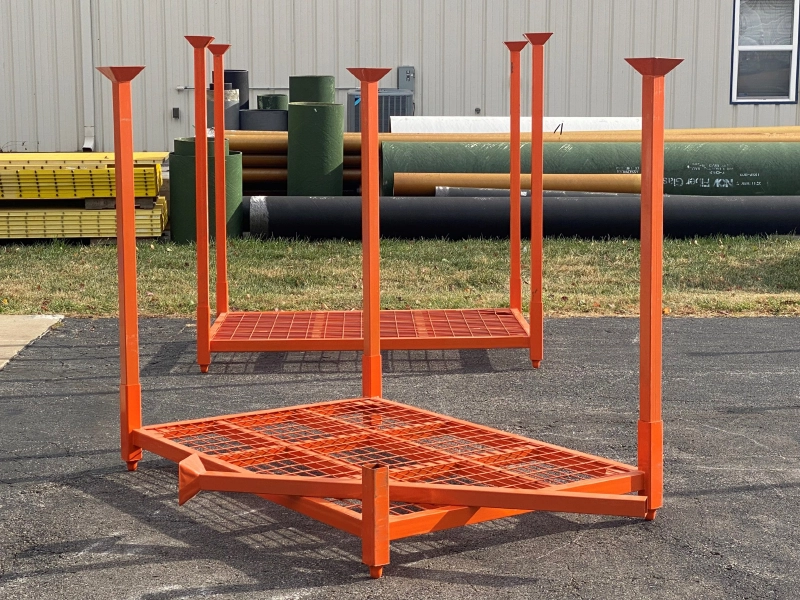

Stop Compromising Your Feed & Flour Quality.
In the milling industry, floor stacking soft bags is a calculated risk. Go too high, and the bottom layers of layer mash or cake flour turn into bricks due to compression. Stay low, and you waste 60% of your warehouse airspace. The choice between “crushed product” and “wasted space” ends today.
The Hidden Costs of Wooden Pallets in Food & Feed Logistics
For operations managers at General Milling Corporation (GMC) or similar high-volume feed and flour producers, the humble wooden pallet is often a necessary evil. However, in a strict food safety environment, wood is a liability. Splinters contaminate bakery ingredients, moisture absorption leads to mold on animal feed sacks, and they are notoriously difficult to sanitize to HACCP standards.
The stack rack (also known as a metal post pallet) changes the hygiene equation. Unlike wood, hot-dip galvanized steel is impervious to moisture, does not harbor pests (crucial for grain storage), and can be steam-cleaned between cycles. It transforms your logistics carrier from a consumable expense into a hygienic asset.

Fig 1. The skeletal structure of a metal post pallet eliminates moisture retention and pest harborage zones common in wooden pallets.
Solving the “Crush Factor” in Soft Bag Storage
Whether you are storing hog starter feeds or premium soft wheat flour, bag compression is the enemy. Traditional floor stacking forces the bottom bags to support the weight of everything above them. In humid Philippine climates, this pressure combined with moisture causes powdered goods to cake or “block,” rendering them unsellable.
By implementing heavy duty stack racks, you convert “product-on-product” loading to “frame-on-frame” loading. The steel columns take 100% of the vertical load. You can stack 4 to 5 units high—effectively quadrupling your density—without a single kilogram of pressure resting on the bottom sacks of flour. This ensures that the chick booster at the bottom of the stack remains as loose and free-flowing as the bag at the top.
Standardizing the Unstandardized: Handling Multiple SKUs
Feed mills and food manufacturers often juggle dozens of SKUs—from duck laying pellets to specialized siopao flour. In a block-stacking environment, accessing a specific SKU buried behind a wall of cornstarch is a forklift nightmare, often requiring double-handling that increases the risk of bag tears.
Pallet stillages act as portable rack locations. Because each rack is a self-contained unit, your forklift operators can move a stack of “Red Star Yeast” to access the “Hard Wheat Flour” behind it without unstacking every single pallet. This flexibility is critical for maintaining First-In-First-Out (FIFO) protocols for perishable goods.

Fig 2. A modular base designed to hold standard pallet loads, providing structural integrity for vertical stacking.
The Economics of Reverse Logistics
Distribution to large commercial bakeries or farms often involves a return trip. If you use rigid cages or wooden pallets, the return truck is mostly transporting air. Portable stack racks are designed with a demountable or nesting capability.
Once the animal feeds are delivered to the farm, the empty racks can be nested (posts removed or bases stacked). You can fit the empty units of 4 to 5 outbound trucks into a single return vehicle. This dramatic reduction in transport volume makes a closed-loop asset recovery system financially viable.

Fig 3. Empty racks nested for return transport, reducing reverse logistics costs by up to 75%.
Comparative Analysis: Wood vs. Steel in Milling
| Feature | Traditional Wood Pallet | Derack Metal Stack Rack |
|---|---|---|
| Load Bearing | Relies on product compression | Structural Steel Frame (Independent of product) |
| Hygiene | Porous, absorbs moisture/odors | Non-porous, Washable, Food Grade |
| Bag Safety | Nails/Splinters cause tears | Smooth steel finish |
| Lifespan | 3-6 months (High replacement) | 5-10+ years (Asset) |
Frequently Asked Questions for Milling & Feed Logistics
1. Can these racks handle the weight of dense products like mineral feed additives?
Yes. Our heavy-duty models are engineered to hold up to 3,300 lbs (1500 kg) per rack. This is ideal for high-density goods like mineral premixes or dense corn grains, allowing for safe vertical stacking even with heavy loads.
2. Will the metal racks rust in a humid milling environment?
We recommend Hot-Dip Galvanized finishing for food and feed environments. This treats the steel both inside and out, providing superior corrosion resistance against humidity and frequent washing, far outlasting powder-coated alternatives.
3. How do stack racks help with pest control in flour mills?
Unlike wooden pallets, metal racks have no crevices for weevils or rodents to hide. Furthermore, the open base design allows for better airflow and visibility during sanitation inspections, eliminating the “dark corners” where pests thrive.
4. Can we use these racks for “Super Sacks” (FIBCs) or just 25kg bags?
Absolutely. We can customize the base dimension and post height to accommodate large Bulk Bags (FIBCs). The corner posts keep the super sack stable and prevent it from bulging or tipping over, which is a common risk when stacking round bulk bags.
5. Do I need special forklifts to use this system?
No. The base is designed with standard fork pockets compatible with the equipment you already use for wooden pallets. Your current fleet of forklifts and reach trucks will work seamlessly with the Derack system.
Need a Custom Storage Solution?
Speak directly with our technical engineers. We offer free structural designs, heavy-duty catalog evaluations, and quick B2B price quotations.
Request a Quote Now →