

Your CNC cutting table is running non-stop, but a bottleneck is forming. Custom-cut glass lites are piling up, thin 6mm sheets are at risk of chipping in oversized racks, and your team is struggling to sort and ‘pair up’ units for the IGU line. This disorganized workflow isn’t just inefficient—it’s costing you in remakes and delayed orders.
From CNC Chaos to Streamlined Workflow: Solving the Glass Fabricator’s Bottleneck
In the high-stakes environment of a glass fabrication plant, the journey of a glass lite from the CNC Glass Cutting Table to the tempering furnace or laminating line is fraught with risk. Production managers at Custom Glass Fabricator and Insulated Glass Unit Manufacture facilities know the scene all too well: a chaotic accumulation of Work-in-Progress (WIP). Tall, narrow lites for custom shower doors teeter precariously on standard A-frames. Thin 6mm glass sheets for IGUs rattle in slots designed for thicker panes, creating invisible micro-cracks that lead to costly failures down the line. The process of sorting and “pairing up” these units becomes a time-consuming, manual task that stifles the entire production flow.
This critical gap between your multi-million dollar processing machines requires more than just a place to store glass; it demands a dynamic, mobile logistics tool. It requires a heavy-duty rack built for the realities of your shop floor.
The Harp Rack: More Than Storage, It’s Your Mobile WIP Command Center
The Heavy duty mould rack, known in the industry as a Glass Harp Rack, is engineered specifically to bridge this gap. It’s not a static storage unit; it’s a mobile command center for your glass lites, transforming your in-plant transfer process from a liability into a competitive advantage. Its design directly addresses the core pain points of modern glass fabrication.
Individual Slot Protection: Eliminate Scratches and Edge Chipping
Every slot on our Harp Rack features PVC-Coated Steel Dividers. The robust steel core provides the rigidity to separate heavy glass plates, while the soft, resilient PVC casing creates a non-abrasive contact surface. This is critical when handling high-value materials like Low-E glass, where a single scratch to the coating means a complete remake. This design effectively prevents surface damage and edge chipping during loading, transit, and unloading, protecting your materials and your profit margins.

Customizable Base Design: Conquer Non-Standard and Thin Glass
Glass is not one-size-fits-all, and your storage shouldn’t be either. We offer two specialized base configurations to solve your most persistent handling challenges:
- Full Steel Base with Slots: This design provides a continuous line of support along the entire bottom edge of the glass. It is the definitive solution for storing and moving non-standard, short-but-tall architectural glass that is notoriously unstable on traditional roller-based racks. You can confidently take on diverse custom orders without risking material loss.
- Nylon Roller Base with Custom Slot Widths: Specifically for IGU manufacturers handling thin glass (e.g., 6mm), we can customize the slot width to a precise tolerance (e.g., 8-10mm). This snug fit eliminates the wobble and vibration that cause micro-fractures, ensuring the integrity of every lite destined for your Insulated Glass Production Line Equipment.

Unlock Tangible ROI: Boosting Safety, Efficiency, and Capacity
Investing in the right equipment delivers returns in safety, throughput, and operational flexibility. Our Harp Rack is built to provide measurable improvements across your entire facility.
Enhanced Safety with the Foot-Actuated Locking System
Moving a fully loaded rack weighing over 3,000 lbs is a serious task. Our unique Foot-Actuated Lifting Mechanism provides an unmatched level of safety. With a simple press of a pedal, the mechanism slightly lifts the entire glass load off the base rollers and locks it securely against a fixed rubber buffer. This completely immobilizes the glass during in-plant transfer, preventing any shifting or sliding due to inertia or uneven floors. This active safety feature protects both your valuable product and your most valuable asset—your team.
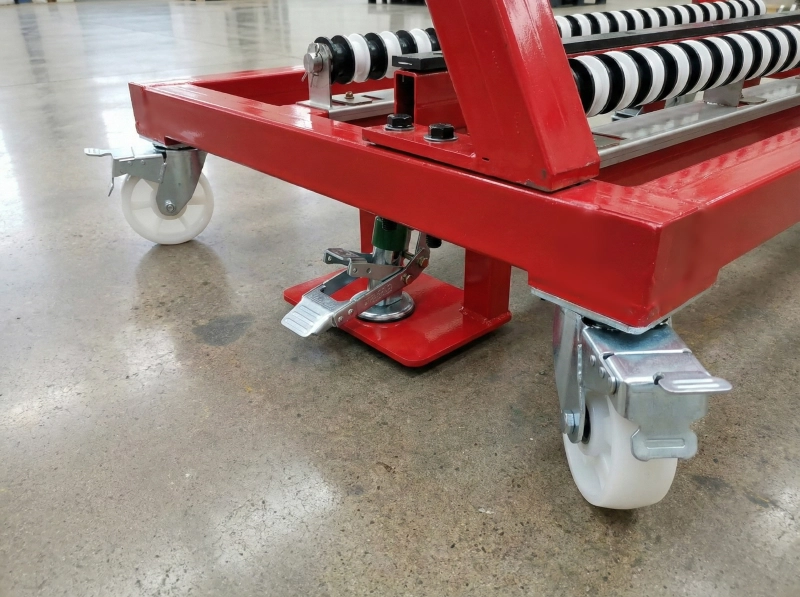
Built to Last: Heavy-Duty Construction and Precision Engineering
A rack is only as good as its construction. We use high-grade Q235A Carbon Steel and a full welding process to ensure maximum structural integrity and fatigue resistance. The frame is finished with a durable electrostatic powder coating (customizable to your RAL color preference) for long-lasting protection against the harsh industrial environment. Every component is engineered to handle the dynamic loads of a busy production floor.
| Model | External Dimensions (L×W×H) | Storage Slots | Dynamic Load Capacity | Primary Feature |
|---|---|---|---|---|
| HR-40 | 59″ x 39.4″ x 71″ | 40 | 1500 kg (approx. 3300 lbs) | Standard, high versatility |
| HR-84 | 59″ x 47.2″ x 70.9″ | 84 | 1500 kg (approx. 3300 lbs) | High-density for thin glass |
Drastically Reduced Shipping Costs: The Knock-Down Advantage
For our national and international clients, logistics costs are a major consideration. Our Harp Racks feature a knock-down, bolted assembly design. This allows us to flat-pack the components, dramatically reducing the shipping volume. This smart design means more units can fit into a single container, significantly lowering freight costs and making it easier to maneuver the components into facilities with restricted access.

Frequently Asked Questions
1. Can this rack handle very thin glass, like the 6mm lites we use for IGUs?
Absolutely. We recommend the nylon roller base with our custom slot width option. We can engineer the slot spacing to provide a snug, secure fit for thin glass, preventing the wobble and vibration that can cause micro-cracks during transport.
2. We process many odd-sized, tall and narrow glass lites for architectural projects. Will they be stable?
Yes. The Full Steel Base model is specifically designed for this challenge. It provides continuous support along the entire bottom edge of the glass, ensuring maximum stability for non-standard dimensions that are unsafe on conventional roller racks.
3. How is the rack shipped? Is assembly difficult on-site?
The rack is shipped in a knock-down, flat-packed state to significantly reduce your freight costs. Assembly is straightforward, involving a simple bolt-together process with standard tools. We provide clear instructions to ensure a quick and secure build.
4. What is the typical dynamic load capacity?
Our standard models, like the HR-40 and HR-84, are rated for a dynamic load capacity of 1500 kg (approximately 3300 lbs). We also engineer custom, higher-capacity solutions for clients with specific heavy-duty requirements.
5. How exactly does the foot-actuated locking mechanism improve safety?
When the rack is stationary, the glass rests on rollers for easy loading. Before moving the rack, the operator steps on a pedal. This engages a lever system that lifts the glass panes slightly and presses them firmly against a fixed rubber stopper. This completely immobilizes the load, preventing any dangerous shifting or sliding during transit across the factory floor.
Need a Custom Storage Solution?
Speak directly with our technical engineers. We offer free structural designs, heavy-duty catalog evaluations, and quick B2B price quotations.
Request a Quote Now →