
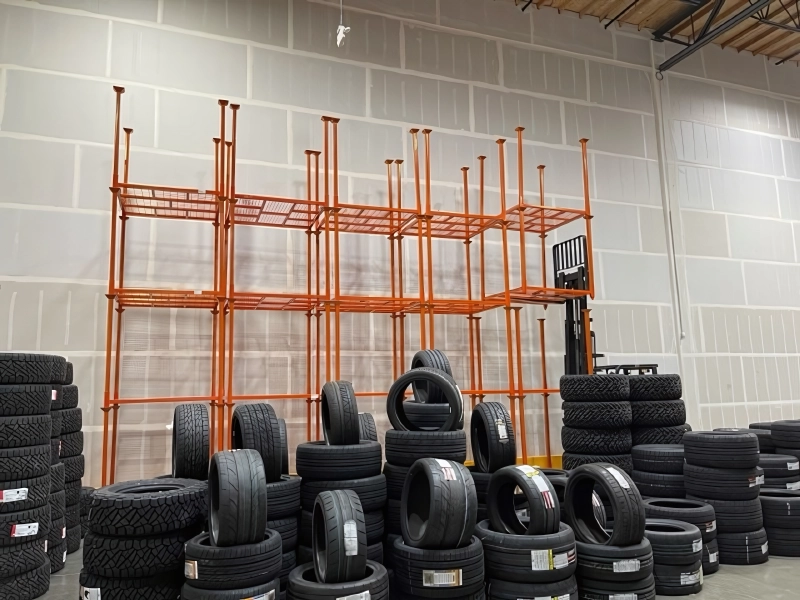
Heavy duty stacking racks

In the feed and flour milling industry, the integrity of your packaging is your bottom line. You are likely dealing with heavy 50kg sacks of starter mash or premium flour that cannot withstand the crushing weight of block stacking. If you are struggling with “pyramid stacks” that waste 40% of your vertical space, or if wooden pallets are introducing contamination risks into your GMP-compliant zones, it is time to rethink your storage infrastructure.
Stop the “Crush”: Protecting Bagged Yields
In high-volume milling operations, the standard practice of floor stacking (block stacking) creates a hidden yield loss. When you stack palletized bags of flour or animal feed 3-4 levels high directly on top of each other, the bottom layer inevitably suffers from compression. This leads to hardened product, burst bags, and compromised packaging seals.
Heavy duty stack racks function as a protective exoskeleton for your palletized goods. By transferring the vertical load through the steel posts rather than the product itself, you ensure that the bottom pallet bears zero weight from the pallets above it. This allows you to stack 4 to 5 units high—maximizing your warehouse cube—without risking a single kilo of product loss due to compression.

Figure 1: Frame-style base design allows standard wooden pallets loaded with bagged flour or feed to be inserted directly, preventing load compression.
Hygiene and GMP Compliance in Food Logistics
For facilities producing consumables like Swan Flour or Chick Booster, hygiene is non-negotiable. Traditional wooden pallets are porous; they absorb moisture, harbor mold, and are difficult to sanitize effectively. In a humid climate like the Philippines, wooden pallets inside a warehouse can become a vector for pest infestation and bacterial growth, threatening HACCP certification.
Our pallet stillages are treated with hot-dip galvanization (zinc coating). This finish is impervious to moisture, rust-proof, and can be steam-cleaned. Unlike wood, steel does not splinter, eliminating the risk of physical contaminants (foreign materials) tearing your woven polypropylene (WPP) bags during handling.

Figure 2: The open mesh base allows for airflow and easy sanitation, critical for preventing mold in humid feed storage environments.
Mastering SKU Complexity without Fixed Aisles
Feed mills often juggle dozens of SKUs—from Hog Starter to Layer Mash to Duck Pellets. When you use static selective racking, you are forced to dedicate permanent aisles, wasting 50% of your floor space. When you block stack, you trap inventory, making it impossible to access the “Layer Mash” buried behind the “Hog Starter” without moving tons of product (violating FIFO principles).
Portable stack racks offer the “Moveable Warehouse” concept. You can stack them densely like block stacking, but unlike pallets, a forklift can easily lift a stack of two or three racks at once to access the rear inventory. This flexibility allows you to change your warehouse layout based on seasonal demand spikes—such as increasing storage density during harvest season and opening up floor space for maintenance during downtime.

Figure 3: Unlike fixed racking, portable racks allow for dynamic layout changes to accommodate fluctuating stock levels of different feed SKUs.
Comparison: Wood Pallets vs. Steel Post Pallets
| Feature | Traditional Wood Pallet Stacking | Derack Heavy Duty System |
|---|---|---|
| Load Stability | Depends on bag friction; prone to toppling. | Constraint by steel posts; 100% stable. |
| Vertical Limit | Max 2-3 layers (risk of crushing). | 4-5 layers (load on posts, not product). |
| Hygiene | High risk (bugs, mold, moisture absorption). | High safety (Galvanized, washable, inert). |
| Bag Damage | Common (nails, splinters, compression). | Near Zero (smooth steel surfaces). |
The “Nesting” Advantage for Return Logistics
Supply chains in the Philippines often involve inter-island transport. Sending empty pallets back is shipping air. The defining feature of our system is its nestability. When not in use, or during return trips, the posts are removed, and the bases nest into one another. This reduces the volume by up to 80%, drastically cutting your reverse logistics costs compared to rigid cages or plastic pallets.

Figure 4: Empty racks can be nested (posts removed), allowing you to fit hundreds of units in a single truck for cost-effective return transport.
Frequently Asked Questions
1. Can these racks hold standard wooden pallets?
Yes, we design the base dimensions specifically to accommodate standard ISO or local pallet sizes (e.g., 1200x1000mm). You can forklift your existing wooden pallet directly into the rack, instantly upgrading it to a stackable unit without restacking the bags.
2. How much weight can a single rack support?
Our heavy duty models are engineered for industrial loads, typically ranging from 1,000 kg (2,200 lbs) to 2,000 kg (4,400 lbs) per rack. This easily handles a full pallet of 50kg flour or feed sacks.
3. Are these racks suitable for cold storage or high humidity areas?
Absolutely. We recommend the Hot-Dip Galvanized finish for any food or agricultural application. This creates a metallurgical bond that prevents rust even in wet, humid environments or cold storage freezers, ensuring a 10+ year lifespan.
4. Do the racks require bolting to the floor?
No. Unlike selective racking, these are portable. They rely on “cup feet” or stacking targets for stability. This allows you to turn your receiving dock into storage space and back again within minutes.
5. How do these help with pest control?
By lifting goods off the floor and allowing for vertical spacing, stack racks eliminate the dark, undisturbed corners where rodents typically nest in block-stacked bags. The open structure also allows for easier inspection and cleaning of the floor beneath the inventory.
Need a Custom Storage Solution?
Speak directly with our technical engineers. We offer free structural designs, heavy-duty catalog evaluations, and quick B2B price quotations.
Request a Quote Now →