

In your glass fabrication shop, are you still leaning expensive lites against walls or posts? Every square foot of floor space taken up by disorganized glass is a direct hit to your efficiency and a serious risk to both your materials and your team. A single chipped edge or a scratch on a Low-E coated panel discovered just before shipping can wipe out the profit on a job. It’s time to move beyond the high-risk gamble of floor storage.
The Real Costs of “Free” Floor Storage in Glass Fabrication
In any busy glass processing facility, from a custom shower door fabricator to a large-scale insulated glass unit (IGU) manufacturer, the workshop floor can quickly become a minefield. Stacks of raw, semi-finished, and finished glass lites propped against walls or stacked on simple A-frames are a common sight. This method, while seemingly free, carries significant hidden costs that directly impact your bottom line.
Compromised Material Integrity: From Micro-Cracks to Scrapped Lites
When a heavy glass sheet is leaned at an angle, its own weight creates immense pressure points along the bottom edge. This constant stress can introduce invisible micro-cracks. These defects may go unnoticed until the glass enters the glass tempering furnace, where the thermal shock causes it to shatter, wasting the material, machine time, and labor. Thin glass (e.g., under 8mm) is especially vulnerable to flexing and chipping when stored improperly on the floor, leading to unacceptable reject rates.
Workflow Bottlenecks: The Search-and-Shuffle Game
Consider the IGU assembly process. Your operator needs two perfectly matched, cleaned lites. If those lites are buried in a floor stack, the “search and shuffle” begins. They must carefully move multiple heavy sheets just to access the correct one. This non-value-added time creates a bottleneck, starving your expensive downstream equipment like the glass washing machine or laminating line. Every minute your production line waits is a minute of lost output and profit.
The Harp Rack: An Engineered System for Glass Flow, Not Just Storage
A Harp Rack is not just a place to put glass; it’s a mobile, high-density Work-in-Progress (WIP) station designed to integrate directly into the glass fabrication workflow. It fundamentally solves the chaos of floor storage by transforming how you handle, sort, and transport glass between processes.
Structure to Function: How Smart Design Protects High-Value Glass
The core value of a Harp Rack lies in how its specific components directly prevent common types of damage.
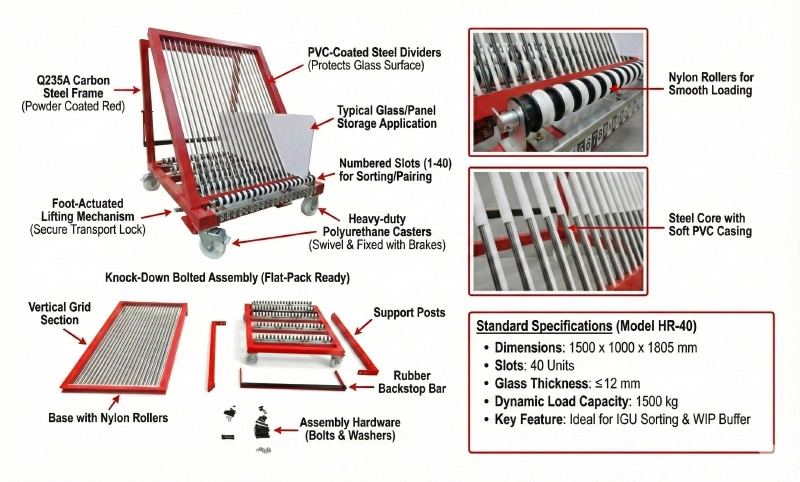
- PVC-Coated Dividers: Each glass lite slides into its own slot, separated by a strong steel rod sheathed in a soft, non-abrasive PVC casing. This design provides robust separation while ensuring that expensive, delicate surfaces, like Low-E coatings, are never scratched or abraded during loading or transport.

- Advanced Base Options: Instead of resting on a hard, unforgiving concrete floor, glass is placed on either smooth nylon rollers for effortless loading or a full, slotted steel base. This full base design is critical for safely handling non-standard, short-and-tall lites from a CNC glass cutting table that would be dangerously unstable on a traditional rack or the floor.
From Static Clutter to Dynamic Flow: The Mobile WIP Station
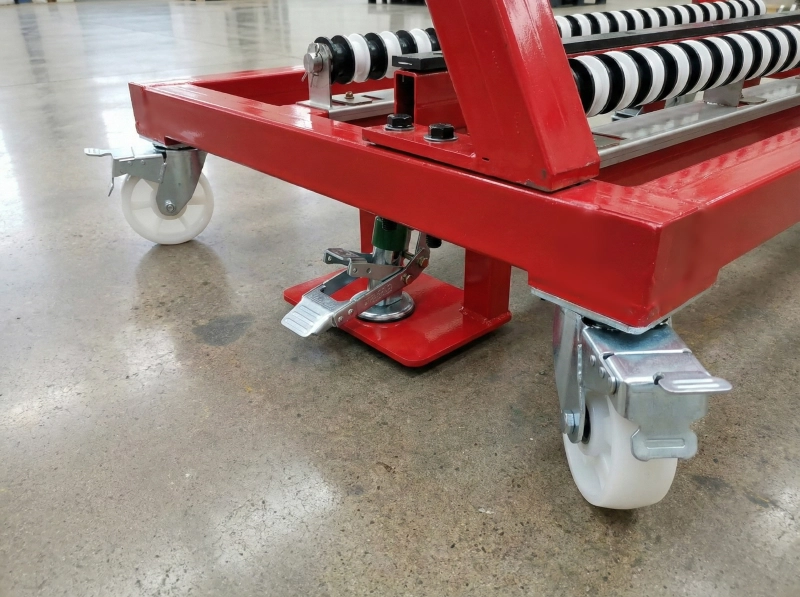
The true power of the Harp Rack is its mobility. Mounted on heavy-duty polyurethane casters, it acts as a “logistics catalyst” between your fixed machinery. An entire batch of cut glass can be loaded onto a harp rack glass trolley at the cutting station, sorted for IGU “kitting,” and then safely rolled to the next stage. This eliminates multiple manual handling steps, drastically cutting down on labor and the risk of damage or injury. For ultimate safety during this in-plant transfer, the foot-actuated lifting mechanism locks the rack firmly in place, preventing any movement while loading or unloading.
The Tangible ROI: Harp Rack vs. Floor Storage
Moving from the floor to a purpose-built rack system is not an expense; it is a direct investment in operational excellence. The comparison is stark:
| Metric | Floor Storage (The “Before”) | Harp Rack System (The “After”) |
|---|---|---|
| Material Waste | High scrap rate due to chipped edges, scratches, stress fractures, and contamination from floor debris. | Minimal to zero damage. Each lite is isolated and protected, preserving the value of every piece. |
| Production Workflow | Constant delays and bottlenecks caused by the “search and shuffle” game. Inefficient material flow. | Streamlined, predictable workflow. Glass moves as organized batches from station to station. |
| Labor Efficiency | High labor cost per unit due to excessive, risky manual handling and searching for parts. | Operators spend time on value-added tasks, not wrestling with disorganized glass. |
| Worker Safety | High risk of serious injury from tipping glass sheets and ergonomic strain from lifting. | Dramatically improved safety. Reduced manual handling and stable, secure transport. |
| Floor Space Utilization | Disorganized, sprawling storage consumes valuable production space. | High-density vertical storage maximizes capacity per square foot, freeing up floor space for operations. |
Ultimately, reclaiming your floor and organizing your process with a Harp Rack system directly translates to higher throughput, lower costs, a safer workplace, and greater profitability for your glass fabrication business.
Frequently Asked Questions
1. Can the Harp Rack handle the very thin glass (e.g., 1/8″ or 3mm) we use for insulated glass units?
Absolutely. While standard racks work well for thicker glass, we can provide a solution with custom slot widths. By narrowing the space between dividers, the rack offers tighter support for thin glass, preventing the flexing and rattling that can cause micro-fractures during transport.
2. We process many non-standard, tall-and-narrow lites from our CNC machine. Will they be stable?
This is a critical pain point that our full base harp racks are designed to solve. Unlike racks with only a few bottom rollers, the full, slotted base provides continuous support along the entire bottom edge of the glass, regardless of its length. This completely eliminates the tipping hazard common with oddly shaped architectural or custom glass.
3. How does the rack improve safety when moving a full load of heavy glass across the workshop?
The key is the foot-actuated lifting and locking mechanism. Before moving, the operator steps on a pedal that slightly lifts the glass and locks the entire load against a firm rubber buffer. This prevents any shifting or sliding due to inertia or uneven floors, ensuring the load is completely stable and secure until it reaches its destination.
4. Our floor space is extremely limited. How does a Harp Rack help?
By converting horizontal, sprawling floor storage into organized, high-density vertical storage. A single Harp Rack can safely store 40, 84, or even more lites in the same footprint that might only hold a dozen sheets leaned against a wall. This frees up significant floor space for more valuable activities like production or staging.
5. We are an international company; shipping fully welded racks is expensive. Is there a solution?
Yes. Our Harp Racks are designed with a knock-down, bolted assembly structure. The entire unit can be flat-packed for shipping, which drastically reduces the volume. This makes international container loading far more efficient and significantly lowers your freight costs compared to shipping rigid, fully welded frames.

Need a Custom Storage Solution?
Speak directly with our technical engineers. We offer free structural designs, heavy-duty catalog evaluations, and quick B2B price quotations.
Request a Quote Now →