
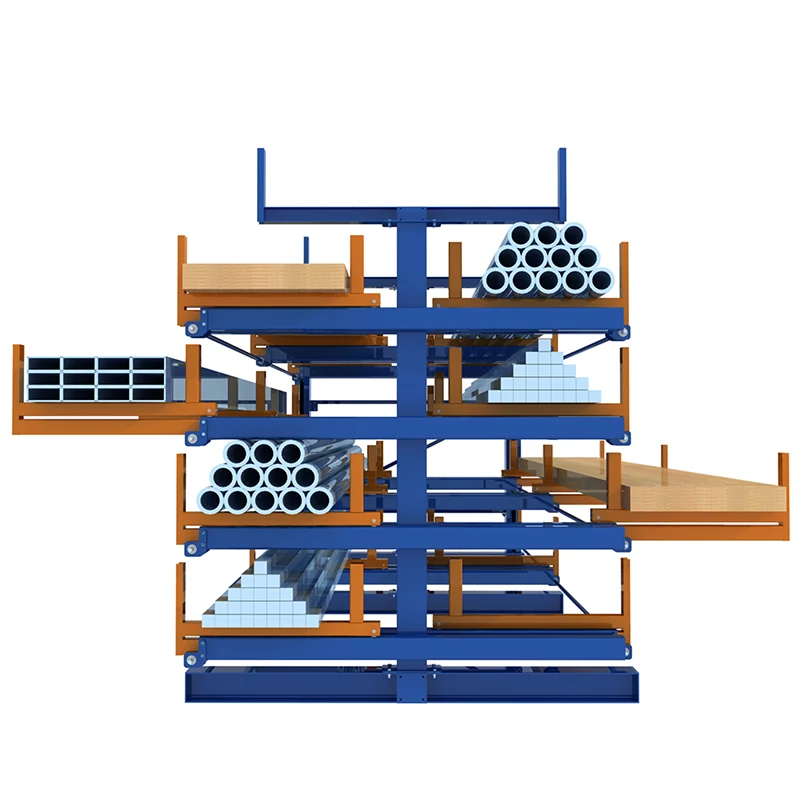
The Real Costs of Your Current Bar Stock Storage Workflow
In any steel service center or metal fabrication shop, the daily routine of moving materials dictates the pace of production. The reliance on forklifts to interact with static cantilever racks or floor stacks introduces a series of operational “taxes” that are often accepted as the cost of doing business. However, these hidden costs directly erode efficiency, compromise material quality, and create unnecessary safety risks.
The “Digging” Tax: How Buried Inventory Idles Your Operation
Your team needs a specific bundle of bar stock for a high-priority order. Unfortunately, it’s at the bottom of a stack or behind three other bundles on a static rack. The process that follows is a pure non-value-added activity. An operator must first remove the “blocking” bundles, find a temporary space for them, retrieve the target material, and then re-stack the original bundles. This “secondary handling” can take anywhere from 15 to 25 minutes, during which your expensive laser cutter or CNC machine sits idle, waiting for material. This isn’t just a loss of labor time; it’s a direct loss of machine uptime and production capacity.
The Scratch Factor: When Surface Finish is Non-Negotiable
For operations handling high-purity stainless steel, such as for the pharmaceutical or food processing industries, the material’s surface is its most critical feature. A microscopic scratch from a forklift tine scraping against a tube isn’t a cosmetic flaw; it’s a potential harborage point for bacteria, leading to a violation of ASME BPE standards and immediate rejection of a high-value asset. The act of sliding heavy metal bundles in and out of a fixed rack arm creates a constant risk of friction damage, compromising the very quality your reputation is built on. This turns your storage area into a source of potential scrap before the material even reaches the production line.
Shifting from Horizontal Obstacles to Vertical Access
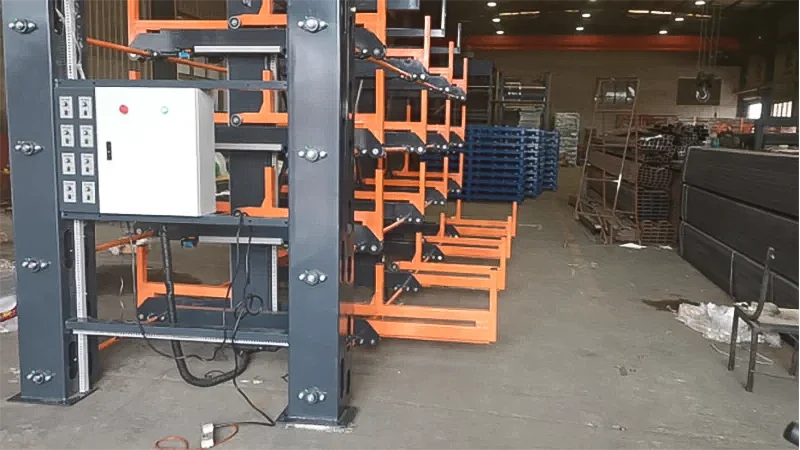
The solution lies in changing the fundamental dynamic of material retrieval. A Crank Out Cantilever Rack re-engineers this process by bringing the material directly to your handling equipment, rather than forcing your equipment to navigate into a dense storage structure. This simple mechanical shift eliminates the core problems of conventional storage.
Achieving 100% Selectivity with an Overhead Crane
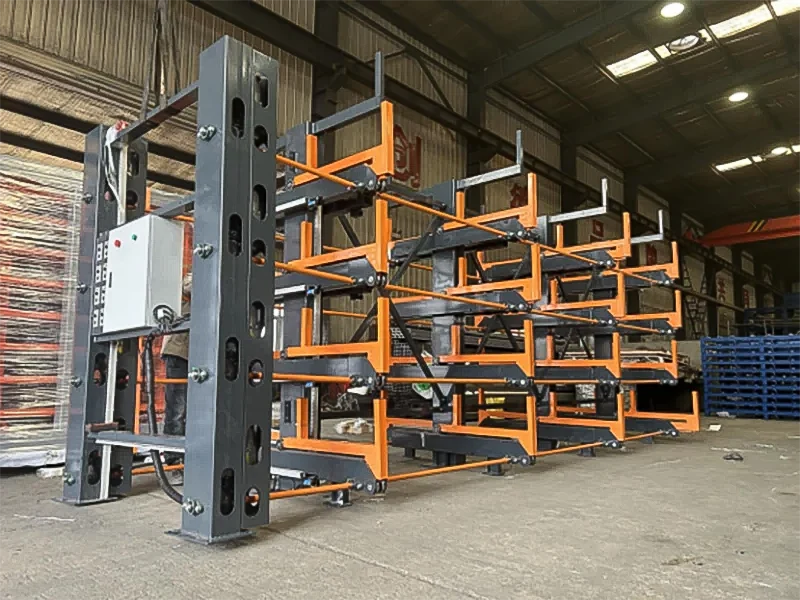
The core mechanism involves retractable cantilever arms. By turning a crank or using an electric motor, a single operator can extend a fully loaded level 100% out into the aisle. This action presents the entire bundle of material directly beneath your overhead crane. There is no need to move other inventory. The crane can lower its slings or vacuum lifter vertically, securely lift the desired bundle, and deliver it to the processing machine. The retrieval process becomes a predictable, 2-5 minute task, every single time, regardless of where the material is stored in the rack.
Protecting High-Value Assets with Contactless Handling
With an overhead crane accessible racking system, the hard steel of forklift tines never touches your product. Soft nylon slings cradle the materials, eliminating the risk of scratches, gouges, and dents associated with sliding loads. This method preserves the pristine, passivated surface of stainless steel and protects the finish of polished aluminum profiles. It transforms material handling from a high-risk activity into a controlled, quality-centric procedure, ensuring your materials arrive at the production stage in perfect condition.
A Direct Comparison: Old Problems vs. New Efficiencies
The transition to a crank-out system isn’t just an equipment upgrade; it’s a fundamental improvement to your entire internal logistics chain. The benefits are direct, measurable, and impact every stage of your operation from receiving to shipping.
| Dimension | Static Racking with Forklift | Crank Out Cantilever with Overhead Crane |
|---|---|---|
| Material Access | Requires moving blocking items (“digging”). Retrieval time is unpredictable. | 100% selective access to any level. Retrieval is fast and consistent (2-5 mins). |
| Surface Integrity | High risk of scratches and impact damage from metal-on-metal contact. | Near-zero risk. Vertical lifting with soft slings prevents contact and friction. |
| Floor Space Utilization | Requires wide aisles (4-6 meters) for forklift turning radius, creating dead space. | Aisles are minimized, increasing storage density by up to 50%. Space is reclaimed for production. |
| Operator Safety | High risk of collisions in confined aisles; potential for unstable loads at height. | Operator is away from the load. Crane provides clear overhead view, reducing incident risk. |
| Ergonomics | Often requires manual pushing/pulling of heavy materials. | Mechanical crank allows one person to move tons with minimal physical effort. |
Frequently Asked Questions
1. What exactly is a Crank Out Cantilever Rack?
It is a heavy-duty storage system designed for long, bulky items like pipe, bar stock, and tubing. Its key feature is cantilevered arms that can be manually or electrically extended 100% from the structure, allowing an overhead crane direct, unobstructed access to the stored materials for safe and efficient handling.
2. How does this system improve safety over traditional racks?
It enhances safety primarily by reducing the reliance on forklifts for material retrieval in storage aisles. By allowing an overhead crane to do the lifting, it separates personnel from the immediate vicinity of the moving load. The controlled, ergonomic crank mechanism also reduces the risk of musculoskeletal injuries associated with manually handling heavy steel.
3. How much floor space can a roll out rack system realistically save?
Because these racks are serviced by overhead cranes, they eliminate the need for wide forklift aisles. This can result in reclaiming up to 50% of the floor space previously dedicated to storage. This recovered space can then be used for value-adding activities like new production machinery or assembly lines.
4. What types of materials are ideal for this storage solution?
This system is ideal for any heavy, long, or unwieldy materials where both density and selectivity are important. This includes steel pipes, stainless steel tubes, aluminum extrusions, structural steel profiles (H-beams, I-beams), bar stock, and even heavy tooling or molds.
5. Is the manual crank mechanism difficult for a single operator to use with heavy loads?
No. The crank mechanism is engineered with a gear ratio that provides a significant mechanical advantage. This allows a single operator to apply minimal force (typically around 20-30kg of effort) to smoothly extend a level loaded with several tons of material, making it an ergonomic and efficient one-person job.
Need a Custom Storage Solution?
Speak directly with our technical engineers. We offer free structural designs, heavy-duty catalog evaluations, and quick B2B price quotations.
Request a Quote Now →