
|
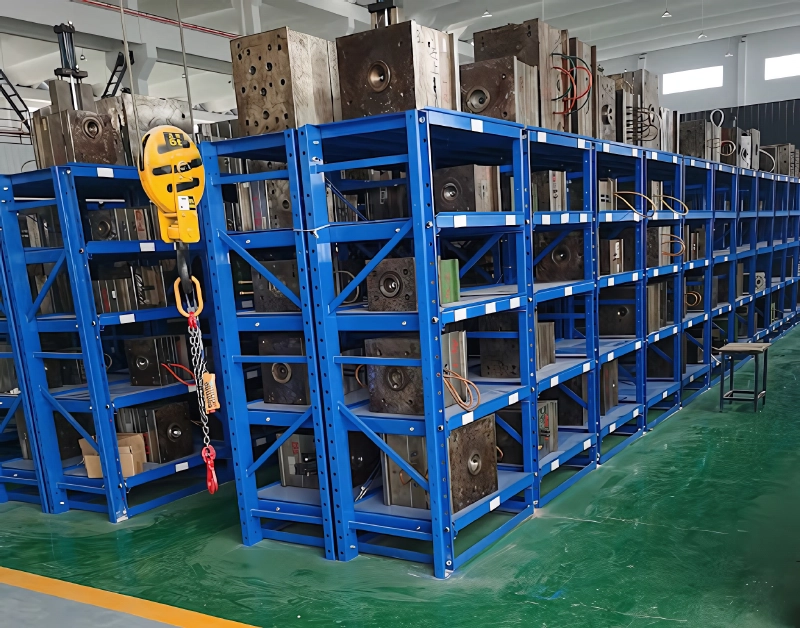
Your injection molding machines are waiting. Your die setters are wrestling with a forklift in a crowded aisle. Every minute of downtime costs you a production run of PET bottles or thermoformed cups. When your valuable injection and blow molds are buried on pallets, your entire production schedule suffers. There is a more streamlined, profitable way to manage your tool and die assets. |
Transform Your Workshop with Heavy Duty Die Rack Shelving
In the fast-paced world of plastic packaging manufacturing, floor space is production space. Yet, for many facilities, a significant portion of that valuable real estate is consumed by disorganized, floor-stacked injection molds and blow molds. This common practice doesn’t just create clutter; it introduces critical inefficiencies and safety hazards directly impacting your bottom line. Maneuvering a forklift to retrieve a 2,500 Lbs mold from the back of a pile is a slow, risky process that extends machine downtime and puts your expensive tooling at risk of collision damage.
The Core Problem: Inaccessible, At-Risk Molds
The traditional method of storing molds on the floor or on static shelving creates a fundamental accessibility issue. To retrieve a specific mold, operators often need to move several others, a time-consuming process known as “shuffling.” This directly sabotages any Single-Minute Exchange of Die (SMED) initiatives and inflates the time your injection mold storage area takes to respond to production needs. Furthermore, molds left on damp concrete floors are susceptible to rust, and the constant risk of being struck by a passing forklift can damage precision parting lines, costing thousands in repairs.
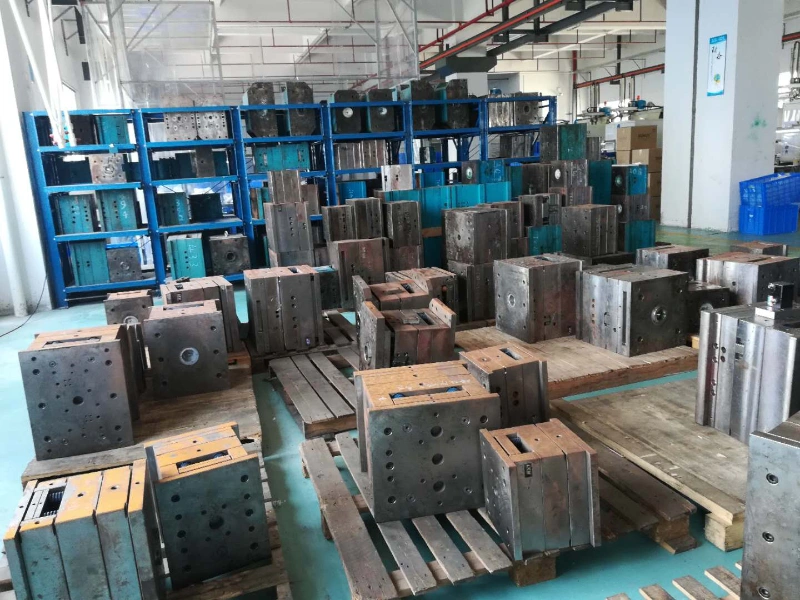
Unlock Efficiency with Engineered Roll-Out Access
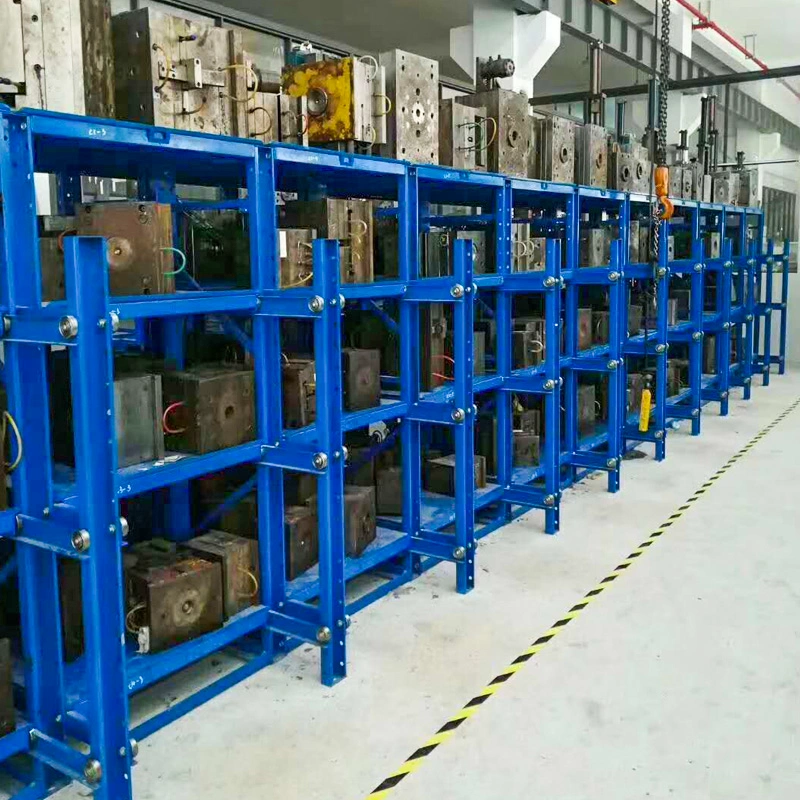
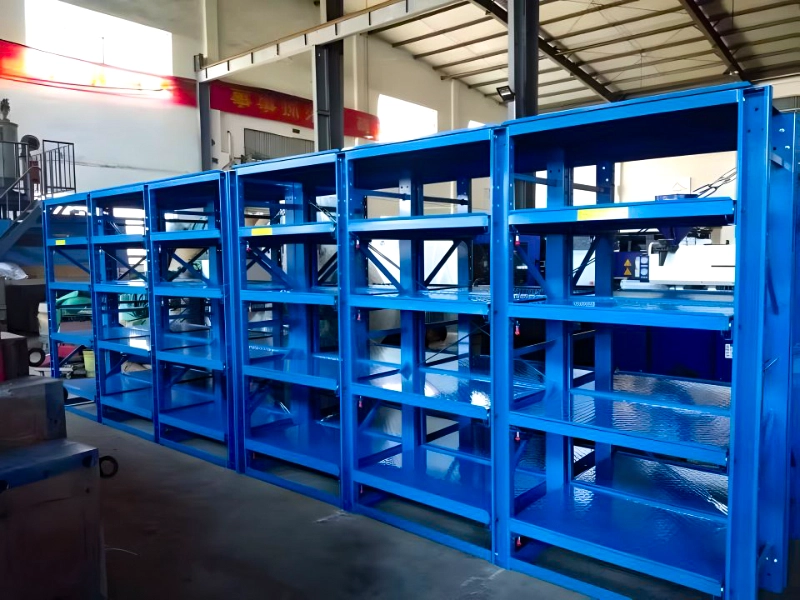
The solution lies in shifting from horizontal shuffling to vertical, direct-access storage. Our heavy duty die rack shelving is engineered around a 100% full-extension drawer system. Each drawer, equipped with high-precision Harbin roller bearings, glides out smoothly, transforming a multi-ton mold into a load that can be moved with minimal effort.
Why Full Extension is a Game-Changer for Plastic Molders
When a drawer is fully extended, the entire mold is clear of the rack structure. This creates an unobstructed vertical path for an overhead crane or chain hoist. Your die setter can now position the hook directly over the mold’s center of gravity for a perfectly balanced, safe lift. This eliminates the wide, hazardous turning radius required by forklifts, allowing you to reduce aisle widths from 4 meters down to just 1.2 meters. The result is a recovery of up to 80% of your mold storage floor space, which can be reallocated for new production lines—be it for more PET bottle machines or custom plastic container molding.
The Foundation of Security: Uncompromising Structural Integrity
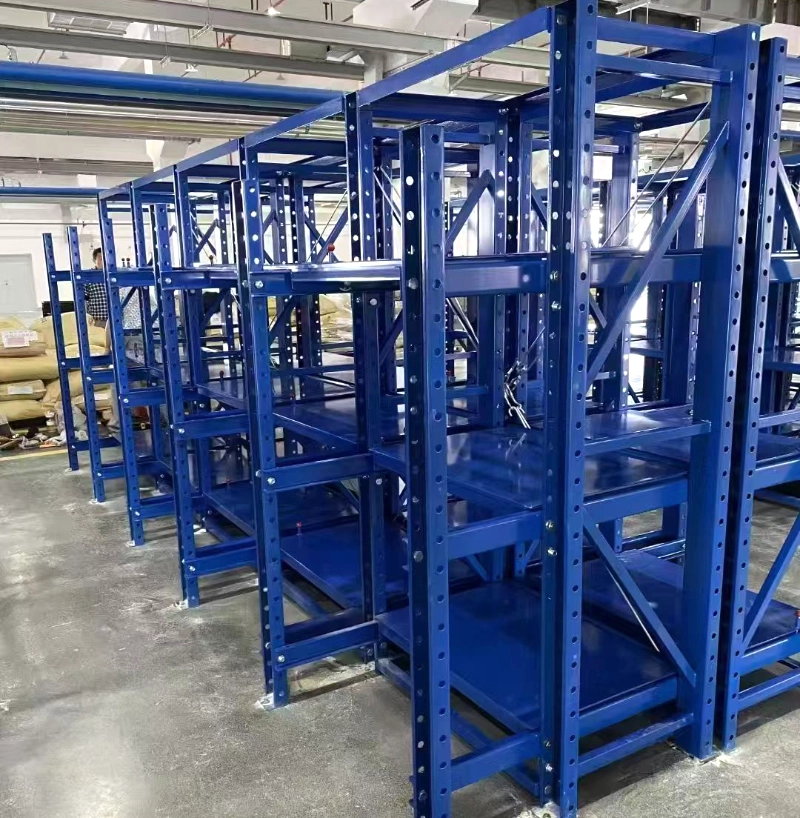
A die rack is only as reliable as its structural core. To handle the immense point loads of heavy molds, our systems are built using a robust three-pillar framework. The main uprights are constructed from 10# channel steel (Q235B grade), providing exceptional resistance to vertical pressure and lateral forces. This high-rigidity structure ensures that even when fully loaded to its 3-ton capacity per layer, the frame experiences no plastic deformation, and the drawers maintain perfect alignment for smooth operation year after year.
Protecting Your Assets from the Ground Up
Each rack is further stabilized by a system of solid steel cross-bracing and back-pull tensioners. This design provides superior resistance to side-to-side sway, a critical safety factor in a busy workshop environment. The entire structure is anchored securely to your concrete floor, guaranteeing stability and compliance with rigorous safety standards like OSHA and ANSI. This isn’t just shelving; it’s an engineered vault for your most critical production assets.
From Hours to Minutes: A Real-World Impact on SMED
Consider the typical workflow for changing a blow mold. The “Before” scenario involves 10 minutes to locate the mold, 20 minutes to clear a path and move other pallets, and 15 minutes for a forklift to carefully extract and transport it. Total time: 45 minutes of costly machine inactivity.
The “After” Workflow with a Die Roll-Out Rack System:
- Locate (30 seconds): Each mold has a dedicated, labeled slot.
- Access (10 seconds): The operator pulls out the correct drawer.
- Lift & Transport (2 minutes): An overhead crane lifts the mold vertically and moves it directly to the machine.
The total time is reduced to under 3 minutes. By positioning the die roll out racks directly beside your injection or blow molding machines, you create a seamless, highly efficient changeover cell. This drastic reduction in non-productive time allows for more frequent production changes, shorter runs, and greater manufacturing agility to respond to customer orders for different plastic packaging solutions.
Built-in Safety and Long-Term Durability
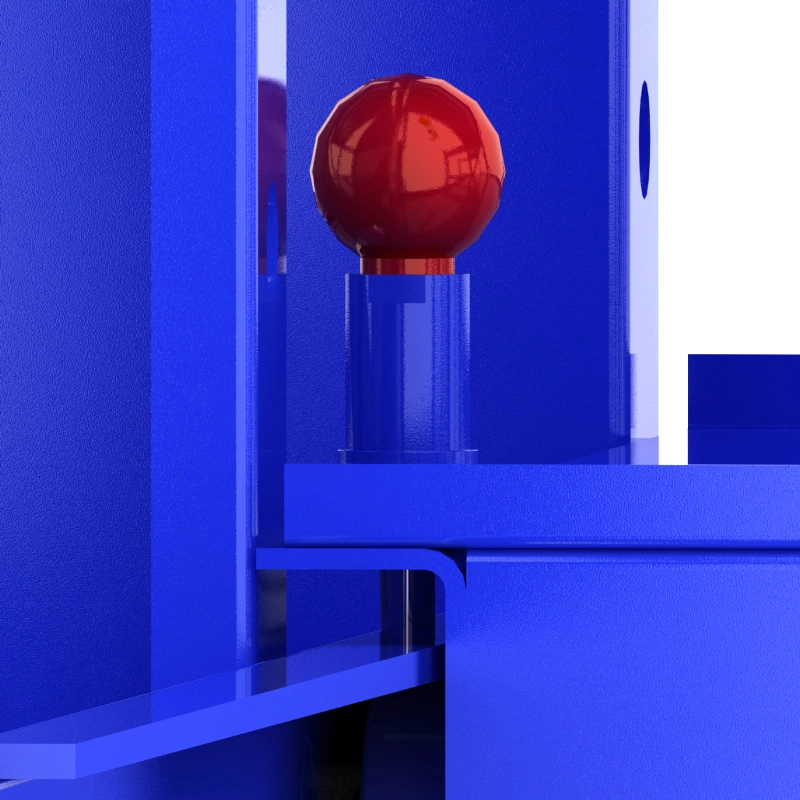
Safety is non-negotiable. Every drawer in our system is fitted with a heavy-duty mechanical safety pin. This physical lock automatically engages when the drawer is closed, preventing accidental roll-out. When the drawer is extended, a secondary lock prevents it from being pushed back in during a lift, ensuring a stable platform for your crane operator. This multi-layered approach to safety protects your personnel and prevents catastrophic equipment failure.
To protect the molds themselves, each rack undergoes a 7-step industrial surface treatment, including acid washing, phosphating, and a 60-80μm powder-coated finish. This creates a durable, corrosion-resistant barrier that protects your multi-thousand-dollar tools from the humidity and airborne contaminants common in a production environment, ensuring they remain in pristine condition for longer.
Frequently Asked Questions
1. What is the maximum weight capacity for a single drawer?
Our standard heavy duty die rack shelving is engineered to support loads from 1,000kg (approx. 2,200 Lbs) to 3,000kg (approx. 6,600 Lbs) per drawer layer. We can also provide custom-engineered solutions for exceptionally heavy or oversized blow molds.
2. Can this system integrate with our existing factory overhead crane?
Absolutely. The system is designed specifically to work in tandem with standard overhead cranes and electric chain hoists. The 100% roll-out feature ensures your crane has clear, unimpeded vertical access to lift the mold safely.
3. How does this racking contribute to our 5S or lean manufacturing initiatives?
This system is a cornerstone of 5S implementation. It promotes “Sort” and “Set in Order” by providing a specific, labeled location for every mold. This eliminates clutter, drastically reduces search times (a form of ‘waste’ in lean terms), and creates a visually organized, safer, and more efficient workspace for your tool room or production floor.
4. What is the typical installation process and timeline?
Our racks are designed with a modular, bolt-together structure for efficient installation. A standard unit can typically be assembled by a small team within a day. The process involves assembling the frame, installing the drawer runners, and securely anchoring the unit to the floor with heavy-duty expansion bolts to ensure maximum stability.
5. Is the powder-coated surface resistant to common industrial fluids?
Yes, the high-quality epoxy resin powder coating provides excellent resistance to scratches, abrasion, and incidental contact with common workshop fluids like hydraulic oils, lubricants, and cleaning agents. This ensures the rack maintains its integrity and appearance for many years, even in a demanding manufacturing environment.
Need a Custom Storage Solution?
Speak directly with our technical engineers. We offer free structural designs, heavy-duty catalog evaluations, and quick B2B price quotations.
Request a Quote Now →