
Può un contenitore in rete metallica per carichi pesanti da 2 tonnellate contenere in sicurezza pezzi industriali?
Scopri come i progetti Mybox 14452 e 15860 di contenitori in rete metallica per carichi pesanti da 2 tonnellate differiscono per dimensioni, distribuzione del carico, strati di impilaggio sicuro, accesso tramite cancello e requisiti di sollevamento con gru.
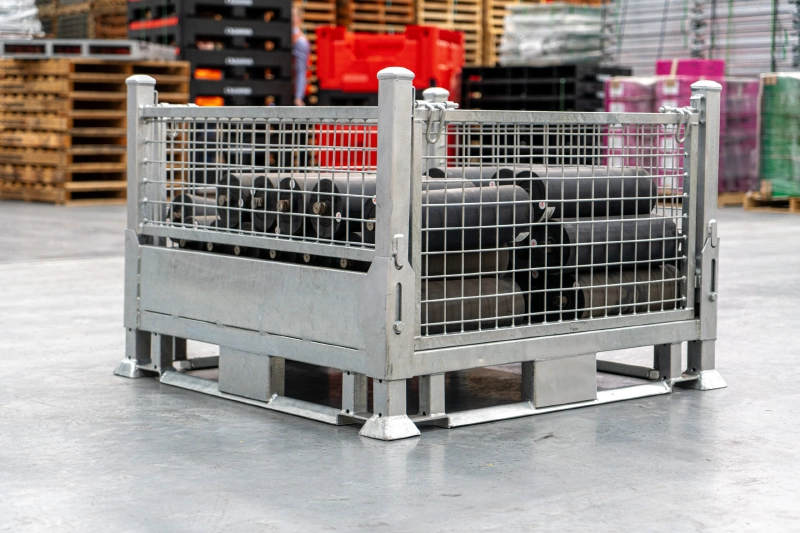
Match the load capacity to how your parts are arranged
For industrial parts weighing 100–500 kg each, the right question is not only "Can the cage hold 2,000 kg?" It is also how that load is distributed, how many full containers will be stacked, and whether lifting points are required.
Mybox can be configured as a steel pallet cage, metal pallet box, or foldable container for handling with forklift and pallet jack. The two 2-ton project references listed below are deliberately separate: project 14452 uses a mesh-bottom configuration with a recommended safe stacking of 2 layers, while project 15860 uses a heavy-duty wire mesh box with a load capacity of 2,000 kg and 3-layer stacking. These are project-specific parameters, not a single universal load capacity for every Mybox configuration.
- Project 14452: 200 × 1.000 × 900 mm; peso a vuoto 102/110 kg; carico richiesto 2.000 kg; impilaggio sicuro consigliato: 2 strati.
- Project 15860: 200 × 1.070 × 700 mm; peso a vuoto 94 kg; capacità di carico 2.000 kg; impilaggio: 3 strati; riferimento di carico: 48 unità in un 20GP / 126 unità in un 40HQ.
- Access and openings: confirm the required door or half-height gate before manufacturing; the type of opening affects access for loading and must match the handling method for the parts.
- Handling options: standard forklift pockets support handling of the entire container; wheels can be added for controlled picking in the plant. Crane lifting points are an additional requirement, not included in the 2-ton storage load capacity.
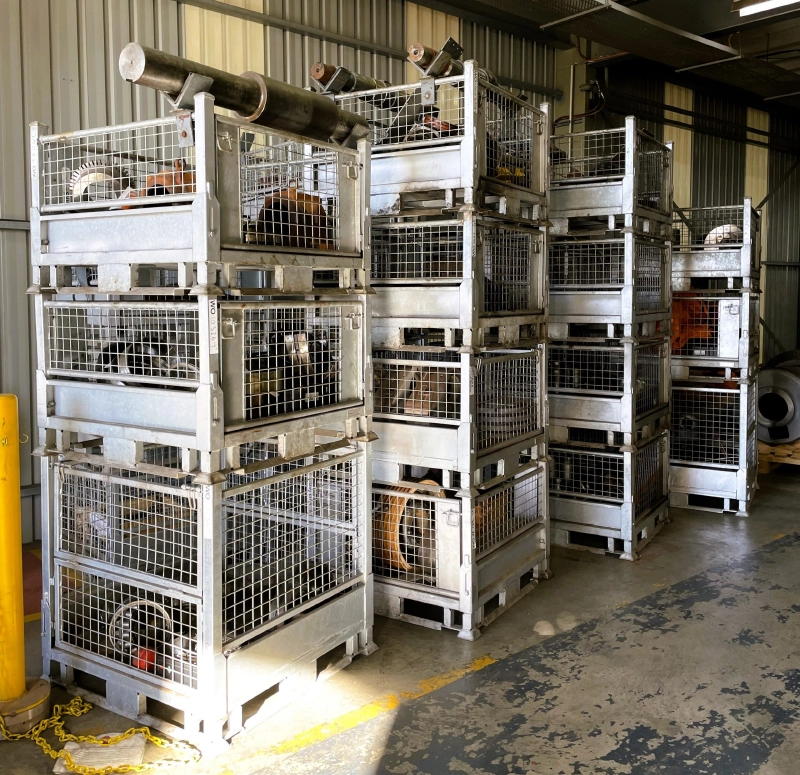
Choose based on stacking, footprint, and access
Project 14452
Mesh-bottom cage for 2-layer storage
Use this project reference when a footprint of 1,200 × 1,000 × 900 mm and a mesh bottom panel are suitable for your industrial parts. The requirement is 2,000 kg per cage, with a recommended safe stacking of 2 layers.
Dimensioni: 200 × 1.000 × 900 mm
Empty weight: 102/110 kg
Required load: 000 kg
Safe stacking indications: 2 layers
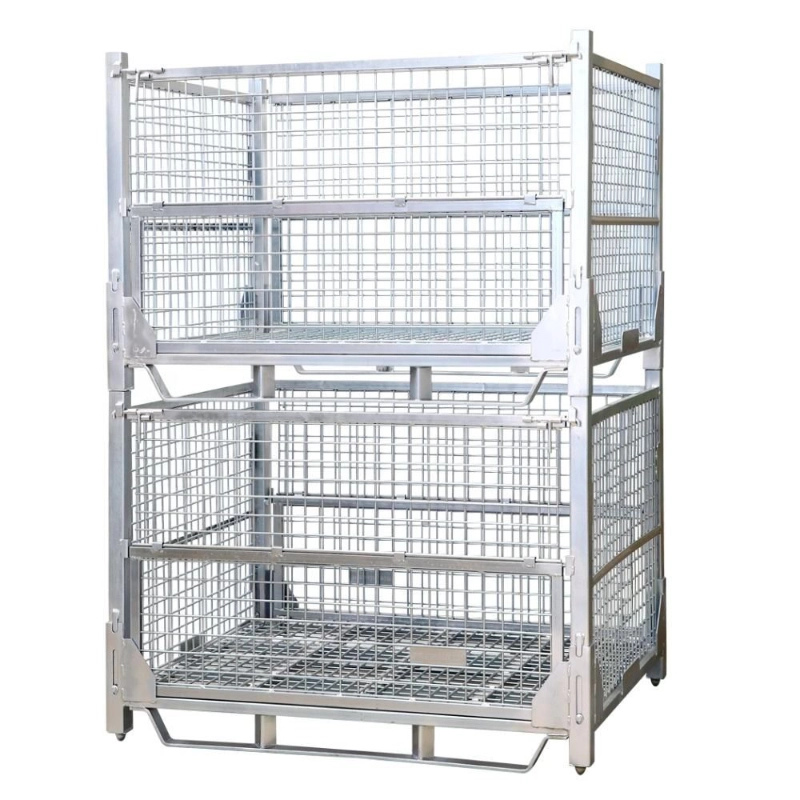
Project 15860
Compact heavy-duty cage for 3-layer stacking
This project reference uses a 1,200 × 1,070 × 700 mm heavy-duty wire mesh container with a load capacity of 2,000 kg, with 3-layer stacking. It also provides a planning reference for export loading.
Dimensioni: 200 × 1.070 × 700 mm
Empty weight: 94 kg
Capacità di carico: 000 kg
Container load: 48 units / 20GP; 126 units / 40HQ
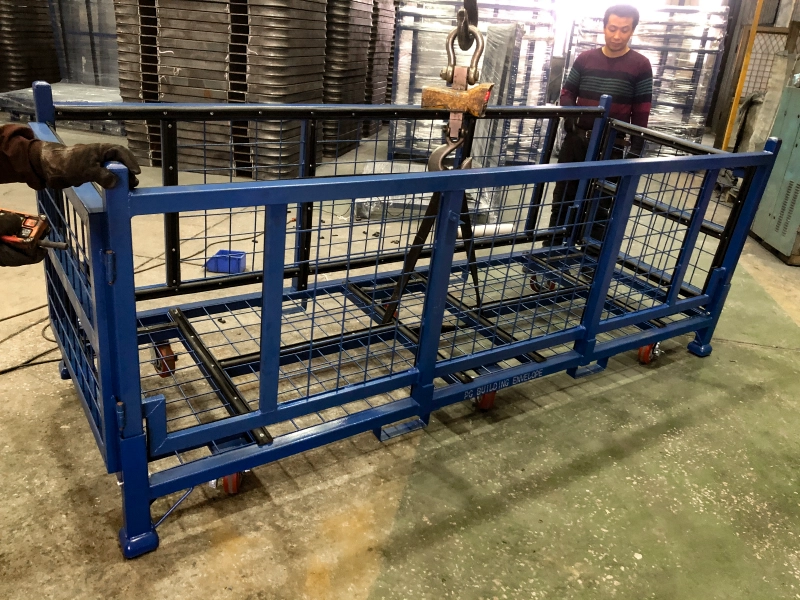 Optional handling
Storage cage with designed lifting provision
The reference images show a custom steel container during a crane lifting test in the factory. If crane handling is required, specify the load, lifting method, center of gravity, and lifting points before project release.
Crane lifting: additional design scope
Possible additions: lifting points or wheels
Do not assume: a storage load capacity equals a lifting load capacity
What makes a 2-ton wire mesh container safe to specify ?
Distributed load versus concentrated load
Uniformly distributed parts use the mesh bottom and frame more predictably. A single part weighing 100–500 kg, a concentrated contact area, or a one-sided load can increase local stress; tell us the part footprint and center of gravity rather than assuming that the entire 2,000 kg load applies unchanged.
Stack according to the stated project limit
For reference 14452, the recommended safe stacking is 2 levels. For 15860, the stated stacking is 3 levels. Do not transfer the 3-level figure to project 14452 or interpret either figure as a universal Mybox rule.
Doors fit the workflow
A front or half-height gate can make loading and unloading heavy parts easier, while a different door arrangement may suit forklift access or side access. The gate style is confirmed based on the part geometry and the handling path.
Storage, wheeled movement, and lifting are different cases
Transfer with a forklift or pallet jack is not the same as crane lifting. Wheels are optional for controlled movement, and lifting points must be designed and confirmed separately when overhead handling is required.
How to request the right heavy-duty container
Describe the parts
Share the part name, maximum single-part weight, quantity per cage, dimensions, contact points, and whether the load is uniform or offset.
Define the stacking target
State whether you need 2 levels, 3 levels, or no full-load stacking. Include floor, rack, aisle, and forklift constraints.
Confirm door and handling
Select the access side and gate type, then confirm handling with forklift, pallet jack, wheels, or overhead crane. Crane lifting requires a separate review of the lifting points.
Review the calculation sheet
Request the 2-ton project calculation sheet and use the approved dimensions, load distribution, door layout, and stacking limit for procurement.
Direct answers on the handling of heavy industrial parts
Can a Mybox safely hold 2,000 kg?
Two project references specify a 2,000 kg requirement or capacity: 14452 uses 1,200 × 1,000 × 900 mm with a tare weight of 102/110 kg, and 15860 uses 1,200 × 1,070 × 700 mm with a tare weight of 94 kg. Final suitability depends on the selected configuration, load distribution, handling method, and approved project calculation.
How many levels can be stacked at 2 tons?
Project limits differ. Project 14452: the recommended safe stacking is 2 levels. Project 15860: stacking is 3 levels. The 15860 figure must not be applied to the 14452 configuration, and neither should be interpreted as a universal guarantee for all heavy-duty wire mesh containers.
What is the difference between uniform load and offset load?
Uniform load distributes weight across the bottom panel and support frame. Offset or point load concentrates force on a smaller area and may change the required base, reinforcements, or stacking design. Provide the load footprint and center of gravity for evaluation.
Are crane lifting points included?
Non automaticamente. Le configurazioni di stoccaggio sopra descritte sono pensate per la movimentazione di pezzi industriali con accesso tramite carrello elevatore o transpallet. I punti di sollevamento, la geometria delle imbracature, il centro di gravità e la portata di sollevamento devono essere specificati e progettati separatamente. Le immagini del sollevamento con gru mostrano una scena di prova di sollevamento personalizzata, non un'approvazione generale al sollevamento per ogni Mybox.
Quale tipo di porta dovrei scegliere?
Scegliere la porta o il cancelletto a metà altezza in base al percorso di carico e prelievo: accesso frontale per carico diretto, accesso laterale per corridoi stretti, o un'altra disposizione confermata in base alla geometria del pezzo. Il tipo di porta è una scelta di progetto e dovrebbe essere inclusa nella richiesta di preventivo.
La gabbia può essere dotata di ruote?
Le ruote sono un'opzione di movimentazione disponibile per spostamenti controllati all'interno dello stabilimento e per il prelievo. Confermare la portata delle ruote, le condizioni del pavimento, la frenatura e se la gabbia verrà spostata vuota o carica. La mobilità su ruote non sostituisce la revisione progettuale per carrello elevatore o gru.
Quante unità 15860 entrano nei container per l'esportazione?
Il riferimento di progetto indica 48 unità in un 20GP e 126 unità in un 40HQ. Considerare questi come i riferimenti di carico dichiarati per quella configurazione; l'imballo finale dipende dallo stato piegato o assemblato, dall'imballaggio e dal piano di spedizione confermato.
Cosa dovrei inviare per un preventivo per 2 tonnellate?
Send the required dimensions, weight and quantity of pieces, load distribution, preference for door or gate, number of stacking levels, details on forklift or pallet truck, any requirements on wheels, and whether crane lifting is needed. We can then return a project-specific calculation sheet and the basis for the quote.