
Kann ein 2-Tonnen-Schwerlast-Drahtgitter-Stillage industrielle Teile sicher halten?
Sehen Sie, wie sich die Mybox 2-Tonnen-Schwerlast-Drahtgitter-Stillage-Projekte 14452 und 15860 in Abmessungen, Lastverteilung, sicheren Stapellagen, Torzugang und Kranhebeanforderungen unterscheiden.
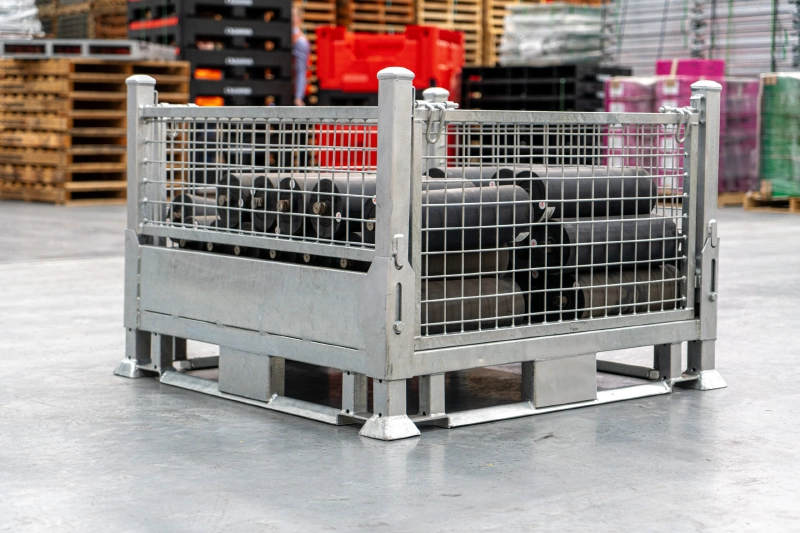
Vote on the Tragfähigkeit on the way your parts are stored
For industrial parts with a unit weight of 100–500 kg, the right question is not just: "Can the cage withstand 2,000 kg?" It is also about how that load is distributed, how many filled cages are stacked, and whether lifting points are required.
Mybox can be configured as a steel pallet cage, metal pallet box, or collapsible stillage for handling with forklifts and pallet jacks. The two 2-ton project references below are deliberately separated: Project 14452 uses a configuration with a mesh floor and a recommended safe stacking of 2 layers, while Project 15860 uses a heavy-duty wire mesh box with a 2,000 kg load capacity and 3-layer stacking. These are project-specific parameters – not a uniform universal load capacity for every Mybox configuration.
- Project 14452: 200 × 1.000 × 900 mm; Eigengewicht 102/110 kg; erforderliche Traglast 2.000 kg; empfohlene sichere Stapelung: 2 Lagen.
- Project 15860: 200 × 1.070 × 700 mm; Eigengewicht 94 kg; Tragfähigkeit 2.000 kg; Stapelung: 3 Lagen; Ladequote: 48 Einheiten in einem 20GP / 126 Einheiten in einem 40HQ.
- Gate and access: Confirm the required gate or half-height folding gate before manufacturing; the gate type affects loading access and must match the handling method of the parts.
- Handling options: Standard forklift pockets support the movement of complete cages; rollers can be added for controlled order picking in the plant. Crane lifting points are an additional requirement and are not included in the 2-ton storage load capacity.
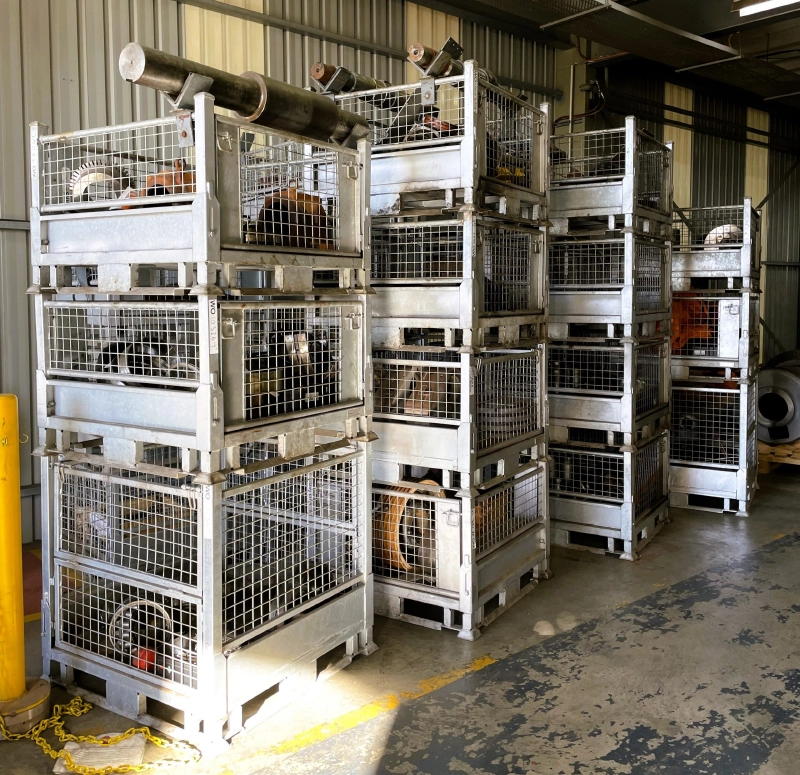
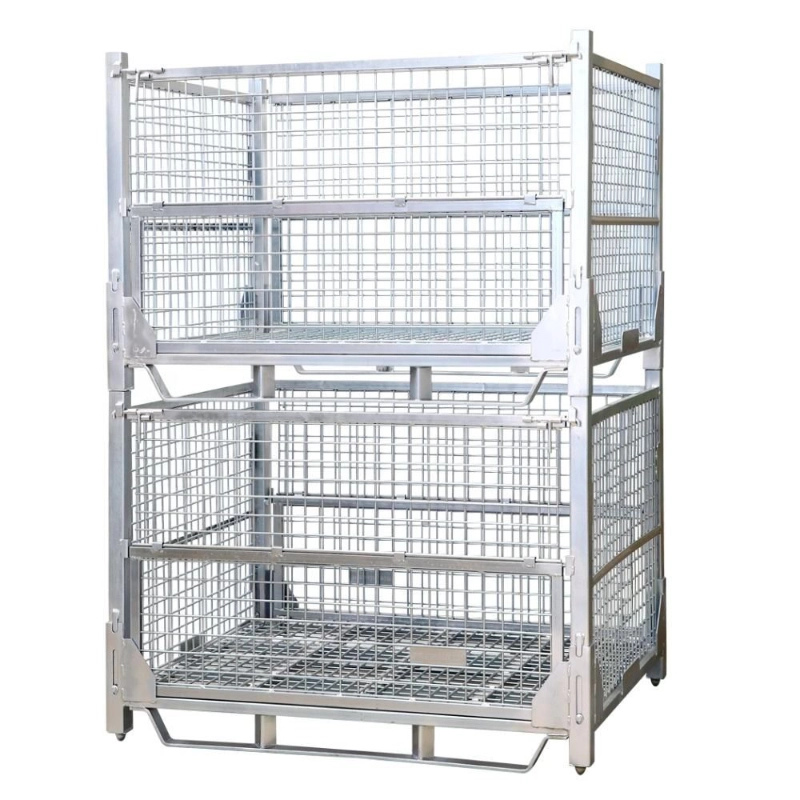
Choose according to Stacking, footprint, and access
Project 14452
Mesh floor cage for 2-layer storage
Use this project reference when a footprint of 1,200 × 1,000 × 900 mm and a mesh floor suit your industrial parts. The requirement is 2,000 kg per cage, with a recommended safe stacking of 2 layers.
Abmessungen: 200 × 1.000 × 900 mm
Own weight: 102/110 kg
Required load capacity: 000 kg
Safe stacking recommendation: 2 layers
Project 15860
Compact heavy-duty cage for 3-layer stacking
This project reference uses a heavy-duty wire mesh stillage with 1,200 × 1,070 × 700 mm and a load capacity of 2,000 kg, with 3-layer stacking. It also provides a planning reference for export loading.
Abmessungen: 200 × 1.070 × 700 mm
Own weight: 94 kg
Tragfähigkeit: 000 kg
Container loading: 48 units / 20GP; 126 units / 40HQ
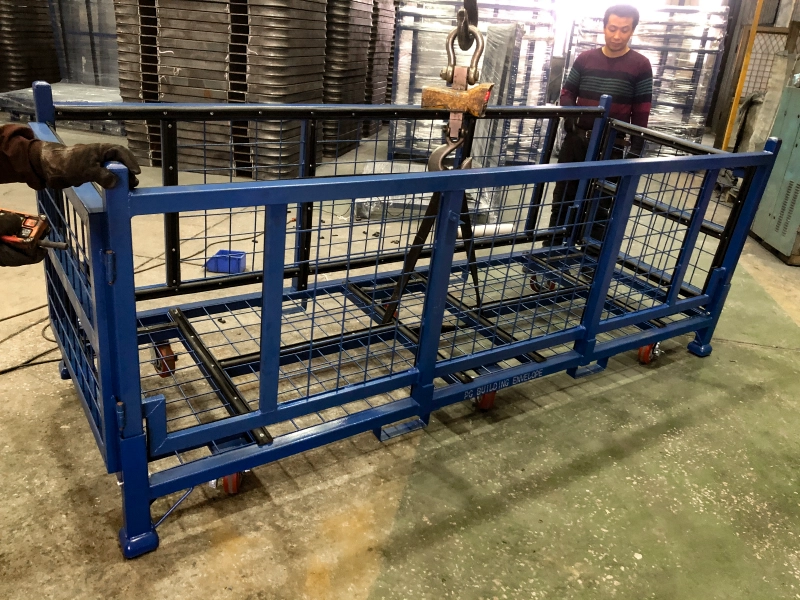 Optional handling
Storage container with structurally provided lifting device
The reference images show a custom steel stillage during a crane lifting test at the factory. If you require handling with an overhead crane, specify the load, the lifting method, the center of gravity, and the lifting points before the design is approved.
Crane lifting: additional design scope
Possible additions: Lifting points or casters
Do not assume: a storage nominal load is not the same as a lifting nominal load
What makes a 2-ton wire mesh stillage specification-safe?
Area load versus point load
Uniformly distributed parts use the mesh floor and the frame more predictably. A single part of 100–500 kg, a concentrated contact area, or one-sided loading can increase local stress. Let us know the contact area and center of gravity of the part instead of assuming that the full 2,000 kg applies unchanged.
Stack according to the specified project limit
For reference 14452, the recommended safe stacking is 2 layers. For 15860, the specified stacking is 3 layers. Do not transfer the 3-layer value to design 14452, and do not regard either value as a general Mybox rule.
Doors match the workflow
A front flap or half drop-down door can make loading and unloading heavy parts easier, while a different door arrangement may be suitable for forklift or side removal. The door style is confirmed based on the part geometry and the handling path.
Storage, rolling, and lifting are different cases
Transferring by forklift or pallet jack is not the same as lifting with a crane. Rollers are optional for controlled movement, and lifting points must be separately designed and confirmed if overhead handling is required.
How to request the right Heavy-duty stillage an
Describe the parts
Provide the part name, maximum individual weight, quantity per container, dimensions, support points, and whether the load is uniform or offset.
Define the stacking target
State whether you need 2 layers, 3 layers, or no filled stacking. Take into account floor, rack, aisle, and forklift constraints.
Confirm the door and handling
Select the access side and door type, then confirm handling by forklift, pallet jack, rollers, or crane. For crane lifting, a separate review of the lifting points is required.
Check the calculation sheet
Request the calculation sheet for the 2-ton project and use the approved dimensions, load distribution, door arrangement, and stacking limit for procurement.
Direct answers for the Handhabung
heavy industrial parts
Can a Mybox safely hold 2,000 kg?
Two project references specify a requirement or capacity of 2,000 kg: 14452 uses 1,200 × 1,000 × 900 mm with a tare weight of 102/110 kg, and 15860 uses 1,200 × 1,070 × 700 mm with a tare weight of 94 kg. Final suitability depends on the selected configuration, load distribution, handling method, and approved project calculation.
How many layers can be stacked at 2 tons?
The project limits are different. Project 14452: The recommended safe stacking is 2 layers. Project 15860: The stacking is 3 layers. The value of 15860 must not be applied to the 14452 configuration, and neither should be read as a general guarantee for all heavy-duty wire mesh containers.
What is the difference between uniform and asymmetric loading?
With uniform loading, the weight is distributed over the floor and the support frame. Asymmetric or point loading concentrates the force on a smaller area and can change the required design of the floor, reinforcement, or stacking. Provide the load footprint and center of gravity for review.
Are crane lifting points included?
Not automatically. The storage designs described above are intended for handling industrial parts with a forklift or pallet jack. Lifting points, sling geometry, center of gravity, and a lifting capacity must be specified and structurally designed separately. The crane lifting images show a custom lifting test scene and not a blanket lifting approval for every Mybox.
Which door type should I choose?
Choose the door or the half-drop gate according to the loading and unloading path: front access for direct loading, side access for a narrow aisle, or another confirmed arrangement for the part geometry. The door type is a project decision and should be specified in the quotation request.
Can the cage be equipped with casters?
Casters are an available handling option for controlled internal movement and order picking. Confirm caster load capacity, floor condition, braking function, and whether the cage is moved empty or loaded. Caster mobility does not replace the design review for forklift or crane.
How many 15860 units fit in export containers?
The project reference states 48 units in a 20GP and 126 units in a 40HQ. Consider these values as specified loading references for this configuration; final packaging depends on whether the units are folded or assembled, on the packaging, and on the confirmed shipping plan.
What should I send for a quotation over 2 tons?
Send the required dimensions, part weight and quantity, load distribution, door or gate preference, stacking layers, forklift or pallet jack data, any caster requirements, and whether crane lifting is required. We can then return a project-specific calculation sheet and a quotation basis to you.