
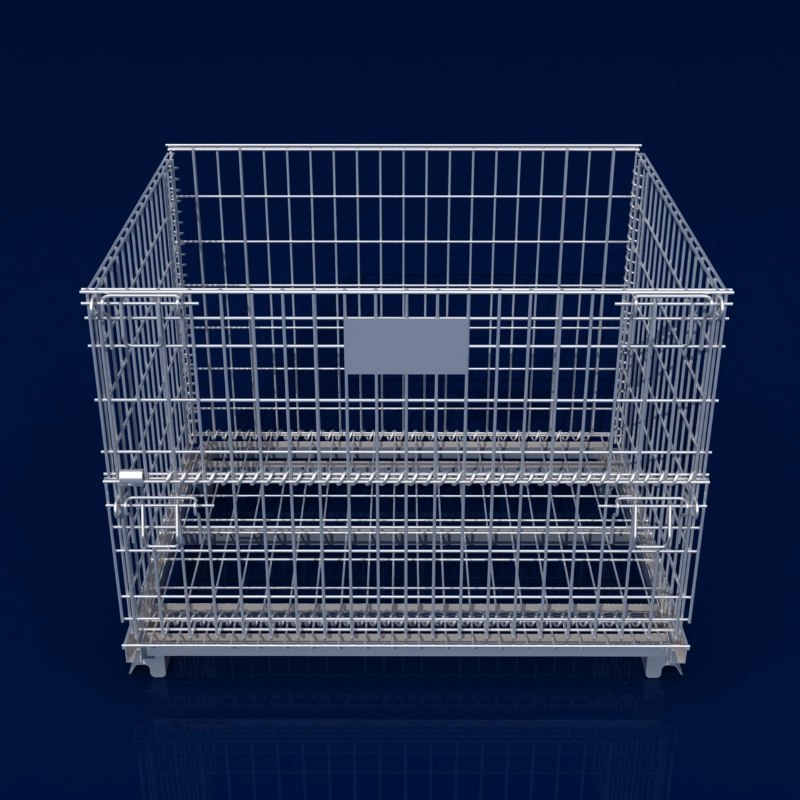
A shortage at the line side, a two-high stack of wire mesh containers for steel, and nobody wants to unload a full cage to find out whether the last batch of castings is actually missing. This is the practical question behind "can I count the pieces inside a wire mesh container without opening it?" — and the honest answer is partly, because it is the mesh that does the work.
On the recorded design configurations of this collapsible wire mesh container, the grid is specified at 50 × 50 mm. That grid gives a supervisor a direct line of sight to the load from the aisle: full, half full, empty, or short at the gate. It is a visual check, not an automatic count. Below: what the grid lets you see, what stops air passing through the mesh, what happens to small parts, how the half-drop gate removes the need to take down the stack, and when a wire mesh container is the wrong choice.
What mesh opening is needed to count pieces without opening the container?
The 50 × 50 mm grid is the specification recorded in the design configurations available for this container — for example the 1000 × 800 × 840 mm, 1050 × 1050 × 1000 mm and 800 × 1200 × 890 mm versions — with recorded wire diameters between 5.8 mm and 6.0 mm. These are design data and not a single universal specification, so the approved drawing for your version is what governs the opening, the wire and the finish.
At the stack, that grid means that any component whose smallest dimension is clearly larger than the opening stays where it was loaded and appears as a visible block of material. Loads organised in layers are the easiest to read: machined cylinders arranged in rows, castings stacked flat, subassemblies packed. A supervisor can walk the row at the start of the shift, see which cages are nearly empty and bring forward the short one without touching a gate.
What the mesh does not give you: the front layer and the top of the load are what you see. Pieces hidden behind the first row, pieces in the lower corner in shadow, and pieces behind the gate frame and the identification plate are not visible, and small loose pieces mixed in a bulk load cannot be counted one by one through the mesh. Visual stock checking through the mesh reduces the number of times a stack has to be broken down to verify a suspicion. It does not replace cycle counting, and no mesh specification turns it into a zero-error count.
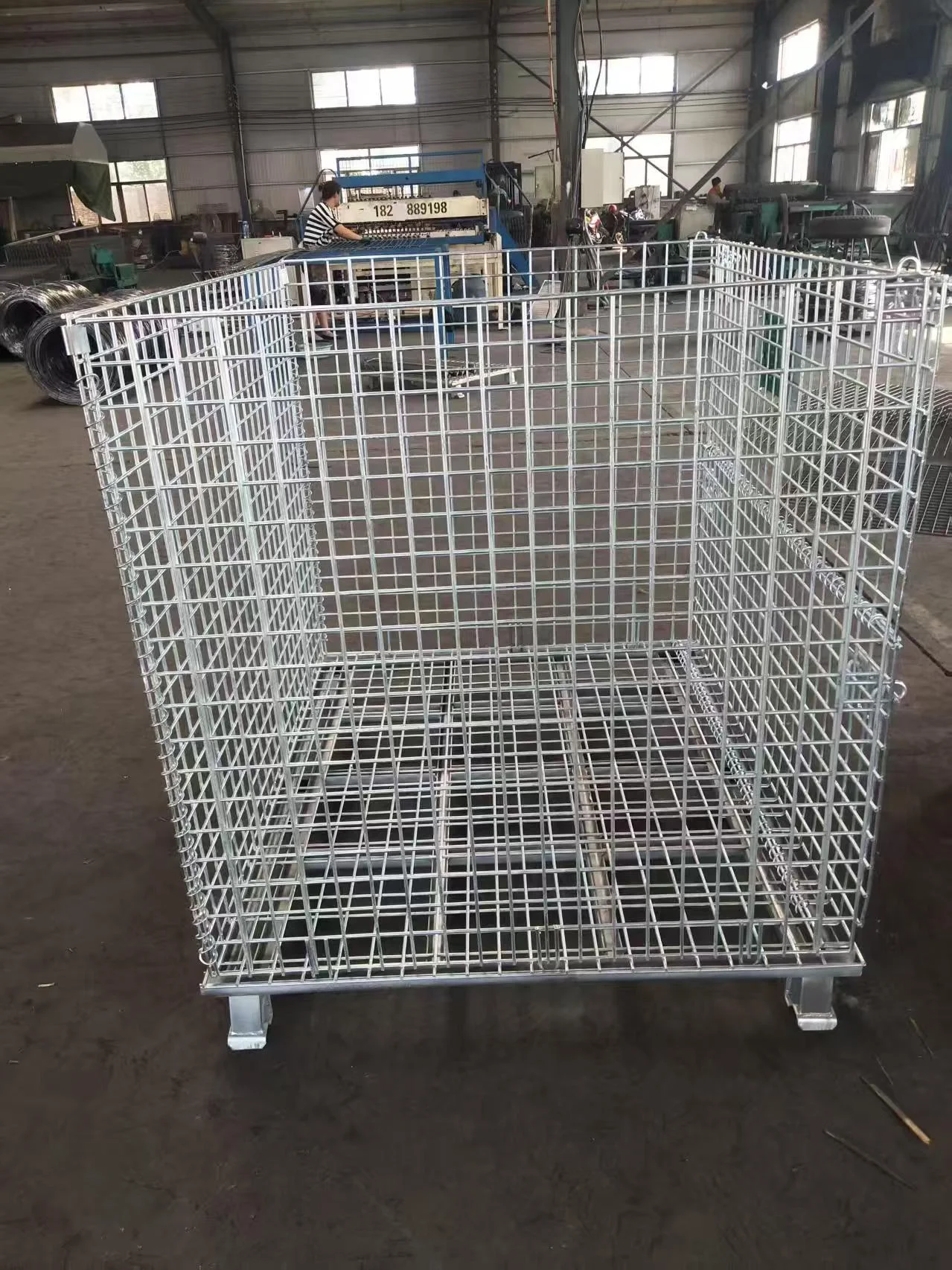
Why open-mesh ventilation matters as much as visibility
A closed panel keeps the load and its microclimate in the same pocket. Moisture evaporating from parts after washing, condensation on cold steel, warm humid air in a semi-outdoor area — inside a sealed container it all stays at the bottom, and the bottom layer is the last place to dry. Mesh faces let air pass through the container, so a load that arrived damp can dry in place, condensation does not sit against machined surfaces, and a wet base or a leaking part is visible from the aisle instead of being discovered the next time the container is opened.
Two limits matter here. First, an open grid is not a dust barrier and is not airtight: dust, splashes and airborne particles pass straight through. Second, corrosion performance in damp or outdoor storage depends on the zinc finish you choose, and the recorded design options are not a single figure — cold galvanising around 10 μm on some versions, hot-dip galvanising around 40 μm on others. Do not treat a single coating thickness as the whole range, and check the finish against the actual storage environment before ordering.
Do small parts fall through the mesh?
They can. If the smallest dimension of a loose part is smaller than the grid opening, it can fall through the bottom or side mesh, and precision parts can also rub against the wire during handling. The recorded data on this container flags both risks. There are three documented ways to manage them:
- PP honeycomb sheet lining. A sheet of honeycomb board mounted inside the cage creates a physical barrier on the faces it lines. The image documents show black and light green linings in this container, used to keep small parts and metal dust away from the mesh and to prevent scratches on precision surfaces.
- Finer mesh. A tighter grid is a design specification rather than a default catalogue option. The opening needed depends on the smallest part you handle, and must be confirmed on the drawing.
- Lid. A lockable top lid is a documented variant of this container. It keeps loose parts inside during handling and closes the top opening when the container is stored or moved.
If the parts are genuinely very small and counting is critical, a lining is a workaround rather than a solution — a closed container is the honest alternative, and it is worth saying so before a batch order.
Taking parts from a stack without unloading the cage
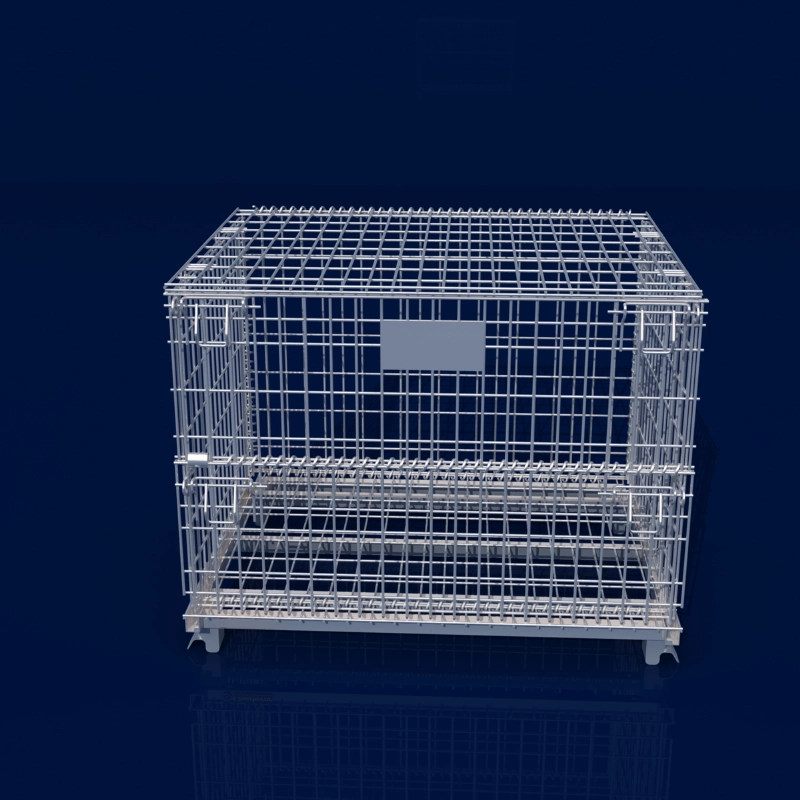
La visibilità risponde alla domanda "manca qualcosa". L'accesso risponde a "come prelevo un pezzo senza smontare la pila". Su questo container la risposta è il cancello a metà altezza: la metà superiore del pannello frontale si ribalta di circa 180°, lasciando un'apertura raggiungibile ad altezza di lavoro, così l'operatore può prelevare da un container impilato senza dover abbassare la pila né ribaltare la gabbia a terra. Due condizioni ne determinano l'efficacia sulla vostra linea — la faccia del cancello deve essere rivolta verso la corsia di prelievo e il pezzo deve essere raggiungibile a mano. I pezzi lunghi, pesanti o ingombranti richiedono comunque un paranco o una faccia diversa.
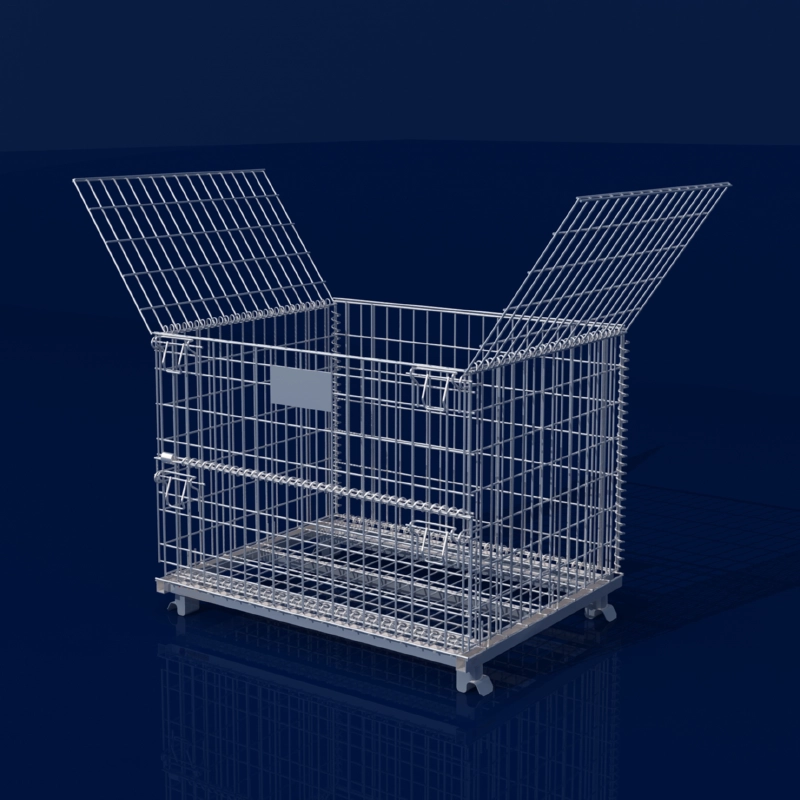
Container in rete metallica vs cassone in acciaio completamente chiuso: cosa cambia davvero
I due design rispondono a esigenze diverse, e la scelta è solitamente dettata dal processo piuttosto che dal prezzo:
- Visibilità. La rete mostra il carico dalla corsia; un cassone chiuso deve essere aperto, oppure controllato per peso o livello.
- Flusso d'aria. La rete ventilata e lascia asciugare un carico umido; un cassone chiuso mantiene un microclima sigillato attorno ai pezzi.
- Polvere e umidità. Un cassone chiuso è una barriera; un container in rete necessita di un rivestimento o di un coperchio quando il controllo della polvere fa parte dei requisiti.
- Sicurezza e contenimento. Un coperchio bloccabile è una variante documentata del container in rete; un cassone completamente chiuso è chiuso per design.
- Dove la rete non è la risposta. Pezzi più piccoli dell'apertura senza rivestimento, carichi sensibili alla polvere e processi che richiedono un container sigillato o opaco.
Questo container è una gabbia di stoccaggio in rete metallica pieghevole e impilabile. Non è una scaffalatura da magazzino, non è una recinzione di sicurezza e non è un cassone in acciaio completamente chiuso — se la specifica richiede la tenuta, specificate un container sigillato invece di aggiungere accessori a una gabbia in rete.
Dove il controllo visivo dell'inventario attraverso la rete dà i suoi frutti
- Buffer di WIP a bordo linea dove un componente mancante ferma una stazione.
- File di gabbie contenenti pezzi cilindrici lavorati, controllati a vista all'inizio del turno e avvicinati quando sono in esaurimento.
- Prelievo attraverso il cancello a metà altezza da un container impilato invece di scaricarlo.
- Aree di spedizione e di ritorno vuoti, dove le gabbie piegate o caricate vengono verificate a vista prima del carico.
Domande frequenti
Posso contare ogni pezzo attraverso la rete senza aprire il container?
No. Consideratelo un controllo visivo con linea di vista libera, non una quantità conteggiata. I pezzi dietro lo strato frontale, nell'angolo inferiore in ombra o dietro il telaio del cancello rimangono invisibili, e i pezzi sciolti mescolati in un carico sfuso non possono essere separati a occhio. Usate la rete per individuare tempestivamente una carenza e per decidere se è necessario aprire il cancello — poi confermate con un conteggio ciclico.
Un container con rete da 50 × 50 mm è a tenuta di polvere?
No. La rete è aperta per design: ventilata il carico e vi permette di vederlo, ma lascia anche passare polvere, spruzzi e particelle fini. Dove il processo richiede una barriera, specificate un rivestimento in PP alveolare, un coperchio o un container chiuso.
Cosa succede se i miei componenti sono più piccoli della griglia?
Allora la griglia non li tratterrà. Le opzioni sono un rivestimento in alveolare all'interno della gabbia, una rete più fine confermata sul disegno, un coperchio per il contenimento dall'alto, o un container chiuso. Quale sia la scelta giusta dipende dalla dimensione dei pezzi, da quanto è critico il conteggio e da quanto deve essere pulita l'area di stoccaggio.
La rete cambia il modo in cui il container viene movimentato?
L'interfaccia di movimentazione resta invariata: le configurazioni di progetto registrate sono gestite con carrello elevatore e transpallet, con limiti di impilamento definiti per progetto. Verificate la geometria d'ingresso, i livelli di impilamento e il carico del container superiore per la vostra realizzazione sul disegno approvato anziché su un dato generico.
Se state dimensionando un buffer a bordo linea o un setup di inventario a vista, gli input utili sono il mix di pezzi, la dimensione minima gestita, l'ambiente di stoccaggio e se la faccia del cancello può essere rivolta verso la corsia. Le configurazioni registrate per il container in rete metallica Stbox sono riassunte sulla pagina prodotto del container in rete metallica pieghevole.
Serve una Soluzione di Stoccaggio Personalizzata?
Parli direttamente con i nostri ingegneri tecnici. Offriamo progetti strutturali gratuiti, valutazioni di cataloghi per carichi pesanti e preventivi B2B rapidi.
Richiedi un Preventivo Ora →