
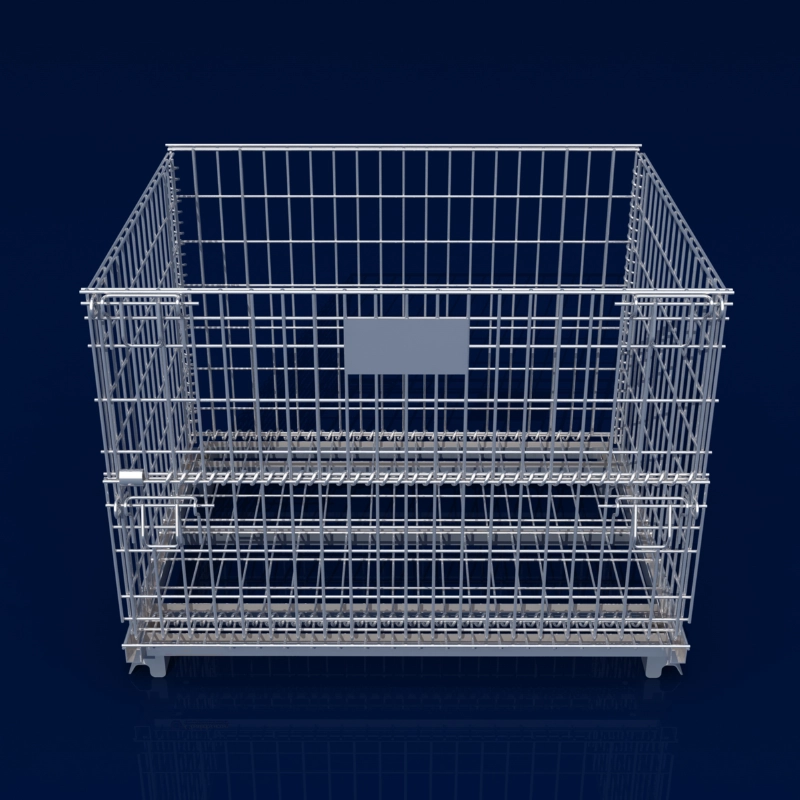
A line-side shortage, a two-high stack of steel wire containers, and nobody wants to unload a full cage to find out whether the last batch of castings is really missing. That is the practical question behind “can I count the parts inside a wire mesh container without opening it?” — and the honest answer is partly, because the mesh is doing the work.
On the recorded project configurations of this collapsible wire mesh container, the grid is specified at 50 × 50 mm. That grid gives a supervisor a direct line of sight to the load from the aisle: full, half full, empty, or short at the gate. It is a visual check, not an automatic count. Below: what the grid lets you see, what airflow through the mesh prevents, what happens to small parts, how the half-drop gate removes unstacking, and when a mesh container is the wrong choice.
What Mesh Opening Do You Need to Count Parts Without Opening the Container?
The 50 × 50 mm grid is the recorded specification across the project configurations held for this container — for example 1000 × 800 × 840 mm, 1050 × 1050 × 1000 mm and 800 × 1200 × 890 mm builds — with wire diameters recorded between 5.8 mm and 6.0 mm. These are project records rather than one universal specification, so the approved drawing for your build is what governs the aperture, the wire and the finish.
At the stack, that grid means any component whose smallest dimension is clearly larger than the opening stays where it was loaded and reads as a visible block of material. Layer-organised loads are the easiest to read: machined cylinders standing in rows, castings stacked flat, boxed sub-assemblies. A supervisor can walk the row at shift start, see which cages are running low and pull the short one forward without touching a gate.
What the mesh does not give you: the front layer and the top of the load are what you see. Parts hidden behind the first row, parts in the shadowed bottom corner, and parts sitting behind the gate frame and the identifier plate are not visible, and loose small parts mixed into a bulk load cannot be counted one by one through wire. Visual inventory control through the mesh cuts the number of times a stack has to be broken to check a suspicion. It does not replace cycle counting, and no mesh specification turns it into a zero-error count.
Why Open Mesh Ventilation Matters as Much as the Visibility
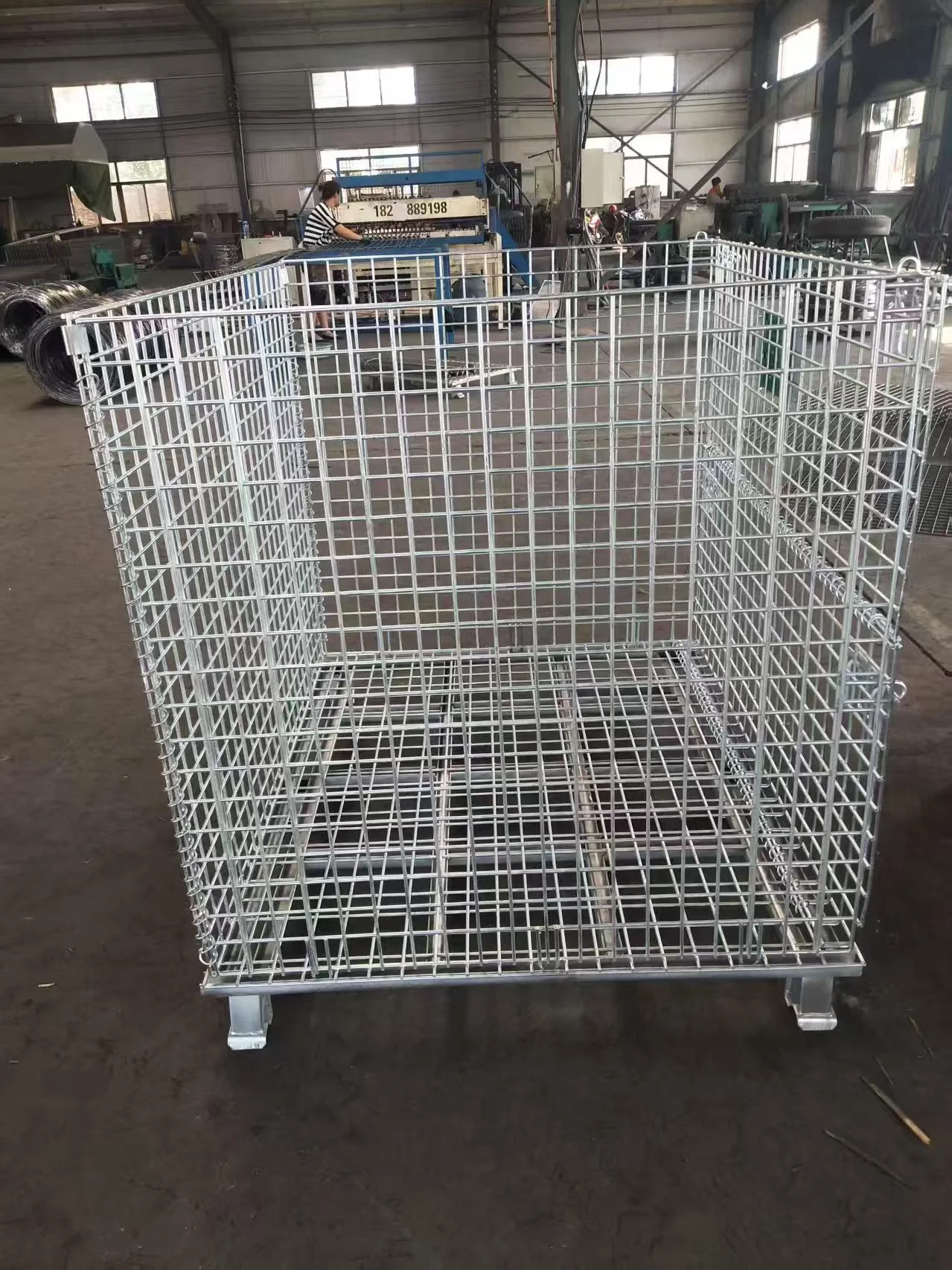
A closed panel keeps the load and its microclimate in the same pocket. Moisture evaporating off parts after washing, condensation on cold steel, warm humid air in a semi-outdoor yard — inside a sealed container all of it stays at the bottom, and the bottom layer is the last place to dry. Mesh faces let air move through the container, so a load that came in damp can dry in place, condensation does not sit against machined surfaces, and a wet base or a leaking part is visible from the aisle instead of being discovered the next time the container is opened.
Two boundaries matter here. First, an open grid is not a dust barrier and not watertight: dust, spray and airborne particles pass straight through. Second, corrosion performance in humid or outdoor staging follows the zinc finish you select, and the recorded project options are not one number — cold galvanizing around 10 μm on some builds, hot-dip galvanizing around 40 μm on others. Do not treat a single coating thickness as the range, and confirm the finish against the actual storage environment before ordering.
Will Small Parts Fall Through the Mesh?
They can. If the smallest dimension of a loose part is smaller than the grid opening, it can drop through the bottom or the side mesh, and precision parts can also rub against wire during handling. The recorded notes on this container flag both risks. There are three documented ways to handle it:
- PP hollow-board liner. A hollow-board sheet fitted inside the cage creates a physical barrier on the faces you line. Image records show black and light green liners in this container, used to keep small parts and metal dust off the mesh and to stop scratching on precision surfaces.
- Finer mesh. A tighter grid is a project specification rather than a catalogue default. The aperture you need follows the smallest part you handle, and it has to be confirmed on the drawing.
- Lid. A lockable top lid is a documented variant of this container. It keeps loose parts inside during handling and closes the top opening when the container is stored or moved.
If the parts are genuinely tiny and the count is critical, a liner is a workaround rather than a solution — a closed container is the honest alternative, and it is worth saying so before a batch order.
Getting Parts Out of a Stack Without Unloading the Cage
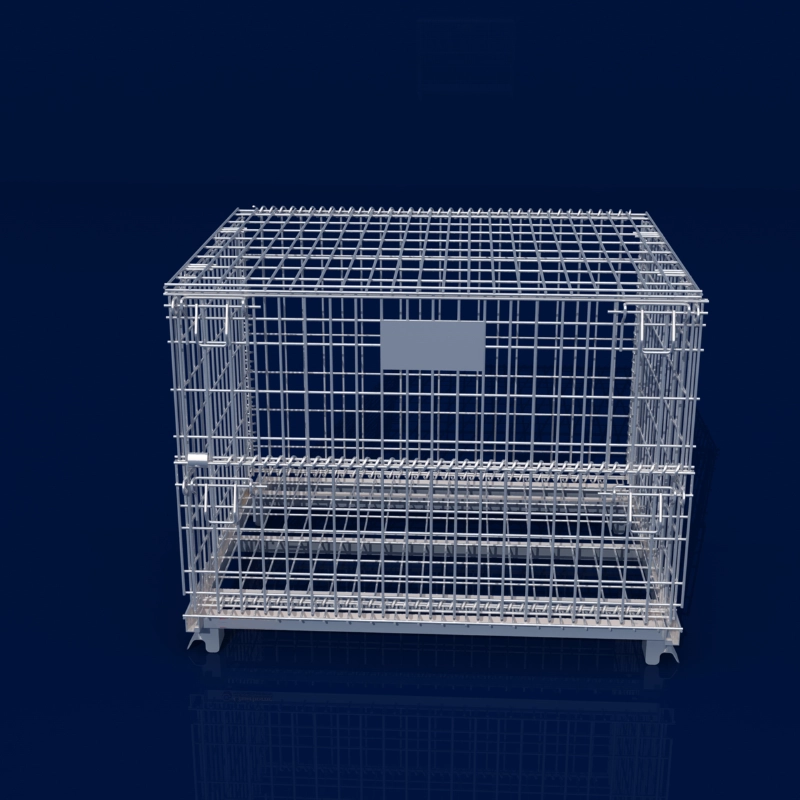
Visibility answers “is anything missing”. Access answers “how do I take one part without breaking the stack”. On this container the answer is the half-drop gate: the upper half of the front panel folds down about 180°, leaving a reach-through opening at working height, so an operator can pick from a stacked container without lowering the stack or tipping the cage onto the floor. Two conditions decide whether it works on your line — the gate face has to point at the pick aisle, and the part has to be reachable by hand. Long, heavy or awkward parts still need a hoist or a different face.
Wire Mesh Container vs Fully Enclosed Steel Bin: What Actually Changes
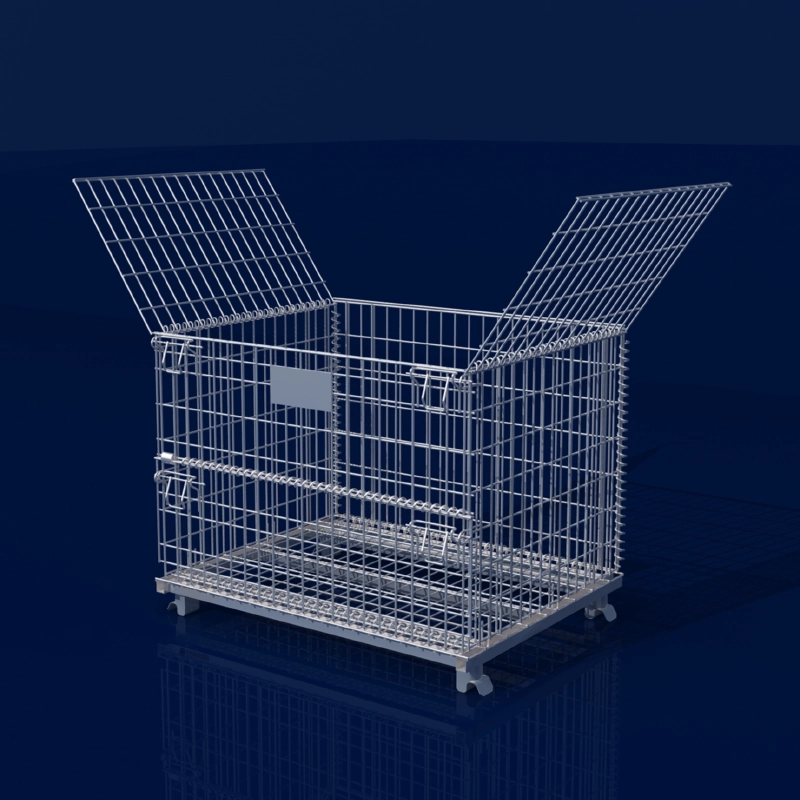
The two designs answer different requirements, and the choice is usually decided by the process rather than the price:
- Visibility. Mesh shows the load from the aisle; a closed bin has to be opened, or checked by weight or level.
- Airflow. Mesh ventilates and lets a damp load dry; a closed bin holds a sealed microclimate around the parts.
- Dust and moisture. A closed bin is a barrier; a mesh container needs a liner or a lid when dust control is part of the requirement.
- Security and containment. A lockable lid is a documented variant of the mesh container; a fully enclosed bin is closed by design.
- Where mesh is not the answer. Parts smaller than the opening with no liner, dust-sensitive loads, and processes that require a sealed or opaque container.
This container is a collapsible, stackable wire mesh storage cage. It is not warehouse racking, not a safety fence and not a fully enclosed steel bin — if the specification says sealed, specify a sealed container instead of adding accessories to a mesh cage.
Where Visual Inventory Control Through the Mesh Pays Off
- Line-side WIP buffers where one missing component stops a station.
- Rows of cages holding machined cylindrical parts, checked visually at shift start and pulled forward when low.
- Picking through the half-drop gate from a stacked container instead of unloading it.
- Dispatch and empty-return areas, where folded or loaded cages are confirmed by sight before loading.
FAQ
Can I count every part through the mesh without opening the container?
No. Treat it as a visual check with a clear line of sight, not a counted quantity. Parts behind the front layer, in the shadowed bottom corner or behind the gate frame stay invisible, and loose parts mixed into a bulk load cannot be separated by eye. Use the mesh to spot a shortage early and to decide whether the gate needs to be opened — then confirm with a cycle count.
Is a 50 × 50 mm mesh container dust-proof?
No. The mesh is open by design: it ventilates the load and lets you see it, and it also lets dust, spray and fine particles through. Where the process needs a barrier, specify a PP hollow-board liner, a lid, or a closed container.
What if my components are smaller than the grid?
Then the grid will not hold them. The options are a hollow-board liner inside the cage, a finer mesh confirmed on the drawing, a lid for top containment, or a closed container. Which one is right depends on part size, how critical the count is, and how clean the storage area has to be.
Does the mesh change how the container is handled?
The handling interface is unchanged: recorded project configurations are handled by forklift and pallet jack, with stacking limits set per project. Confirm the entry geometry, the stack tiers and the upper-container load for your build on the approved drawing rather than on a generic figure.
If you are sizing a line-side buffer or a visual-inventory setup, the useful inputs are the part mix, the smallest dimension you handle, the storage environment and whether the gate face can point at the aisle. The recorded configurations for the Stbox wire mesh container are summarised on the collapsible wire mesh container product page.
Need a Custom Storage Solution?
Speak directly with our technical engineers. We offer free structural designs, heavy-duty catalog evaluations, and quick B2B price quotations.
Request a Quote Now →