
When a plant handles many reel diameters, the rack decision is no longer one rack per size. The real question is how to group reels into layers, how to set the 100 mm support pitch, and when a main frame with auxiliary bays can increase usable density without turning the aisle into a bottleneck.
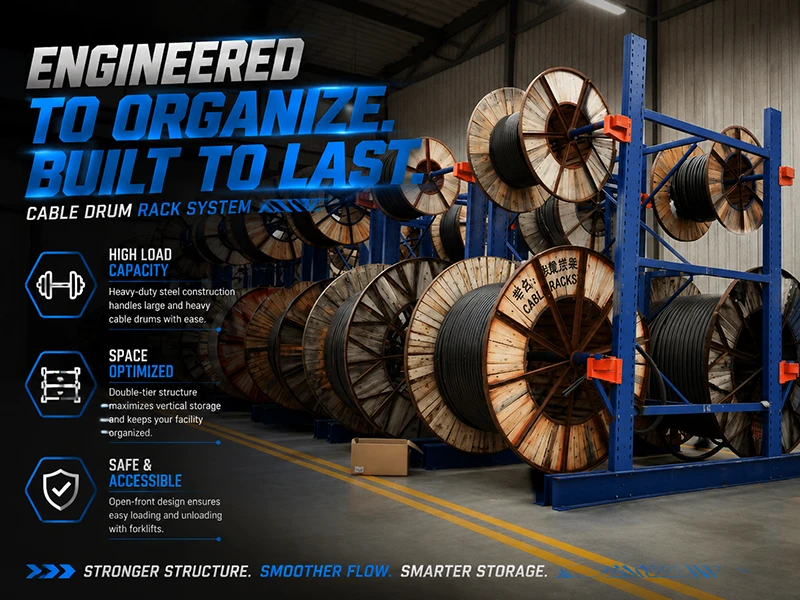
Plants handling mixed reel families usually lose time at the same point: diameter changes impose a new storage rule, a new picking path, or a new rack. A better approach is to treat the rack as an adjustable system. In the Carack layout, the support bracket sits on a perforated upright, and the roller seat can be repositioned in 100 mm steps. This allows one frame family to hold reels from approximately Ø737 to Ø2007 mm without building a separate rack line for each diameter.
Group reels by diameter range, then assign the level
Start with two ranges instead of a long list. Larger reels go on the lower level because they are harder to lift, create a lower center of gravity, and require a clearer approach for the forklift. Smaller reels can go on the upper level if the shaft line still meets the support rollers cleanly. In practice, one pair of supports must be treated as one reel seat, unless otherwise agreed in the design. This keeps the loading path simple and prevents the rack from becoming a custom puzzle at every picking point.
Set the support pitch on the reel centerline, not on the catalog size
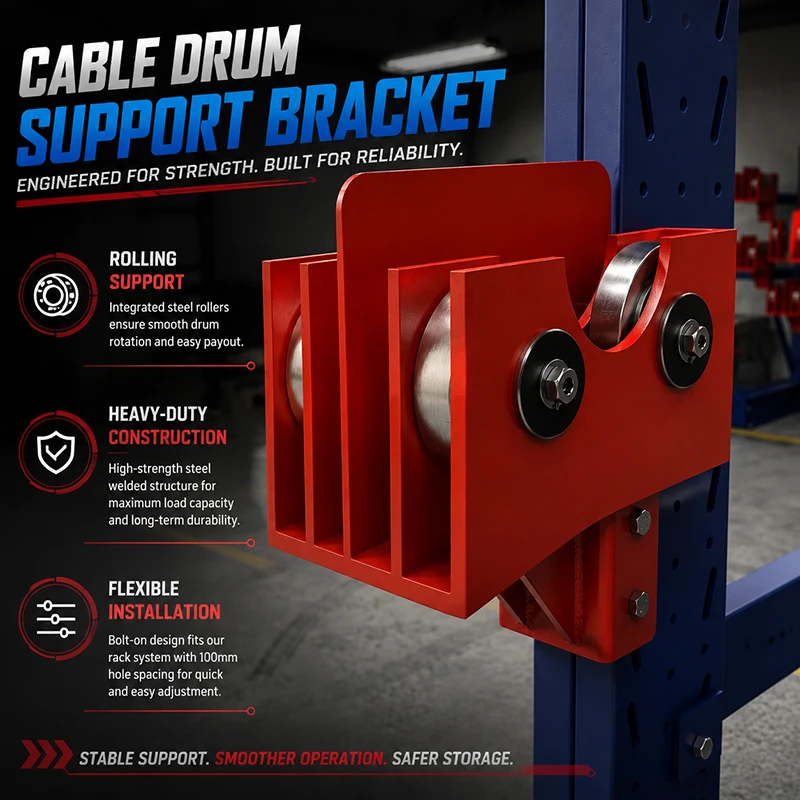
The useful number is not a rack size. It is the height of the support line relative to the reel centerline. The 100 mm pitch matters because it allows small corrections without changing the entire frame. For a plant with mixed reels, this means the same upright can be adjusted for different core heights, while the roller bracket keeps the contact surface aligned. The close-up photo of the bracket shows the bolted roller assembly: double metal rollers, heavy mounting bolts, and a blue upright. This is the mechanical reason why the rack can be adjusted without relying on a fixed cradle.
Use the lower level for heavy reels and the upper level for lighter ones
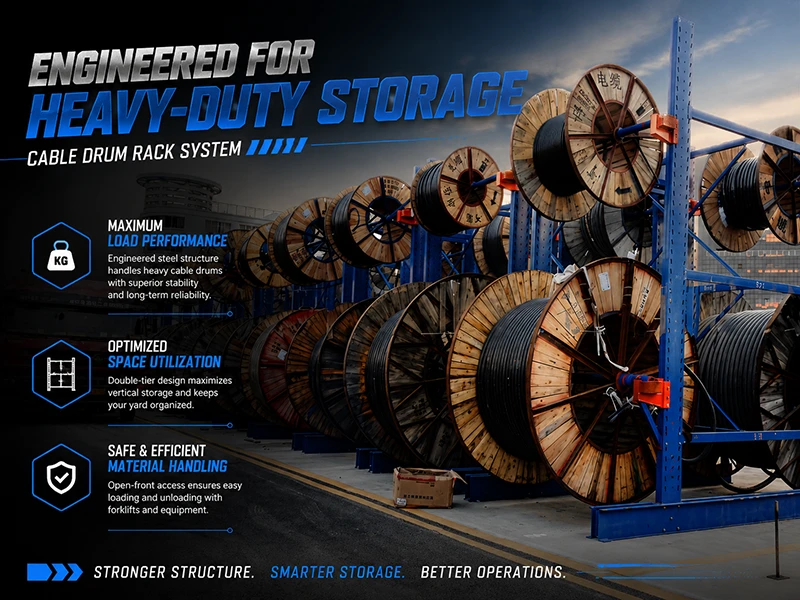
For a mixed inventory from Ø737–2007 mm, the lower level should carry the largest and heaviest reels because it is safer for handling and easier to reach with a cart or forklift. The upper level should not be treated as extra space at all costs. It is the level for reels that can be lifted, rotated, and repositioned without pushing the operator into awkward reach zones. This is where the structure shown in the aisle photo matters: the braced frame keeps the bay rigid while multiple reel sizes sit in one continuous run.
What does the auxiliary bay really add?
An auxiliary bay adds density when it eliminates duplication. If every reel diameter has its own isolated rack line, the plant pays twice: once in steel and once in aisle space. A main frame with auxiliary bays combines sizes into one organized lane, so the density gain comes from reducing empty gaps and redundant aisles. The exact increase is not a catalog number. It depends on the reel mix, aisle width, and how many diameters can share the same support logic. That is why the final number of levels and the load limit must be set in the technical agreement, not copied from a general brochure.
Where this layout fits and where it does not
This layout fits when the plant has mixed reel sizes, frequent handling, and a need to keep storage in one aisle. It is not the right choice when each reel family must be stored in a separate certified cell, when core width is very irregular, or when outdoor exposure requires an anti-corrosion package that has not been approved. In these cases, the frame concept remains the same, but coating, anchoring, and number of levels must be rechecked before release.
Planning checklist for a mixed-reel rack
- Confirm the reel diameter range and group sizes before defining level height.
- Use 100 mm support adjustments to align the reel centerline instead of forcing a fixed cradle.
- Put heavier reels on the lower level and keep forklift access clear.
- Let auxiliary bays increase density by eliminating duplicate rack lines, not by overloading one bay.
FAQ
How many reels should I place on one level?
There is no universally safe answer. A conservative layout treats one pair of supports as one reel seat, then checks whether smaller reels can share the same bay after verifying centerline and clearance. The final count must follow the design agreement.
Is the 100 mm support pitch a fixed catalog promise?
No. It is a practical adjustment method. The pitch gives the installer room to align rollers to different reel geometries, but the final setting still depends on reel diameter, core width, and the handling method defined for the project.
Serve una Soluzione di Stoccaggio Personalizzata?
Parli direttamente con i nostri ingegneri tecnici. Offriamo progetti strutturali gratuiti, valutazioni di cataloghi per carichi pesanti e preventivi B2B rapidi.
Richiedi un Preventivo Ora →