
When a plant handles many reel diameters, the rack decision is no longer one rack per size. The real question is how to group reels into layers, how to set the 100 mm support pitch, and when a master frame with auxiliary bays can raise usable density without turning the aisle into a bottleneck.
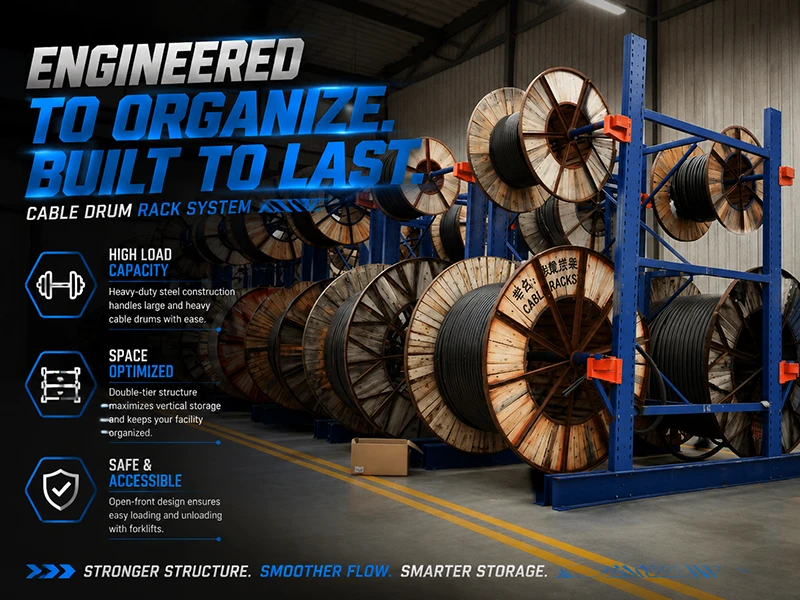
Plants that run mixed reel families usually lose time in the same place: diameter changes force a new storage rule, a new pick path, or a new rack. A better approach is to treat the rack as an adjustable system. In the Carack layout, the support bracket sits on a punched upright, and the roller seat can be repositioned in 100 mm steps. That lets one frame family hold reels from roughly Ø737 to Ø2007 mm without building a separate rack line for every diameter.
1. Group reels by diameter band, then assign the tier
Start with two bands instead of one long list. Larger reels belong on the lower tier because they are harder to lift, create a lower center of gravity, and need a clearer forklift approach. Smaller reels can go on the upper tier if the shaft line still meets the support rollers cleanly. In practice, one support pair should be treated as one reel seat unless the project agreement says otherwise. That keeps the load path simple and prevents the rack from becoming a custom puzzle at every pick point.
2. Set the support pitch to the reel centerline, not the catalog size
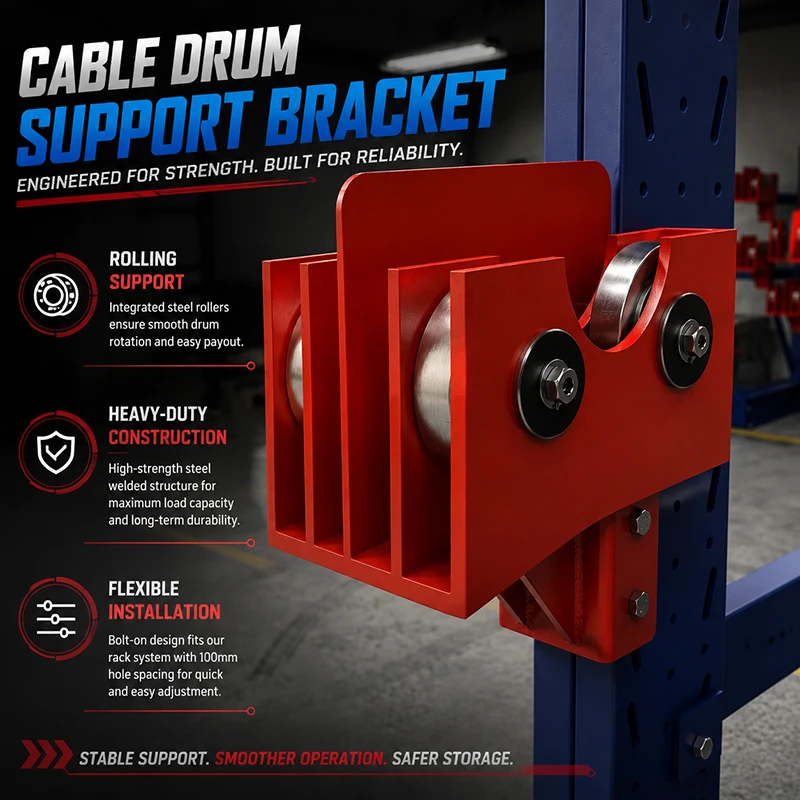
The useful number is not one rack size. It is the support line height relative to the reel centerline. The 100 mm pitch matters because it allows small corrections without changing the whole frame. For a mixed reel plant, that means the same upright can be tuned for different core heights, while the roller bracket keeps the contact surface aligned. The close-up bracket photo shows the bolt-on roller assembly: twin metal rollers, heavy mounting bolts, and a blue upright. That is the mechanical reason the rack can be adjusted without relying on a fixed cradle.
3. Use the lower tier for the heavy reels and the upper tier for the lighter ones
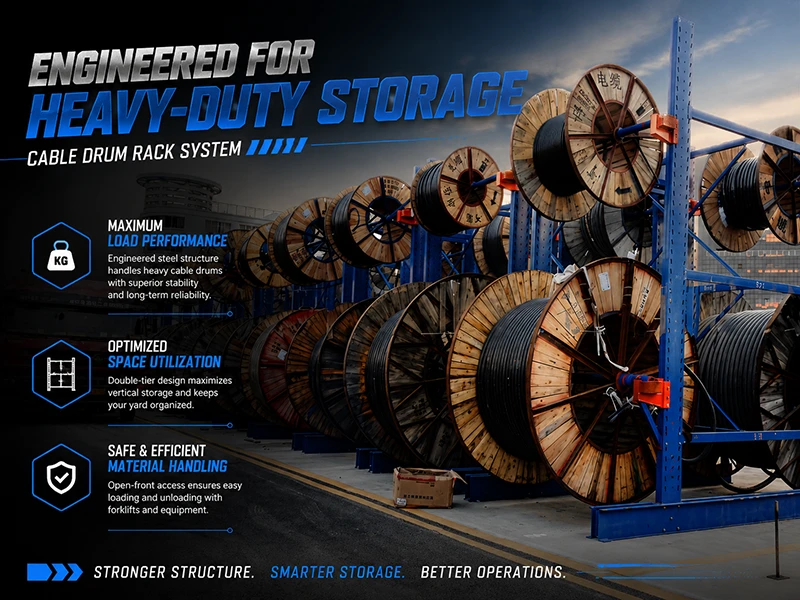
For mixed Ø737–2007 mm inventory, the lower tier should carry the biggest and heaviest reels because it is safer for handling and easier to access with a truck or forklift. The upper tier should not be treated as extra storage at any cost. It is the tier for reels that can be lifted, rotated, and returned without pushing the operator into awkward reach zones. This is where the structure shown in the aisle photo matters: the braced frame keeps the bay rigid while multiple reel sizes sit in one continuous run.
4. What does the auxiliary bay actually add?
An auxiliary bay adds density when it removes duplication. If every reel diameter gets its own isolated rack line, the plant pays twice: once in steel and once in aisle space. A master frame with auxiliary bays combines sizes into one organized lane, so the density gain comes from reducing dead gaps and redundant aisles. The exact uplift is not a catalog number. It depends on reel mix, aisle width, and how many diameters can share the same support logic. That is why the final layer count and load limit must still be set in the technical agreement, not copied from a general brochure.
5. Where this layout fits, and where it does not
This layout is a good fit when the plant has mixed reel sizes, frequent movement, and a need to keep storage inside one aisle. It is not the right choice when every reel family must be stored in a separate certified cell, when core width is highly irregular, or when outdoor exposure needs a corrosion package that has not been signed off. In those cases, the frame concept stays the same, but coating, anchoring, and layer count must be rechecked before release.
Planning checklist for a mixed-reel rack
- Confirm the reel diameter range and group sizes before you define tier height.
- Use 100 mm support adjustments to match the reel centerline instead of forcing one fixed cradle.
- Put the heaviest reels on the lower tier and keep forklift access clear.
- Let auxiliary bays increase density by removing duplicate rack lines, not by overpacking one bay.
FAQ
How many reels should I place on one layer?
There is no safe universal answer. A conservative layout treats one support pair as one reel seat, then checks whether smaller reels can share the same bay after the centerline and clearance are verified. The final count must follow the project agreement.
Is the 100 mm support pitch a fixed catalog promise?
No. It is a practical adjustment method. The pitch gives the installer room to align the rollers to different reel geometries, but the final setting still depends on the reel diameter, core width, and handling method defined for the project.
Need a Custom Storage Solution?
Speak directly with our technical engineers. We offer free structural designs, heavy-duty catalog evaluations, and quick B2B price quotations.
Request a Quote Now →