QUICK CHANGE MOLD WAREHOUSE
Make every mold position visible before the next change
When molds are mixed on the floor, the slow part of a change is often finding and exposing the right tool, not lifting it. Erack assigns each mold a defined bay and allows the selected drawer to slide fully forward for direct lifting.
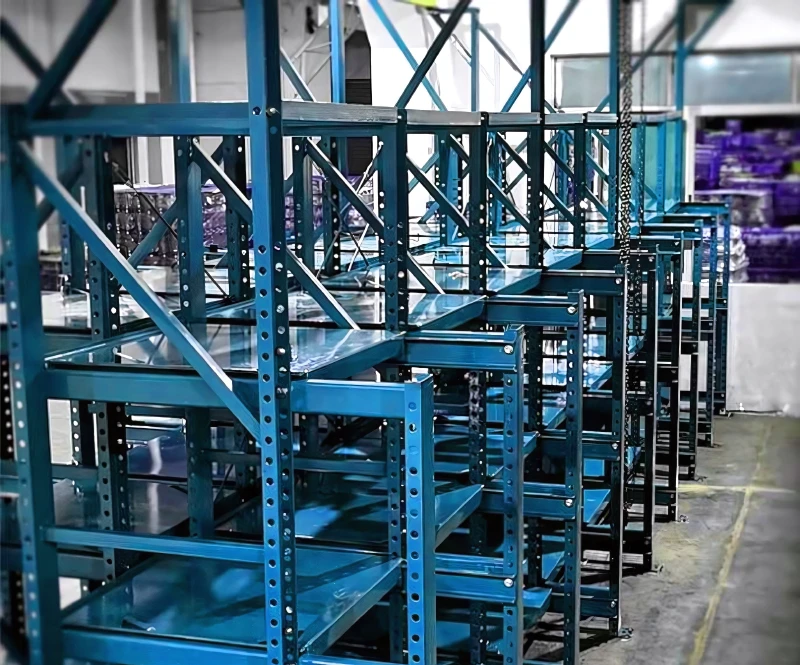
Erack is a heavy-duty drawer rack for storing injection molds and press molds. Instead of stacking molds where the upper tool hides the lower one, the system separates molds into individual pull-out bays. A selected drawer can be fully extracted, so the operator can identify the mold, check its position, and present it to an overhead crane or electric chain hoist without first clearing a pile on the floor. The rack is a fixed industrial system: the site requires a suitable hardened floor for anchoring and a compatible lifting path above the rack. Use the main Erack product page for the product overview, then send a list of molds and change frequency for a layout recommendation.

- Full drawer access exposes one mold bay at a time for faster identification and direct handling.
- Three-column steel support and drawer-level safety devices are designed for heavy mold storage; final capacity and number of levels must be verified against each mold list.
- The layout can be coordinated with an overhead crane or chain hoist so the lifting path is vertical rather than dependent on a wide aisle for forklift maneuvering.
Choose the storage and handling configuration around your change process

Manual pull-out drawer rack
Suitable for sites where operators can safely pull the selected drawer, empty or loaded, and an overhead lifting device handles the mold. It does not replace a crane, hoist, floor anchoring, or a site-specific load review.

Pneumatic-assisted pull-out rack
Use pneumatic assistance when the team needs to reduce manual pulling effort or when an EHS review limits manual handling. Air supply, cylinder selection, speed control, and guarding must be confirmed during the engineering review.

Crane-ready change bay
For frequent injection or press mold changes, position the rack within a verified overhead crane or electric hoist path. The rack supports mold access; it does not replace lifting equipment or approve a lifting plan.

Modular multi-bay layout
For a growing mold library, connect bays and set levels based on actual mold dimensions. Number of tiers, drawer tolerances, total rack length, aisle width, and anchor layout are RFQ decisions, not assumptions based on a standard photo.
Why a pull-out mold rack supports SMED thinking
Stop searching through mixed floor storage
A dedicated bay assigns each mold a defined address. Identification labels can work with the rack, but the rack also removes the physical obstacle caused by stacking one tool in front of another.
Exposes the selected mold with a single horizontal movement
Full drawer access makes the mold visible from the aisle and presents it for vertical lifting. This eliminates the need to move surrounding molds simply to reach the one scheduled for the next job.
Keeps the change path focused on the mold
With the rack positioned next to a verified lifting path, the process can be designed as identify, unlock, extract, lift, and transfer. This supports SMED improvement work without declaring a fixed time saving for every factory.
Protects the process with mechanical controls
Safety pins, support structure, anchoring, and a controlled one-drawer-at-a-time operating sequence are part of the engineering boundary. Operators must not pull multiple fully loaded drawers together.
Make space and handling decisions based on data
The correct number of levels and bay arrangement depend on mold mass, dimensions, usage frequency, crane coverage, floor conditions, and required passage space. Erack is beneficial when these constraints justify a heavy fixed system—not simply because a rack is available.
Domande da risolvere prima dell'acquisto per la velocità di cambio
Perché il cambio stampo è lento quando gli stampi sono conservati a terra?
I cumuli a terra mescolano gli strumenti, nascondono gli stampi inferiori e costringono il team a liberare spazio prima del sollevamento. L'accesso del carrello elevatore può anche richiedere un corridoio di manovra più ampio. Le sole etichette migliorano l'identificazione ma non eliminano il blocco fisico e la movimentazione causata dallo stoccaggio impilato.
Come un cassetto a estrazione completa abbrevia la ricerca e il recupero di uno stampo?
Il cassetto assegna a uno stampo una baia definita e sposta lo strumento selezionato in piena vista. L'operatore può confermare lo stampo prima del sollevamento, quindi utilizzare la rotta della gru o dell'argano verificata per sollevare verticalmente. Il miglioramento effettivo del tempo dipende dalle condizioni iniziali, dalle dimensioni dello stampo, dal personale e dal processo di sollevamento.
Come supporta Erack il SMED?
Fornisce l'hardware per un flusso di preparazione esterna ripetibile: assegna lo stampo a una baia visibile, esponilo senza muovere gli strumenti adiacenti e posizionalo sotto una rotta di sollevamento compatibile prima che la macchina si fermi. Supporta il SMED; non garantisce di per sé un tempo di cambio particolare.
Quanti livelli mi servono, e ogni livello può sostenere qualsiasi stampo?
No. Il numero di livelli, l'altezza libera, la dimensione del cassetto, il rinforzo e il carico nominale devono essere progettati partendo dalle dimensioni, dalla massa, dai punti di supporto dello stampo più grande e dal layout del rack. Il livello finale e la tabella di capacità devono essere confermati nella richiesta di preventivo.
Quale attrezzatura di sollevamento è richiesta?
Il sistema è pensato per funzionare con una gru a soffitto o un argano a catena elettrico che possa raggiungere il cassetto completamente esteso selezionato e sollevare lo stampo attraverso un percorso verticale sicuro. Conferma l'altezza del gancio, la capacità di sollevamento nominale, gli accessori, il percorso, le protezioni e le interferenze con le attrezzature di produzione. Erack non è un sostituto delle attrezzature di sollevamento.
Quando le etichette sono sufficienti, e quando dovremmo considerare Erack o l'automazione?
Ground storage with clear labels can be sufficient when the mold population is small, use is infrequent, each tool remains safely accessible, the floor and lifting method are controlled, and finding a mold does not interrupt production. Consider Erack when molds are frequently mixed or blocked, floor area is limited, forklift access creates delays, or a repeatable changeover route is a priority. Evaluate automation only after measuring demand, identity control, crane or robot interfaces, programming, integration costs, and required operating time.