
🏭 Steelpallet · Factory Direct · OEM Available

Mold Storage for Fast Changeover | Erack Roll-Out Mold Rack
Erack

See how Erack full-extension mold rack drawers support faster injection and stamping changeovers by making each mold visible, crane-ready, and individually accessible. Review SMED planning, level selection, anchoring, and when floor labels or automation may be enough.

100%
Steel Quality
Heavy
Duty Rating
Custom
Sizes Built
Mold Storage for Fast Changeover | Erack Roll-Out Mold Rack

Make every mold location visible before the next changeover

When molds are mixed on the floor, the slow part of a changeover is often finding and exposing the right tool—not lifting it. Erack gives each mold a defined bay and lets the selected drawer roll fully forward for a direct lift.

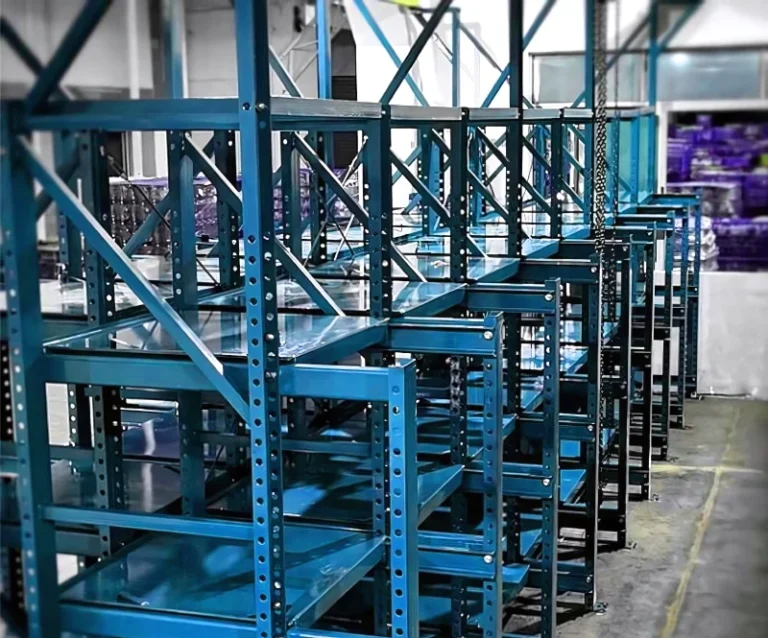
Erack is a heavy-duty drawer mold rack for injection mold storage and stamping-die storage. Instead of stacking molds where the upper tool hides the lower one, the system separates molds into individual roll-out bays. A selected drawer can be pulled to full extension, so the operator can identify the mold, check its position, and present it to an overhead crane or electric chain hoist without first clearing a floor pile. The rack is a fixed industrial system: the site needs a suitable hardened floor for anchoring and a compatible lifting route above the rack. Use the <a href="/erack-pdp-01/">core Erack product page</a> for the product overview, then send a mold list and changeover frequency for a layout recommendation.

Blue three-post roll-out mold racks with fully extended drawers in an industrial workshop

  • Full-extension drawer access exposes one mold bay at a time for faster identification and direct handling.
  • Three-post steel support and drawer-level safety locking hardware are designed for heavy mold storage; final capacity and level count must be checked against each mold list.
  • The layout can be coordinated with an overhead crane or chain hoist so the lifting path is vertical rather than dependent on a wide forklift turning aisle.

Choose the storage and handling setup around your changeover process

Blue three-post die roll-out rack with overhead crane rail, ball bearing rollers, and safety pin

Manual roll-out drawer rack

A fit for sites where operators can safely pull the selected unloaded or loaded drawer and an overhead lifting device handles the mold. It is not a substitute for a crane, hoist, floor anchoring, or a site-specific load review.

Blue three-post mold rack render with overhead crane, adjustable levels, and full-extension drawers

Pneumatic-assisted roll-out rack

Use pneumatic assistance when the team needs to reduce manual pulling effort or when an EHS review limits manual handling. The air supply, cylinder selection, speed control, and guarding must be confirmed during engineering review.

Overhead chain hoist above a heavy-duty mold rack with blue Q235B steel frame

Crane-ready changeover bay

For frequent injection or stamping changeovers, place the rack within a verified overhead crane or electric hoist route. The rack supports access to the mold; it does not replace lifting equipment or approve a lifting plan.

Blue three-post roll-out mold rack with overhead crane track in workshop

Modular multi-bay layout

For a growing mold library, connect bays and set levels around actual mold dimensions. The number of tiers, drawer clearances, total rack length, aisle width, and anchor layout are RFQ decisions—not assumptions from a standard photo.

Why a roll-out mold rack supports SMED thinking

Stop searching through mixed floor storage

A dedicated bay gives each mold a defined address. Identification labels can work with the rack, but the rack also removes the physical obstruction caused by stacking one tool in front of another.

Expose the selected mold in one horizontal movement

Full-extension drawer access makes the mold visible from the aisle and presents it for a vertical lift. That removes the need to move surrounding molds simply to reach the one scheduled for the next job.

Keep the changeover path focused on the mold

With the rack positioned beside a verified lifting route, the process can be designed as identify, unlock, roll out, lift, and transfer. This supports SMED improvement work without claiming a fixed time saving for every factory.

Protect the process with mechanical controls

Safety pins, support structure, anchoring, and a controlled one-drawer-at-a-time operating sequence are part of the engineering boundary. Operators must not pull multiple fully loaded drawers together.

Make space and handling decisions from evidence

The right tier count and bay arrangement depend on mold mass, dimensions, frequency, crane coverage, floor condition, and required aisle clearance. Erack is valuable when these constraints justify a fixed heavy-duty system—not simply because a rack is available.

Build the fast-changeover layout from your actual mold list

  1. 1. Map the current delay

    List where molds are stored, how often each mold is used, how long operators spend finding or exposing it, and where forklifts or temporary staging interrupt the changeover route. If floor stacking plus clear labels already gives safe, quick access for a low-frequency operation, a rack may not be necessary.

  2. 2. Define loads and operating method

    Provide each mold's maximum length, width, height, mass, support points, and lifting method. Use this information to select the number of levels, drawer clearances, reinforcement, required aisle, and whether manual roll-out or pneumatic assistance is appropriate.

  3. 3. Verify the floor and lifting route

    Confirm overhead crane or electric hoist coverage, hook height and travel, lifting accessories, floor hardness and thickness, anchor positions, and safe separation from production traffic. A site without suitable anchoring or a verified lifting route is not ready for this system.

  4. 4. Pilot and request the layout

    Assign a bay and label for each mold, train the team to release the safety pin and operate one drawer at a time, then review the identify-to-lift sequence against the SMED work breakdown. Submit the mold list, changeover frequency, floor plan, crane information, and staging points for a layout recommendation; see <a href="/erack-pdp-04/">PDP-04</a>, <a href="/erack-blog-03/">BLOG-03</a>, and <a href="/erack-case-02/">CASE-02</a>.

Questions to settle before buying for changeover speed

Why is mold changeover slow when molds are stored on the floor?

Floor piles mix tools, hide lower molds, and force the team to clear space before lifting. Forklift access can also require a wider turning aisle. Labels alone improve identification but do not remove the physical blocking and rehandling caused by stacked storage.

How does a full-extension drawer shorten finding and retrieving a mold?

The drawer gives one mold a defined bay and moves the selected tool into full view. The operator can confirm the mold before lifting, then use the verified crane or hoist route to lift vertically. The actual time improvement depends on the starting condition, mold size, staffing, and lifting process.

How does Erack support SMED?

It provides hardware for a repeatable external preparation flow: assign the mold to a visible bay, expose it without moving adjacent tools, and stage it under a compatible lifting route before the machine stops. It supports SMED; it does not by itself guarantee a particular changeover time.

How many levels do I need, and can each level carry any mold?

No. Level count, clear height, drawer size, reinforcement, and rated load must be designed from the largest mold dimensions, mass, support points, and the rack layout. The final level and capacity schedule must be confirmed in the RFQ.

What lifting equipment is required?

The system is intended to work with an overhead crane or electric chain hoist that can reach the selected fully extended drawer and lift the mold through a safe vertical path. Confirm hook height, rated lifting capacity, accessories, travel, guarding, and interference with production equipment. Erack is not a replacement for lifting equipment.

When are labels enough, and when should we consider Erack or automation?

Floor stacking with clear labels may be enough when the mold population is small, usage is infrequent, every tool remains safely accessible, the floor and lifting method are controlled, and finding a mold does not disrupt production. Consider Erack when molds are frequently mixed or blocked, floor area is constrained, forklift access creates delay, or a repeatable changeover route is a priority. Evaluate automation only after measuring demand, identity control, crane or robot interfaces, scheduling, integration cost, and required uptime.

Request Pricing Details


    Request Quote List

    Your quote request list is empty.

    Unlock Professional Blueprint Drawings

    Please provide your business contact information to retrieve original CAD/DWG drawings and engineering calculations.