Mold Storage for Quick Change
Make every mold location visible before the next changeover
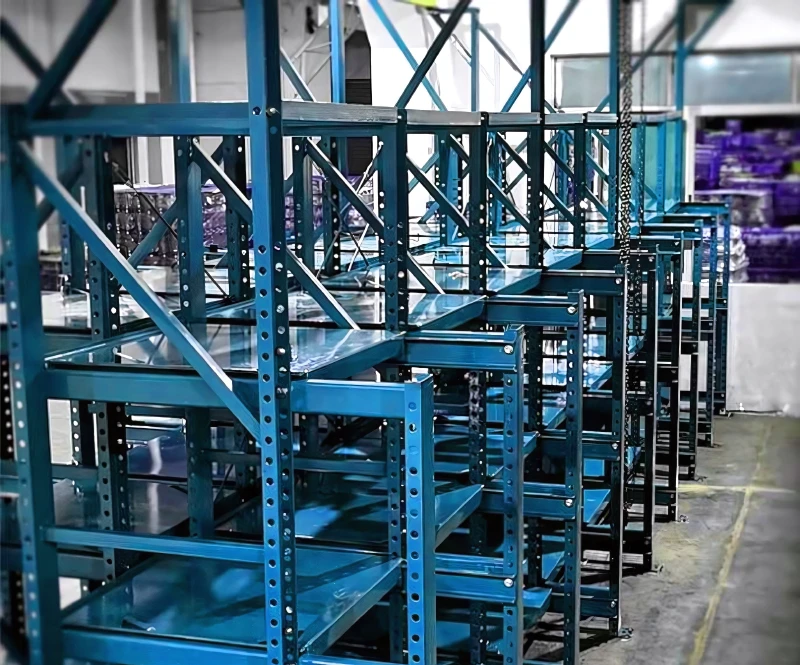
When molds are mixed on the floor, the slow part of a changeover is often finding and exposing the correct tool – not lifting it. The Erack gives each mold a defined bay and allows the selected drawer to roll fully forward for direct lifting.
The Erack is a heavy-duty drawer mold rack for storing injection and stamping molds. Instead of stacking molds where the top tool hides the bottom one, the system separates molds into individual extraction bays. A selected drawer can be pulled to full extension, so the operator can identify the mold, check its position, and present it to an overhead crane or electric hoist without first clearing a pile on the floor. The rack is a fixed industrial system: the location requires a suitable hardened floor for anchoring and a compatible lifting route above the rack. Use the Erack main product page for the product overview, then send a list of molds and changeover frequency for a layout recommendation.

- Full-extension drawer access exposes one mold bay at a time for faster identification and direct handling.
- Three-column steel support and safety locking hardware at drawer level are designed for heavy mold storage; final capacity and number of levels must be verified against each mold list.
- The layout can be coordinated with an overhead crane or hoist so the lifting path is vertical, rather than relying on a wide aisle for forklift maneuvering.
Choose the storage and handling configuration around your changeover process

Manual extraction rack
Suitable for locations where operators can safely pull the selected drawer unloaded or loaded and an overhead lifting device handles the mold. It does not replace a crane, hoist, floor anchoring, or a site-specific load review.

Pneumatic-assisted extraction rack
Use pneumatic assistance when staff need to reduce manual pulling effort or when an EHS review limits manual handling. Air supply, cylinder selection, speed control, and guarding must be confirmed during the engineering review.

Crane-ready changeover bay
For frequent injection or stamping changeovers, position the rack within a verified overhead crane or electric hoist route. The rack supports mold access; it does not replace lifting equipment or approve a lifting plan.

Modular multi-bay layout
For a growing mold library, connect bays and adjust levels around actual mold dimensions. Number of tiers, drawer clearances, total rack length, aisle width, and anchoring layout are RFQ decisions – not assumptions from a standard photo.
Why an extraction mold rack supports SMED thinking
Stop searching in mixed floor storage
A dedicated bay gives each mold a defined address. Identification labels can work with the rack, but the rack also removes the physical obstruction caused by stacking one tool in front of another.
Expose the selected mold in a single horizontal movement
Full-extension drawer access makes the mold visible from the aisle and presents it for vertical lifting. This removes the need to move surrounding molds simply to access the one scheduled for the next job.
Keep the changeover path focused on the mold
With the rack positioned beside a verified lifting route, the process can be designed as identify, unlock, extract, lift, and transfer. This supports SMED improvement work without claiming a fixed time saving for every plant.
Protect the process with mechanical controls
Safety pins, support structure, anchoring, and a controlled operating sequence of one drawer at a time are part of the engineering boundary. Operators must not pull multiple fully loaded drawers together.
Make space and handling decisions based on evidence
The correct number of tiers and bay arrangement depend on mass, dimensions, frequency, crane coverage, floor condition, and required aisle clearance. The Erack is valuable when these constraints justify a fixed high-strength system – not simply because a rack is available.
Questions to resolve before purchasing for changeover speed
Why is mold changeover slow when molds are stored on the floor?
Pilhas no chão misturam ferramentas, escondem moldes inferiores e forçam a equipe a limpar espaço antes de levantar. O acesso da empilhadeira também pode exigir um corredor de manobra mais largo. Etiquetas melhoram a identificação, mas não removem o bloqueio físico e o manuseio adicional causados pelo armazenamento empilhado.
Como uma gaveta de extensão total encurta o tempo para encontrar e recuperar um molde?
A gaveta dá a cada molde uma baía definida e move a ferramenta selecionada para visibilidade total. O operador pode confirmar o molde antes de levantar, depois usar a rota verificada da guindaste ou guincho para levantar verticalmente. A melhoria real de tempo depende da condição inicial, tamanho do molde, dimensionamento da equipe e processo de levantamento.
Como o Erack suporta o SMED?
Ele fornece hardware para um fluxo de preparação externa repetível: atribuir o molde a uma baía visível, expô-lo sem mover ferramentas adjacentes e prepará-lo sob uma rota de levantamento compatível antes da máquina parar. Ele suporta o SMED; não garante por si só um tempo de troca específico.
Quantos andares preciso, e cada andar pode carregar qualquer molde?
Não. O número de andares, altura livre, tamanho da gaveta, reforço e carga nominal devem ser projetados a partir das maiores dimensões, massa, pontos de suporte dos moldes e do layout da prateleira. A programação final de andares e capacidade deve ser confirmada no pedido de cotação.
Que equipamento de levantamento é necessário?
O sistema destina-se a trabalhar com uma guindaste ou guincho elétrico que possa alcançar a gaveta selecionada totalmente estendida e levantar o molde por um caminho vertical seguro. Confirme a altura do gancho, capacidade nominal de levantamento, acessórios, percurso, proteção e interferência com equipamentos de produção. O Erack não substitui equipamentos de levantamento.
Quando etiquetas são suficientes, e quando devemos considerar o Erack ou automação?
O empilhamento no chão com etiquetas claras pode ser suficiente quando a população de moldes é pequena, o uso é infrequente, cada ferramenta permanece acessível com segurança, o piso e o método de levantamento são controlados, e encontrar um molde não interrompe a produção. Considere o Erack quando os moldes são frequentemente misturados ou bloqueados, a área do piso é restrita, o acesso da empilhadeira cria atrasos, ou uma rota de troca repetível é uma prioridade. Avalie a automação apenas após medir a demanda, controle de identidade, interfaces de guindaste ou robô, agendamento, custo de integração e tempo de atividade necessário.