
Two projects can ask for the same thing in words — “a rack for our cable drums” — and end up needing two different machines. In the first, the reel is a load: it goes in, it comes out, and the cable is drawn somewhere else. In the second, the reel is a dispenser: it stays parked on the structure while cable is pulled off its flange. The steel frame may look similar in both cases, but the support hardware, the bay geometry and the operator routine are not interchangeable.
This article sets out the selection logic we use before a cable reel storage rack is quoted: define the action first, configure the rack around that action, then check honestly whether the rack is still the right device or whether the job has moved into payout machinery territory. Carack is a fixed modular steel rack with optional roller-bearing reel supports; it is not an automated cable carousel, winder or payout machine, and the boundary is stated below rather than blurred.
Start with the action, not the rack
Before any dimension is discussed, write down which of these three sentences describes your cable flow. The answer selects the equipment family, not just a model.
| Aktion | What the reel does | What the equipment must provide |
|---|---|---|
| Whole-reel transfer | Reel is loaded, stored, then lifted out and moved to a decoiler, trolley or another building | Open forklift approach, a support geometry the reel can enter and leave cleanly, aisle and travel clearance |
| In-place payout on the rack | Reel stays on the rack and turns slowly while cable is drawn off the flange by hand or by a downstream line | Roller-bearing support brackets at both ends, a free cable path away from steelwork, adjustable bracket height |
| Controlled payout process | Reel must pay off at a defined tension, speed or measured length, or stop in a controlled way | Braking, tensioning, guiding and measuring hardware — a dedicated payout or de-reeling station, not a storage rack |
A site frequently needs the first two in the same building: some reels are stored for dispatch, others are put into service from the rack. That is a layout decision, and it is worth separating those positions from the start rather than retrofitting them later.
Process A — the reel leaves the rack
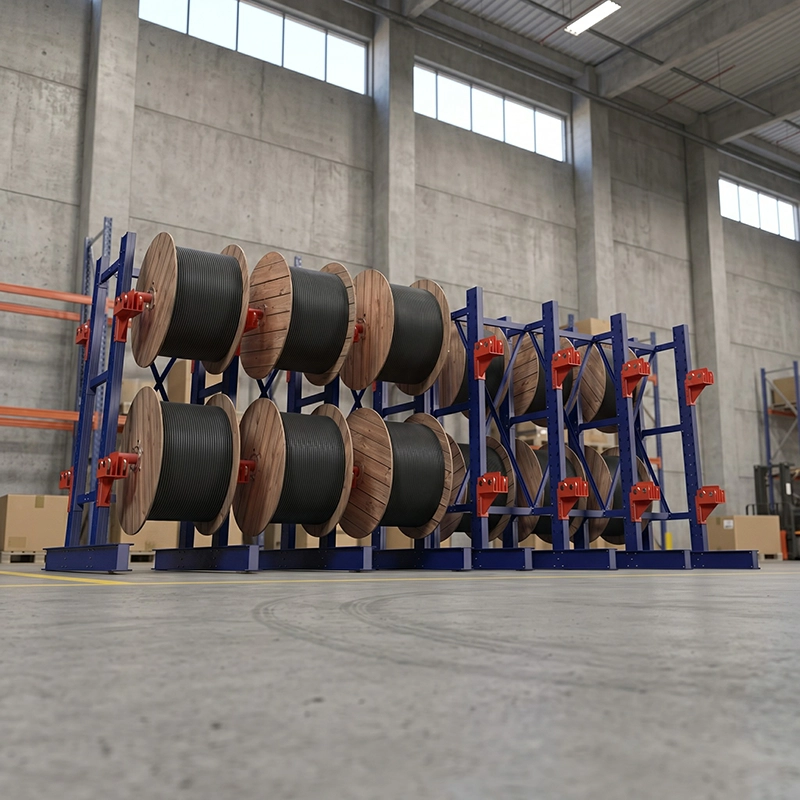
When the reel is only a stored item, the rack is a dense, defined storage location and the real design work sits on the handling side. On one recorded project the reel positions themselves were straightforward, but a second row would have left roughly 1,550 mm of aisle in a 10 × 4.3 m area — too little for the truck to work — so the proposal used a single row per area and applied the same subtraction to the 10 × 3.9 m area. The number that decided the layout was aisle width, not bay count.
For a removal process, the configuration questions are therefore: how far does the mast need to enter the bay, is the base beam low enough for the fork carriage to sit under the reel spindle, does the support arrangement let the reel be picked up and set down without side-shifting into the neighbouring position, and what does the reel weigh once loaded. Documented reel lists on our projects have run from roughly 500 kg to 3,000 kg per reel, with outside diameters from 737 mm to 2,007 mm — a spread large enough that a bay designed around the small end will not accept the large end. Confirm the figures for your own reels; no general rated load per bay is published here.
Process B — the reel stays and turns in place
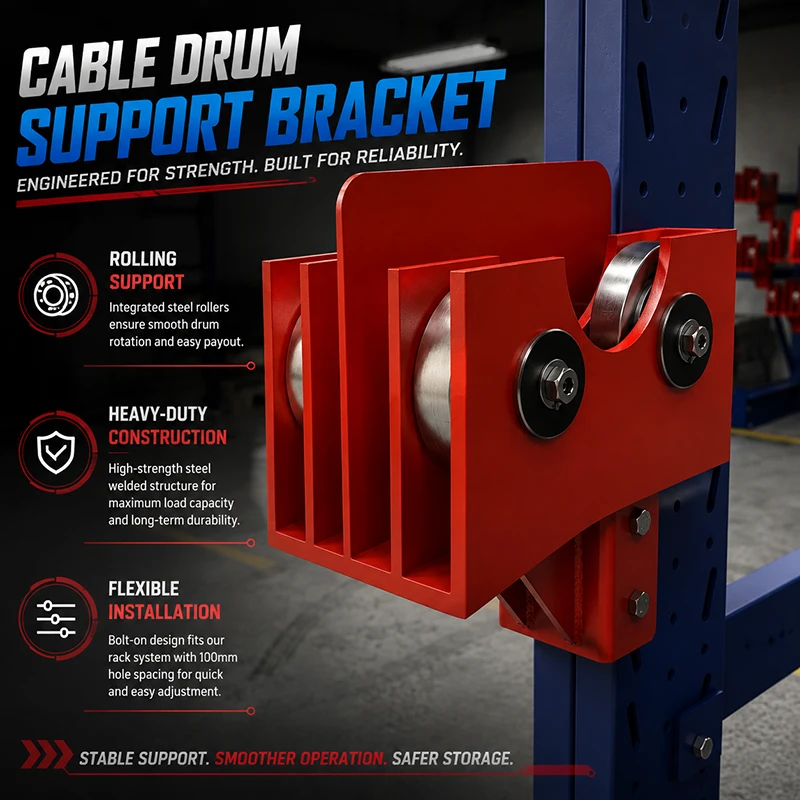
If the reel must remain on the rack while cable is withdrawn, the rack needs roller-bearing reel support brackets rather than plain cradles. Two brackets form one reel position, the reel spindle or drum barrel bears on the bracket rollers, and the friction that the operator has to overcome becomes rolling resistance instead of sliding. On one project a roller-bearing support was specified explicitly for reel rotation and hot-dip galvanizing was requested for outdoor storage — two separate line items in the same quotation, not a default package.
Three configuration points matter more than anything else in this process. First, bracket vertical position: the upright profile on this system carries installation holes at 100 mm intervals, so the support height can be set around the actual drum diameter; the final hole pattern belongs on the approved drawing, not on this page. Second, the cable path: cable leaves the flange tangentially, so the reel position needs enough clear space in front of and above it for the run to leave without rubbing a brace or a neighbouring reel. Third, what happens to the reel when the pull stops — which is the part that most often gets assumed and should not be.
What a roller-bearing support does not do
A rotating support is a low-friction bearing arrangement. That is its whole contribution, and it is worth stating plainly what stays outside the scope of a Carack rack:
- No brake. There is no braking device holding the drum against over-run after an operator stops pulling.
- No tension control. Cable tension is whatever the puller or the downstream machine applies; the rack does not regulate it.
- No speed control and no powered drive. Reel rotation follows the cable, not a motor or a variable-speed unit.
- No length measurement or cut-to-length function. Meterage counting is not part of the rack.
- No guiding or traverse mechanism. Cable layering back onto the drum, or guiding the run sideways, is the operator’s job.
- No automatic anti-slack or accumulation function, and no interlock with a production line.
In other words, a rack with roller-bearing brackets is a storage structure that permits manual, low-effort withdrawal. It is not an automatic payout machine, and a quotation for it should never be read as one.
When to evaluate dedicated payout equipment instead
Move the requirement out of the rack category and into a payout or de-reeling specification when any of the following is true:
- The cable must be drawn at a controlled tension, or the product is damaged by slack or by over-run.
- Payout speed must match a downstream line speed, or the reel must accelerate and stop under control.
- Lengths must be measured and cut to a tolerance on a routine basis.
- One reel is drawn continuously through a shift rather than occasionally, and drum inertia becomes an operating issue rather than an operator annoyance.
- Several reels must pay off simultaneously into one process, or through a common guide.
- The reel is handled outdoors, at height, or in a way where a free-spinning drum is a safety concern.
Some sites keep both: a storage rack for inventory, plus a dedicated payout station for the small group of reels in active service. That split is usually cheaper and safer than asking one structure to be both.
Inputs that decide between the two processes
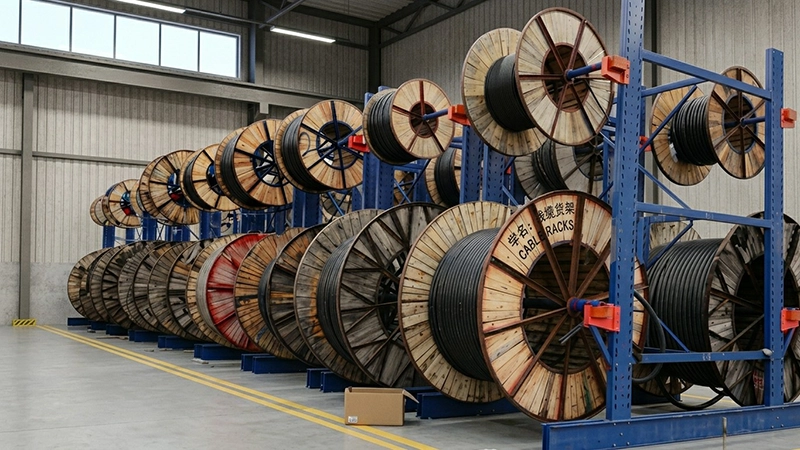
A rack quotation can be produced quickly once the following are known, and it will be wrong if any of them is guessed: the reel list with outside diameter, drum width, centre bore, spindle or through-shaft arrangement, unit weight and quantity; whether each reel type is stored or dispensed from the rack; the handling equipment and the aisle it needs; the cable path from the reel face to the next operation; and, for outdoor positions, the finish and drainage requirement. Our project files show how much this changes — one configuration used one main frame plus two auxiliary frames with four reel positions per unit at roughly 3,000 mm width and height, while another split a mixed reel list into a two-level group and a single-level group because the diameters did not belong on the same shelf spacing.
What remains unconfirmed is equally important. A 2026 customer discussion recorded as opportunity 15314 raised reel removal and transport as the live concern; it did not confirm that a final rack design resolved the removal clearance, so clearance stays a drawing-level confirmation. Retrofit accessories follow the same rule: the recorded cable-reel support tube for existing cantilever racks is Ø60 mm with a 500 mm bracket extension, intended for reels up to Ø1,000 mm once the existing rack connection is verified — not before.
Where a Carack cable reel rack is the right fit
- Cable manufacturer or distributor warehouse where reels of several diameters share one organised footprint.
- Electrical and power-equipment plants storing drums between production, testing and dispatch.
- A cable cutting or dispensing area where reels stay parked and cable is drawn off by hand at low frequency.
- An existing cantilever rack installation being converted to reel support with verified connection dimensions.
It is the wrong fit when the requirement is controlled tension, driven payout, measured cut length or line-synchronised speed. In those cases the correct answer is a payout station, and saying so early is part of the selection work.
Häufig gestellte Fragen
Can cable be pulled off a reel without removing it from the rack?
Yes, when roller-bearing support brackets are specified for that reel position. The reel turns on the bracket rollers as the cable is drawn, so the operator works against rolling resistance rather than the full weight of the drum. Whether a specific reel position supports this depends on the drum diameter, weight and bracket arrangement confirmed on the drawing.
Does fitting roller brackets turn the rack into a payout machine?
No. The brackets remove friction; they add no brake, no tension control, no drive, no speed regulation and no length measurement. If your process needs any of those, evaluate dedicated payout equipment alongside the storage rack.
Can some positions be for whole-reel removal and others for in-place drawing?
Usually yes, and it is a common arrangement for mixed inventory: storage bays without rotating supports for dispatch stock, plus a smaller number of bracket positions for reels in service. The split should be agreed before the layout is frozen, because bay spacing, bracket levels and the cable path differ between the two uses.
What decides whether reels can be removed cleanly?
Forklift approach and aisle width, base beam height, the support arrangement and the reel weight — confirmed per position. Where aisle subtraction rules out a second row, the layout changes rather than the truck.
Next step
Write the action sentence for each reel type first — removed, or drawn in place — and send it with the reel list. The Carack product detail page sets out the structure, the adjustable support positions and the roller-bearing option, and it states the configuration points that have to be confirmed before a quotation is issued rather than after.
Benötigen Sie eine individuelle Lagerlösung?
Sprechen Sie direkt mit unseren technischen Ingenieuren. Wir bieten kostenlose Strukturplanungen, Bewertungen von Hochlast-Katalogen und schnelle B2B-Preisangebote.
Jetzt Angebot anfordern →