

Most collapsible wire container quotes are checked against one number nobody wrote down: the height of the unit when it is folded. An exporter comparing a 20 ft and a 40 ft HC plan, or a buyer deciding how much floor the empty cages will occupy between deliveries, is really comparing a folded increment multiplied by a few hundred units. Get that increment wrong and the plan fails at the loading bay, not in the spreadsheet.
This page brings together what our own project records actually document about folded dimensions, bundling and container quantities for the Stbox collapsible wire mesh container, separates those records from the demonstration figures used in sales presentations, and lists the fields to confirm before a loading plan is quoted. Every figure below belongs to a named opportunity or to a presentation reference. None of them is a universal Stbox specification.
Which project records carry a folded height or a container quantity
Three of our technical proposals and one comparison presentation contain the numbers buyers usually ask for. They do not agree with each other, because they were written for three different cage sizes, so they stay in separate columns instead of being averaged into one headline figure.
| Record | Container quantity recorded | Folded height recorded | Empty stacking record | Unit tare |
|---|---|---|---|---|
| Opportunity 13967, 800 x 1200 x 890 mm | Not recorded | 190 mm | Ten empty cages per stack block, block 1240 x 1240 x 1600 mm | 47 kg |
| Opportunity 15059, 1000 x 800 x 840 mm | About 250 per 20 ft, about 638 per 40 ft HC | Not recorded | Empty cages fold, units per bundle not recorded | 42 kg |
| Opportunity 15217, 1050 x 1050 x 1000 mm | About 150 per 20 ft | Not recorded | Empty cages fold, units per bundle not recorded | 53 kg |
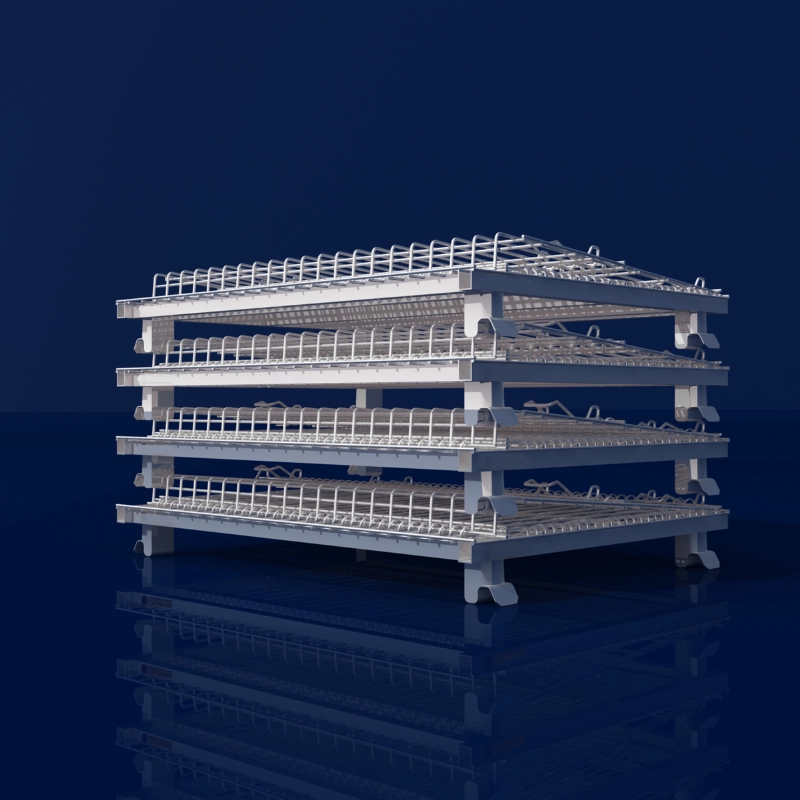
| Comparison presentation, opportunity 64013 | Approximately 360 per 40 ft | Described only as low and flat | Three-level empty stack demonstrated | Not stated |
Two consequences follow. First, 190 mm is a folded height for the 800 x 1200 x 890 mm unit only. It cannot be carried across to the 1000 x 800 x 840 mm or 1050 x 1050 x 1000 mm builds, and we will not quote it as a range until a drawing states it. Second, the 64013 figure of about 360 per 40 ft is a presentation comparison number, corrected during the session in which it was presented, and it exists to show the freight difference between a mesh cage and a square-tube folding box. It is not an approved loading plan.

Why the folded increment decides the estimate, not the assembled size
When a container is loaded with empty cages, the useful unit is the thickness one folded cage adds to a bundle, plus whatever the base frame, feet and hinges need in order to nest without damaging the panel above. On our units the folded package is not a bare pair of mesh panels: the formed stacking feet and the U-channel base reinforcement occupy space and set the minimum gap between folded units, and the spiral hinges leave a slightly thicker edge along one side.
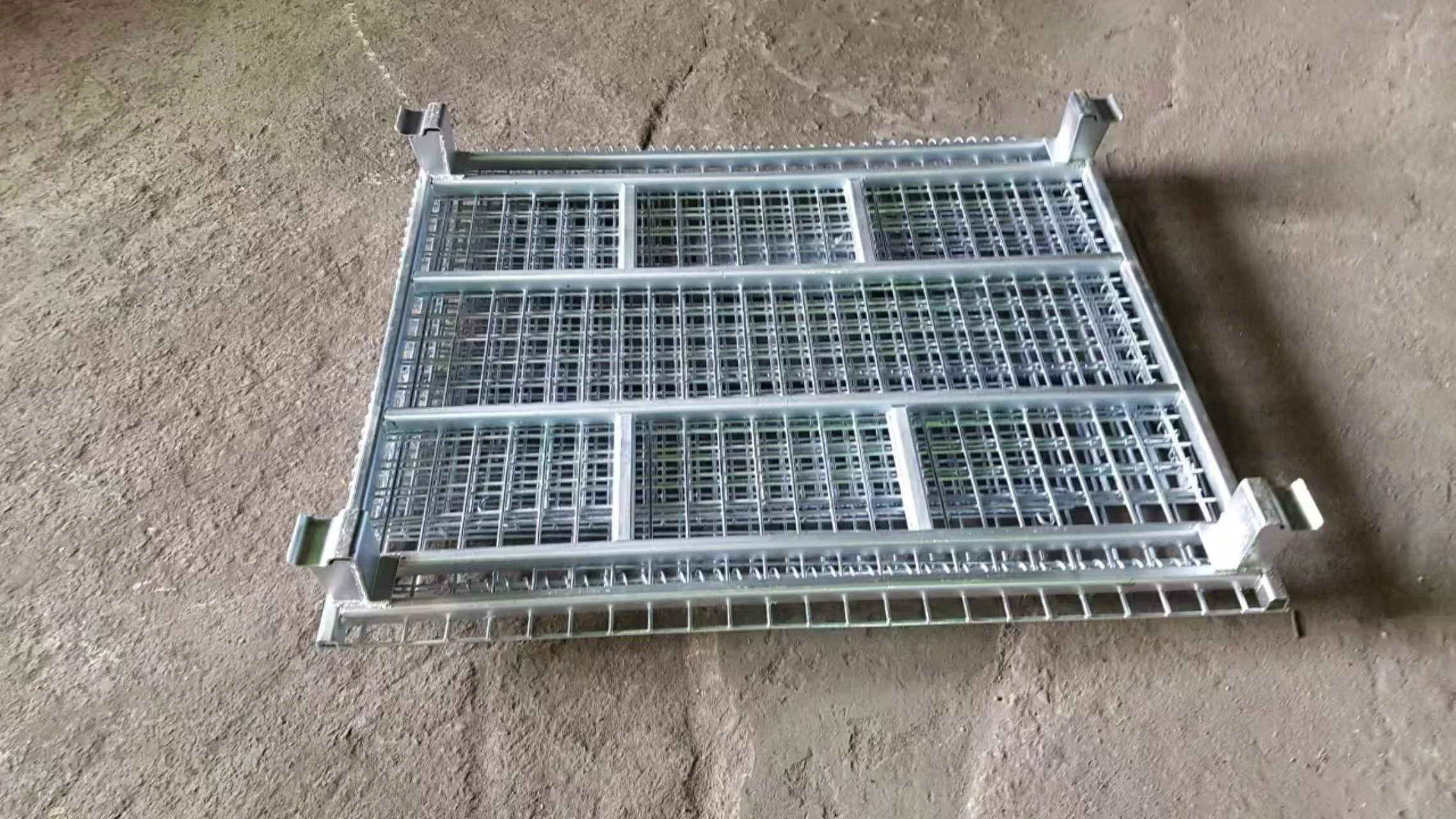
That is why the folded block in our 13967 record measures 1240 x 1240 x 1600 mm for ten empty 800 x 1200 x 890 mm cages, a footprint larger than the cage itself, driven by the feet and the base frame. Estimating container quantity from the assembled footprint alone understates the space each bundle needs; estimating from a single folded panel thickness overstates it. The realistic input is a bundle: units per bundle, bundle footprint, bundle height, and the stacking limit for that bundle.
The same logic applies on the customer’s own floor. Storing folded cages ten high keeps the empty pool compact between deliveries, but the stack still occupies floor area set by the base frame, and it must be inspected before anything is added to it: feet fully seated, panels not distorted, banding not cutting into the coating.
Stretch wrap and strapping versus wooden crating
All three of our technical proposals described the same two packaging routes, so the trade-off here is a documented one rather than a guess.
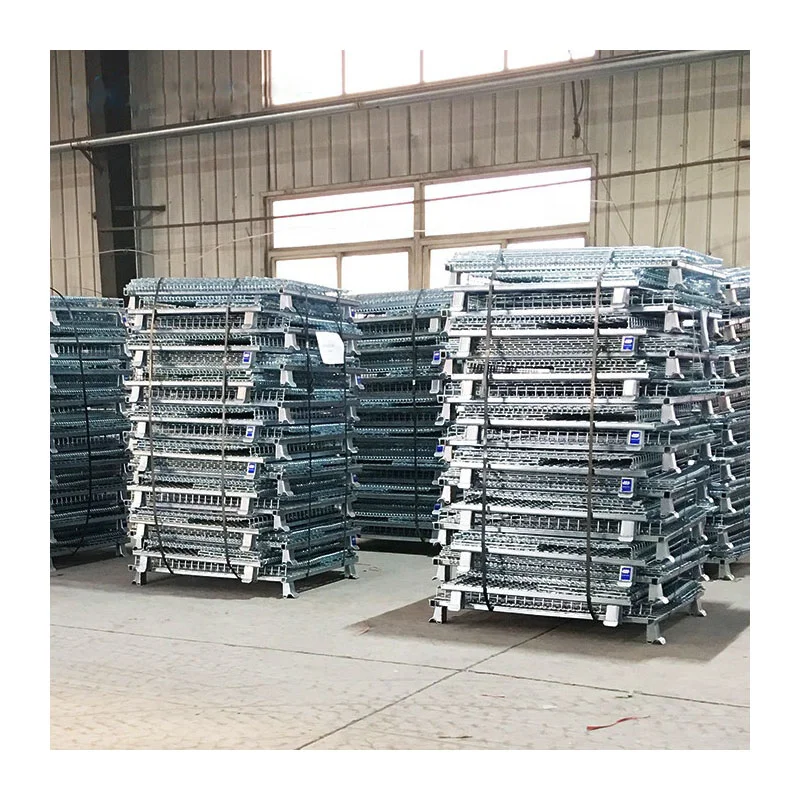
The standard route is stretch film plus strapping bands. It adds no separate packaging cost to the quotation, the bundle stays close to its folded dimensions, and handling at the destination is quick. The documented limitation is protection: film and bands hold the bundle together and keep dust off the top surface, but they do not fully prevent the cages from knocking against each other in transit and marking the zinc surface. Bundles held only by banding also depend on band tension and on corner protection staying in place for the whole route.
The alternative is wooden crating, priced into the product cost at 90 CNY per square metre of crate. It gives a rigid outer shell, protects the coating at the corners and along the panel faces, and makes the package less sensitive to how it is stowed. The cost is not only that rate: a crate adds wall thickness and a base to every bundle, so the package footprint and height grow and fewer cages fit into the same container volume. Crating is the right answer when the surface finish is the deliverable, when the route includes several handling points, or when the buyer’s own receiving process requires closed packages. It is the wrong answer when freight sensitivity dominates and the finish is a working galvanised surface that will be handled again on arrival.
When cages travel loaded instead of folded, neither route applies in the same way, and the binding constraint changes from volume to the stacked payload limits recorded for that project.
How the target container type and packing method move the number
The recorded quantities already show the container effect between a 20 ft and a 40 ft HC, but they were computed for folded, strapped cages in the sizes named above. Four variables move the final count, and each one has to be written into the plan rather than assumed.
- Container type and internal height. A 40 ft HC gives usable height that a standard 40 ft or a 20 ft does not, which is why the 15059 record pairs about 250 units in a 20 ft with about 638 in a 40 ft HC instead of scaling the two linearly.
- Bundle pattern. Whether bundles stand upright or lie flat, and how many units each bundle carries, sets both the floor pattern and the stack height. That is a loading-plan decision, not a product decision.
- Packing method. Strapped bundles can be nested and gap-filled; crates impose fixed rectangles with walls between them, so crating reduces the count in the same container even though the folded cages are unchanged.
- Payload allowance, not only volume. Multiplying the recorded quantity by the recorded tare is the cross-check: 638 units at 42 kg is roughly 26.8 t of steel before packaging, 250 units at 42 kg is about 10.5 t, 150 units at 53 kg is about 8.0 t, and the 360-unit demonstration figure at the same 42 kg tare would be about 15.1 t. Where that product approaches the payload allowance available on the route, weight binds first and the volume figure cannot be used as the plan.
A target container type therefore does not simply triple a 20 ft number. Give us the container, the packing method and the route, and the count is recalculated; give us only the cage size and we can only offer the recorded reference.
Which figures are reference only
Being explicit about this protects both sides of the order. The following values are reference points from our files and must not be written into a purchase order or a letter of credit as a guaranteed loading quantity.
- The approximately 360 units per 40 ft in the 64013 comparison presentation, a demonstration figure corrected during the session it was presented and used to illustrate folded-volume difference.
- The 190 mm folded height in the 13967 record, valid for that 800 x 1200 x 890 mm configuration and not transferable to another size or to a variant with casters, lids or liners fitted.
- The 250 per 20 ft and 638 per 40 ft HC in 15059, and the 150 per 20 ft in 15217, recorded against those two cage sizes with folded strapped packing and without a signed loading drawing in the file.
- Any unit weight and quantity combination that has not been checked against the payload allowance for the actual route.
- Photographs of strapped or stacked bundles, including the ones on this page. They show our packing practice, not an approved lashing or securing scheme for your route.
One further boundary: the folded records say nothing about the load rating of the cage. The 1000 kg, 1400 kg and 1000 kg figures in 13967, 15059 and 15217 belong to loaded handling and stacking, and they are unaffected by how the empty unit packs.
Fields to confirm before a loading plan is issued
When a buyer sends these fields in one message, the estimate becomes a calculation instead of an assumption.
- Assembled outside dimensions, and the width of the side that opens if a half-drop gate is specified.
- Folded height per unit as stated on the approved drawing, and the height and footprint of one complete bundle.
- Units per bundle or per folded stack, and the maximum folded stack height permitted for handling.
- Packing method chosen: stretch film with strapping bands, or wooden crate, with the crate specification if crating is required.
- Target container type and size, plus the internal dimensions and payload allowance the carrier will apply on that route.
- Total quantity, unit tare and the resulting total weight, checked against the payload allowance rather than the volume alone.
- Loading and securing method, and whether bundles must be palletised or loaded loose.
- Destination handling, storage conditions and any receiving requirement for closed packages.
Questions buyers ask about folded dimensions
Can I use the 190 mm folded height for any Stbox size?
No. It is recorded for the 800 x 1200 x 890 mm configuration in opportunity 13967 only. The other two project records confirm that empty cages fold but do not state a folded height, so the value for a different size or for a unit fitted with casters, a lid or a liner has to come from the approved drawing for that build.
Is the approximately 360 per 40 ft figure a loading plan I can order against?
No. It comes from the 64013 comparison presentation and was given as an approximate comparison, corrected in the same session, to show how much more a low folded profile carries than a square-tube box. An orderable quantity comes from a loading plan drawn on your confirmed folded dimensions and packing method.
Does wooden crating always reduce the container quantity?
It reduces usable volume in practice, because every bundle gains walls and a base, but the size of the reduction depends on the crate design and the bundle pattern. That is why packing method is one of the confirmations we ask for before quoting a count, together with the container type.
Send three inputs for a project loading calculation
Folded dimensions, packing method and target container type are enough for us to start a project loading calculation against your own figures rather than against a reference quantity. Add the total quantity and the destination, and the same calculation also exposes whether weight or volume will bind first on your route.
Benötigen Sie eine individuelle Lagerlösung?
Sprechen Sie direkt mit unseren technischen Ingenieuren. Wir bieten kostenlose Strukturplanungen, Bewertungen von Hochlast-Katalogen und schnelle B2B-Preisangebote.
Jetzt Angebot anfordern →