
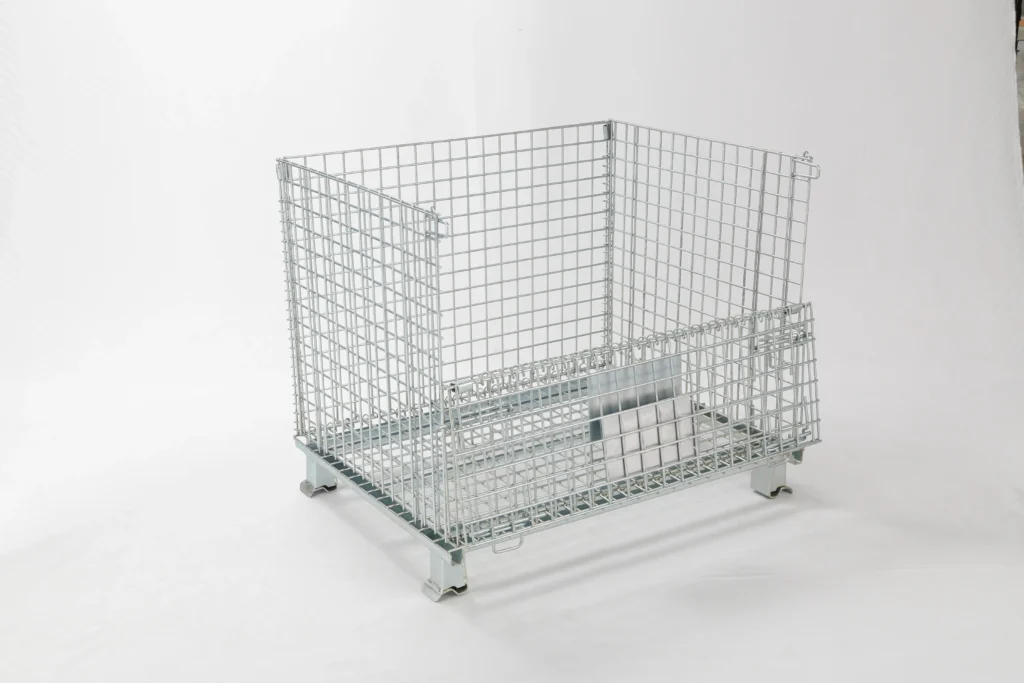
A buyer working to a schedule sends one photograph of a collapsible wire mesh container and asks for a price. That photograph is a starting point, not an instruction. Before anyone opens a drawing or builds a sample, the conditions the container will actually live under have to exist in writing: how much mass goes into it, at which stack level, through which opening, in what environment, and on which transport plan.
Write down the load and handling conditions before approving the drawing. A drawing released too early does not save time; it freezes guesses into steel. The sequence below is the one that keeps a quotation defensible: written conditions first, then a single project drawing, then the sample, then the price.
Why the written conditions come before the drawing
A cage drawing is a translation of agreed inputs. Wire diameter, mesh pitch, base reinforcement, stacking feet and gate position are all answers, and answers only hold when the questions are fixed. If the load per cage, the number of loaded levels and the access side are still open, the drawing has to absorb assumptions that nobody signed — and every later change propagates into the sample, the packing plan and the freight estimate.
One of our own project records shows exactly where interpretation fails. On project 13967 the requested opening sat on the 800 mm side of the container, and the orientation and the wording used for that opening still required drawing confirmation before release. Nothing about that was a technical failure; it was an input that had not been put into words.
Load and handling: the first field to write down
Start with four numbers and one piece of equipment. Load per cage. Number of loaded levels in service. The load the upper cages will carry. The resulting load that reaches the floor or the vehicle bed. And the handling device: forklift, manual pallet truck, overhead lifting, or all three on the same route. Our image index records four-way pallet-jack entry, U-channel base reinforcement, formed stacking feet and spiral hinges on documented variants, but the handling interface still belongs in writing per order.
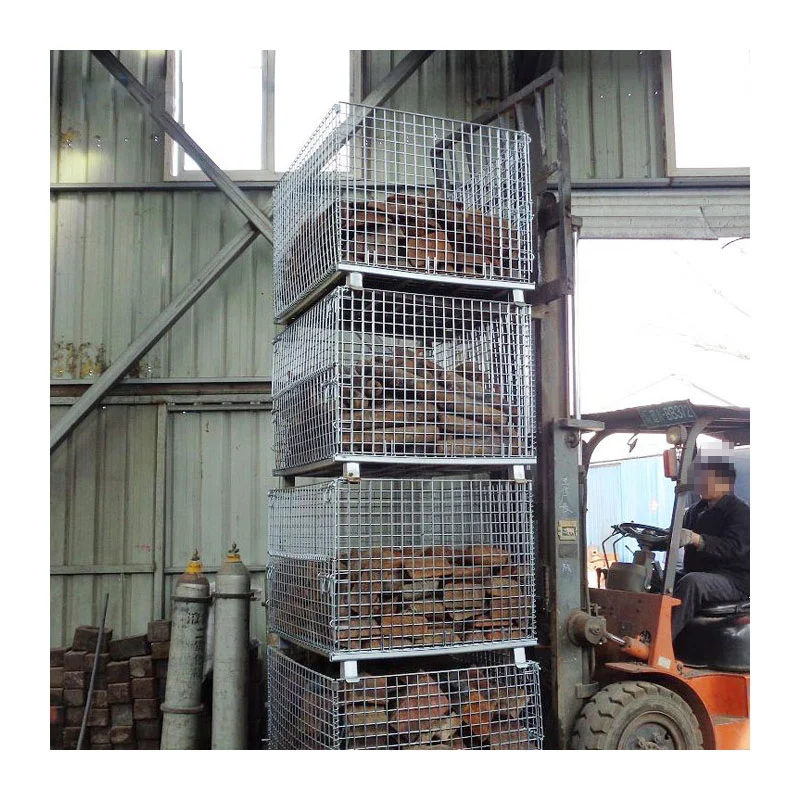
Our project records must stay separate here. Project 15059 stated 1,400 kg per cage with stacking up to four high and an upper-cage total load of 2,000 kg on top. Project 15217 stated 1,000 kg per cage, also four high, with the upper cage limited to 1,200 kg. Project 13967 stated 1,000 kg per cage, and its risk note recommended no more than four tiers with no more than 500 kg in each upper cage. Three different answers, three different files: none of them is a general rated load, and none may be merged into one specification line.
Size, gate side and handling interface belong on the same sheet
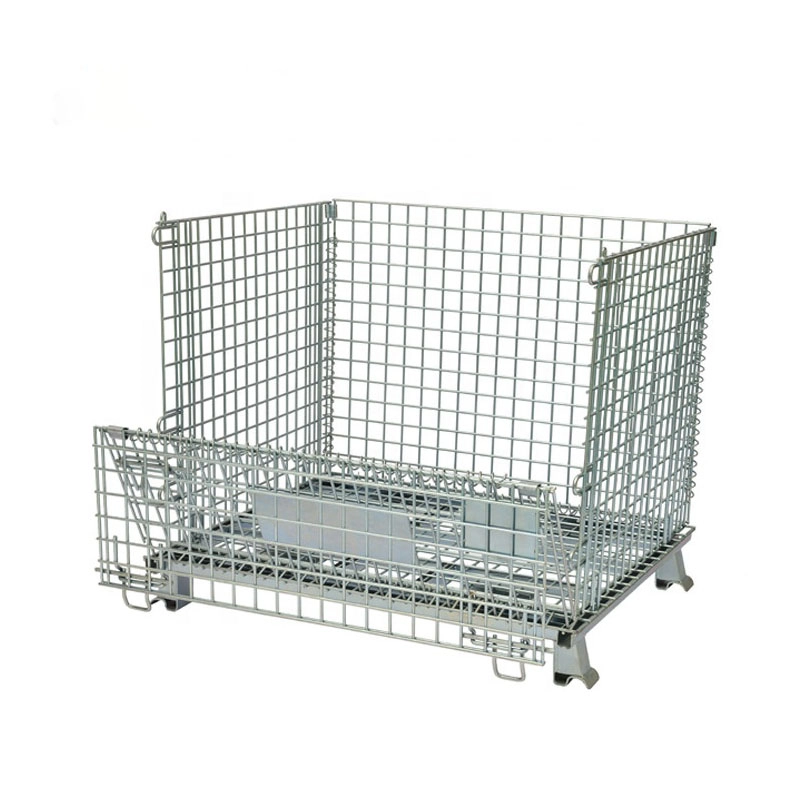
Dimensions only mean something together with the access side. Write the external length, width and height in the orientation the operator sees, then name the gate: which panel, how far it opens, whether it is a half-drop front gate or an opening on the short side, and whether the operator reaches the lower parts without unloading the whole cage. The same sheet should carry mesh pitch, wire diameter, folded height and the tare weight, because those numbers drive both the load path and the shipment.
The three recorded variants again show why one drawing cannot answer for another: 1000 x 800 x 840 mm with 50 x 50 mm mesh, 6 mm wire and a 42 kg tare on project 15059; 1050 x 1050 x 1000 mm with 50 x 50 mm mesh, 6.0 +/- 0.1 mm wire and a 53 kg tare on project 15217; 800 x 1200 x 890 mm with 50 x 50 mm mesh, 5.8 mm wire, a 47 kg tare and a 190 mm folded height on project 13967. Similar machine, different cage.
Coating written as a process plus a measured thickness
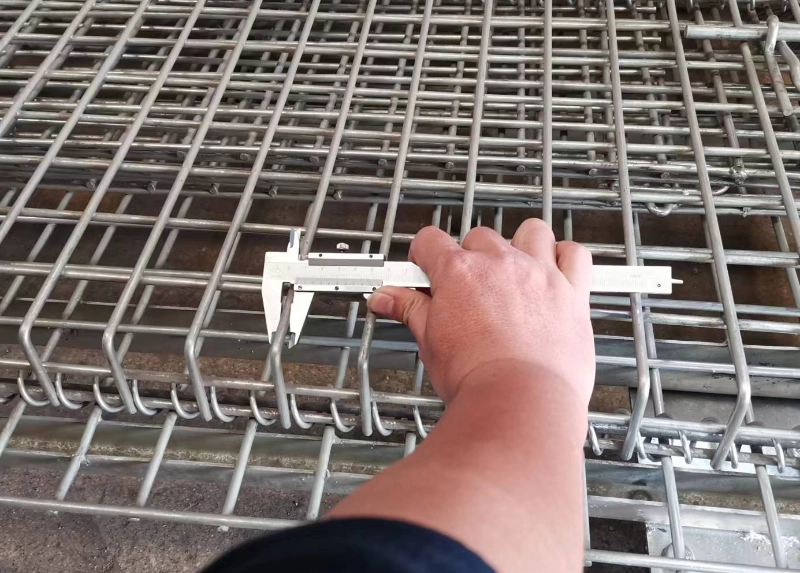
“Galvanized” on its own cannot be inspected. Write the process and the thickness value that will be measured, and say where on the part the measurement is taken. The records we hold show how wide that range is: cold galvanizing at 10 micrometres on project 15217, a 10 and 40 micrometre pair on project 15059 that the file does not yet assign to a single process, and electro-galvanized coating of at least 8 micrometres on project 13967. If a container will stand in rain or a humid yard, that exposure has to be stated with the coating line, not discovered after the order. No supplier can honestly write a corrosion life into a purchase order when the salt-spray grade and the test method are not part of the file.
Container loading and packing are a written line, not a footnote
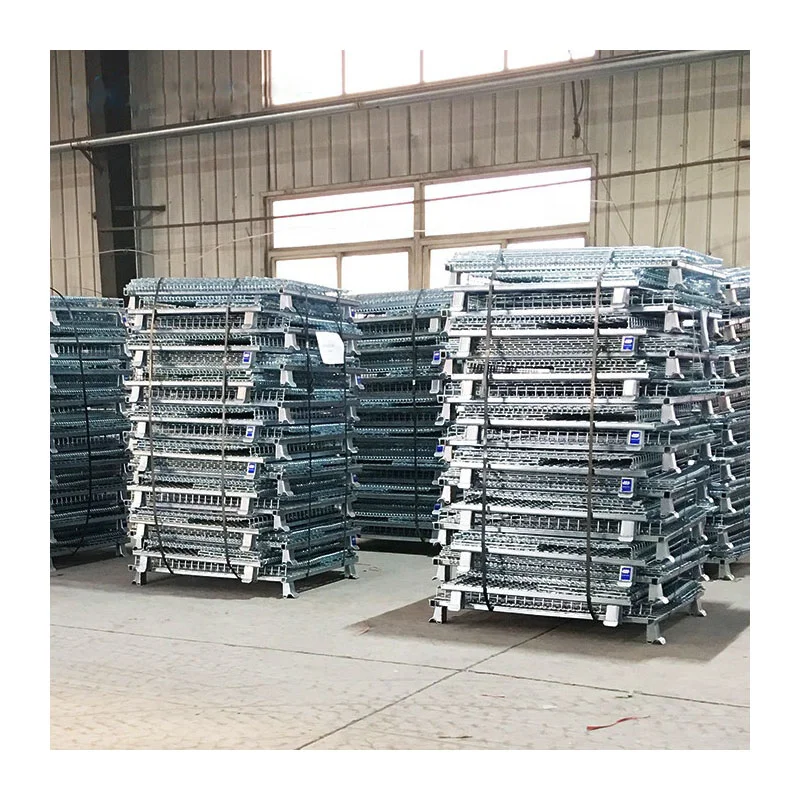
Folded height decides the shipping plan, so it has to be confirmed before the price, not after it. Project 13967 recorded a 190 mm folded height and a stack block of 1240 x 1240 x 1600 mm built from ten folded cages. Project 15059 planned 250 pieces per 20 ft and 638 pieces per 40 ft HC. Project 15217 planned 150 pieces per 20 ft. Each of those is a project plan, calculated from that project’s folded geometry and bundle method; none transfers automatically to a different cage size. Add the packing method to the same paragraph — film and strapping bands, or wooden crating with a stated moisture barrier — because the packing decision changes both the bundle height and the receiving process.
When one project drawing may cover the whole order
One drawing can carry a full purchase order, and should, when five conditions are identical across every line: the load per cage, the number of loaded levels and upper-cage load, the size and gate side, the finish process and thickness, and the packing and container plan. If any one of those differs, the order needs a separate drawing per variant — including the case where only the gate side changes, because that changes the panel set.
- Same drawing: one cage specification repeated across several delivery batches or several plant locations.
- Same drawing: a repeat order with unchanged load, size, gate side and finish, re-confirmed in writing for the new delivery window.
- No shared drawing: sizes that differ only slightly, because 1000 x 800 mm and 1050 x 1050 mm are different cages, not tolerances.
- No shared drawing: a change from cold to hot galvanizing, or a change of stack level, since both move the load path and the acceptance point.
How to record an unknown condition without assuming it
The honest way to handle a missing input is to label it and keep it visible. Write “not yet confirmed” next to the field, name the person who will confirm it, and date the entry. Then state, on the same page, which part of the quotation depends on it. That way an open item is a tracked task rather than an accident waiting for the sample stage.
- Mark the field as open and give it an owner and a date; never fill it with a plausible number.
- Keep every open item on the drawing cover sheet where purchasing, engineering and quality all read it.
- Label a drawing as a draft until it is signed; a draft is never treated as an approved drawing, and never released to tooling.
- State what the price assumes, so a change of input produces a revised price rather than a dispute.
- Record the customer’s own wording next to the technical term, especially for gate, door, opening and side.
The release order we work to
First, the written conditions: load, stacking, size, gate side, finish, packing and container plan. Second, the drawing built from those conditions. Third, a review across purchasing, engineering and quality, with initials against the items each function owns. Fourth, the sample, which only becomes meaningful once the drawing behind it is signed. Fifth, the quotation, priced against confirmed inputs with open items named. Lead-time statements recorded in our project files, such as the 30 day figure attached to the 40 ft quantity on project 15059 or the 25 day figure attached to the 20 ft quantity on project 15217, belong to those projects and their confirmation state; they are not a standing commitment for a new cage.
Where this sequence stops being the right one
This confirmation order is written for a collapsible steel wire mesh container in industrial parts, work-in-progress and bulk handling service. It is the wrong instrument in three situations: when the real requirement is a square-tube frame folding box rather than a mesh body; when the reuse count and load point past the practical working boundary of a mesh-panel cage, where a heavier frame construction should be evaluated instead; and when the buyer needs a certified load rating with a named test standard, because our indexed visual load demonstration carries no standard, fixture, duration or certificate and cannot be converted into one by wording.
Applications where this confirmation order pays back
- Automotive and machining work-in-progress buffered beside the line, where load per cage and picking access are known before the first drawing.
- Electronics, semiconductor supply and contract manufacturing, where a liner decision follows the part surface rather than a template.
- Warehouse bulk storage and floor distribution by forklift or pallet truck, where the handling interface is fixed in writing.
- Export and return logistics, where folded height, bundle height and container count are agreed before the price is issued.
Questions we are asked before the drawing stage
Which of these must always be in writing?
Load per cage, the number of loaded levels and the upper-cage load, the size and gate side, the coating process with its thickness, and the packing and container plan. If any of those is missing, the drawing is a draft and cannot be approved.
Can one drawing cover several sizes in the same order?
Only when load, stack level, size, gate side, finish and packing are identical. A different size, a different gate side or a different coating produces a different drawing, even when the containers look similar in a photograph.
What if the customer does not know a value yet?
Record it as open, name the owner and the date, and state which part of the quotation depends on it. That keeps the missing value visible through drawing review, sampling and pricing instead of hiding it inside an assumed number.
Send your product data and the current drawing you are working from — size, load per cage, stack level, gate side, finish, packing and container plan, with any field you have not confirmed marked as open. We return a pre-quote verification checklist that shows which items are settled, which still need a signature, and which must close before any drawing is approved or a sample is built.
Benötigen Sie eine individuelle Lagerlösung?
Sprechen Sie direkt mit unseren technischen Ingenieuren. Wir bieten kostenlose Strukturplanungen, Bewertungen von Hochlast-Katalogen und schnelle B2B-Preisangebote.
Jetzt Angebot anfordern →