
Limited-Reuse Mesh Cages for Delivery Staging and Temporary Warehouse Buffers
Collapsible wire mesh cages for delivery staging, temporary warehouse buffers and volume despatch. When a mesh cage fits, when it does not, and when to switch to a square-tube frame box.

Short-cycle work belongs in a mesh cage. Permanent heavy turnover belongs in a square-tube box.
Stbox is a collapsible wire mesh container built for delivery staging, temporary warehouse buffers and volume despatch where the cage works a handful of cycles, not a decade of shifts. If your cages will be reshuffled every day, stacked loaded, or kept for years, this is the wrong route — the square-tube frame box is the one to price.
Read the boundary before the configuration. The body is welded wire mesh on a Q235 structural base: mesh panels, mesh-panel edge members and a formed base frame carry the load, with four pressed stacking feet locating on the cage below. Because the mesh is the main load path, the product is light and folds to a low, flat package. Because the mesh is the main load path, it is also the member that reaches its limit first under a loaded stack. That single structural fact explains every non-selection condition below — it is not a marketing qualifier.
When not to choose Stbox:
- Your reuse count is high. If the same cage is loaded, moved and returned week after week, the structural margin of a square-tube frame buys more working life than a lower delivered cost per unit.
- Units will be stacked with material in them. A loaded stack is one structure: the bottom cage carries the payload of every level above it. Once that combined figure leaves the approved limit, side mesh panels deform and stack stability becomes the risk.
- Load goes beyond roughly one tonne per cage, or varies. A load that ranges from light to heavy wants margin; the mesh cage in our comparison material is positioned for loads at or below about one tonne.
- You need years of service from the same unit. No cycle life is published for this product, and none should be assumed. The positioning is one-time or limited use.
- You need a sealed, lockable, dust-tight container as the baseline. A liner, top lid and lock set are options on this product, not standard configuration.
When those conditions do not apply, the cage is a practical answer: half-drop front gate for picking without emptying the box, forklift and pallet-jack handling, and a folded profile that turns return freight and empty storage into a volume problem instead of a space problem.
- Delivery staging: parts loaded once at the despatch bay and shipped out with the consignment.
- Temporary warehouse buffer: a project or seasonal overspill that occupies floor space for weeks, not years.
- Volume despatch and flat-folded return: the folded increment, not the assembled size, sets how many units a container carries.
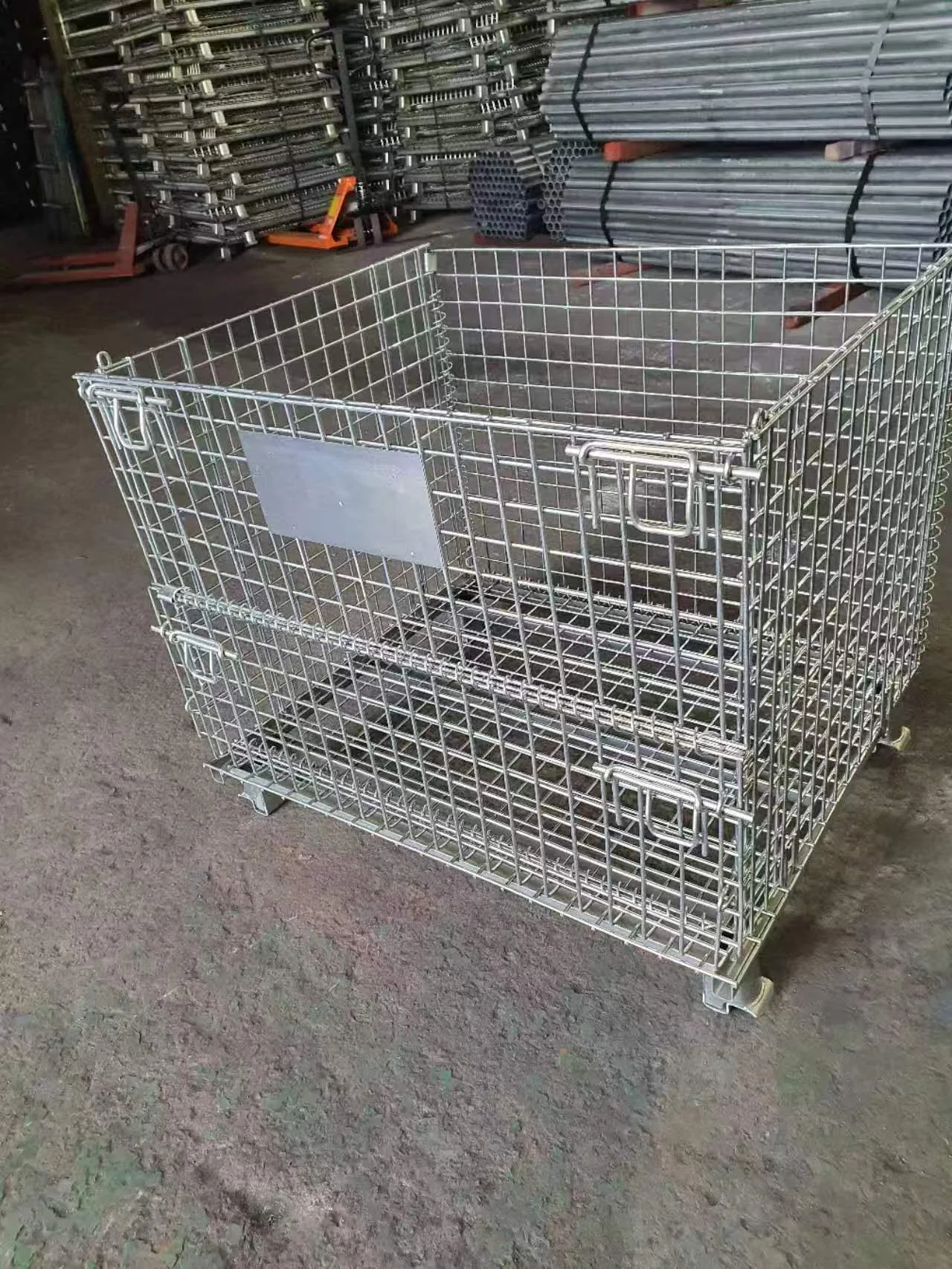
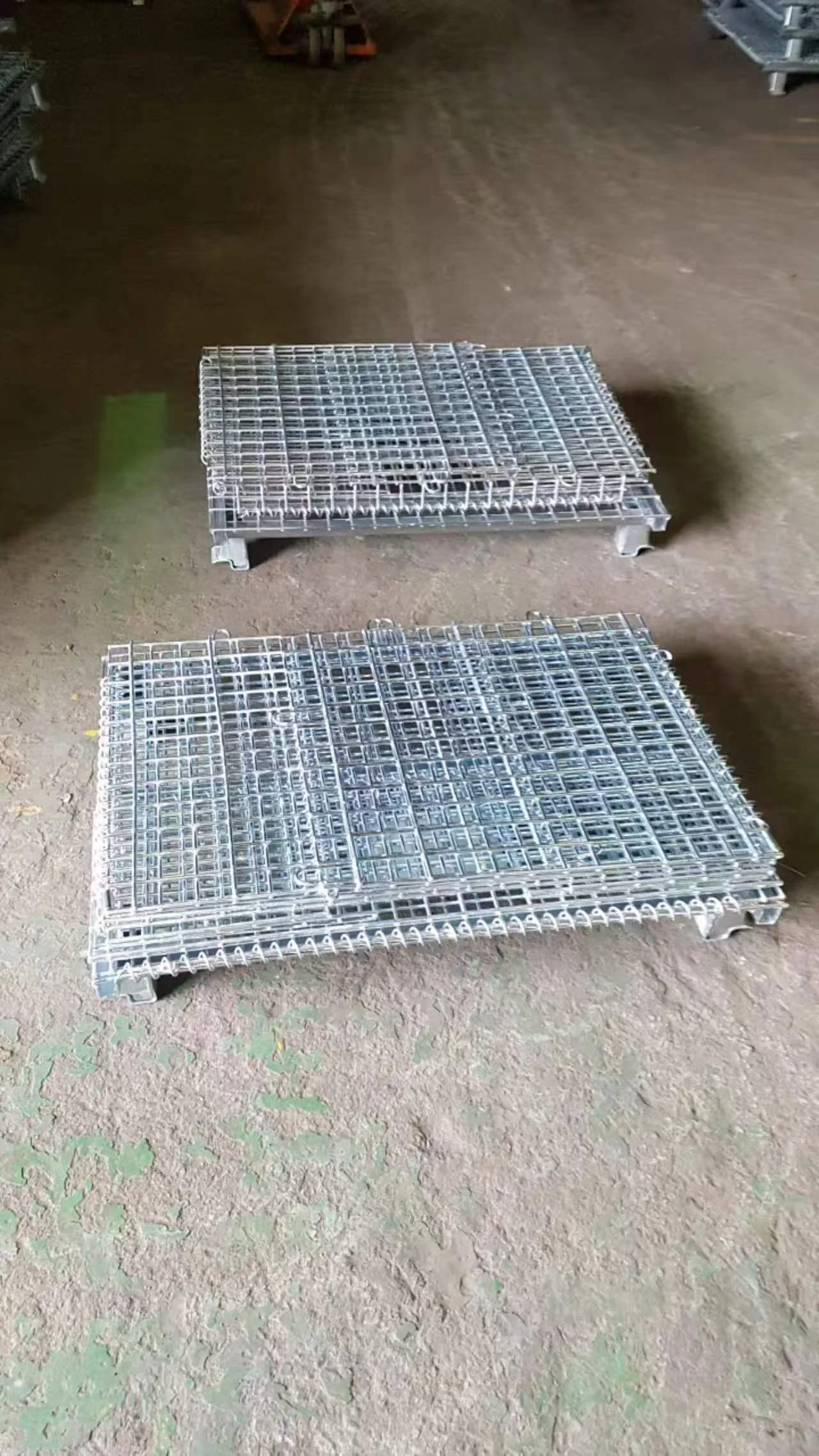
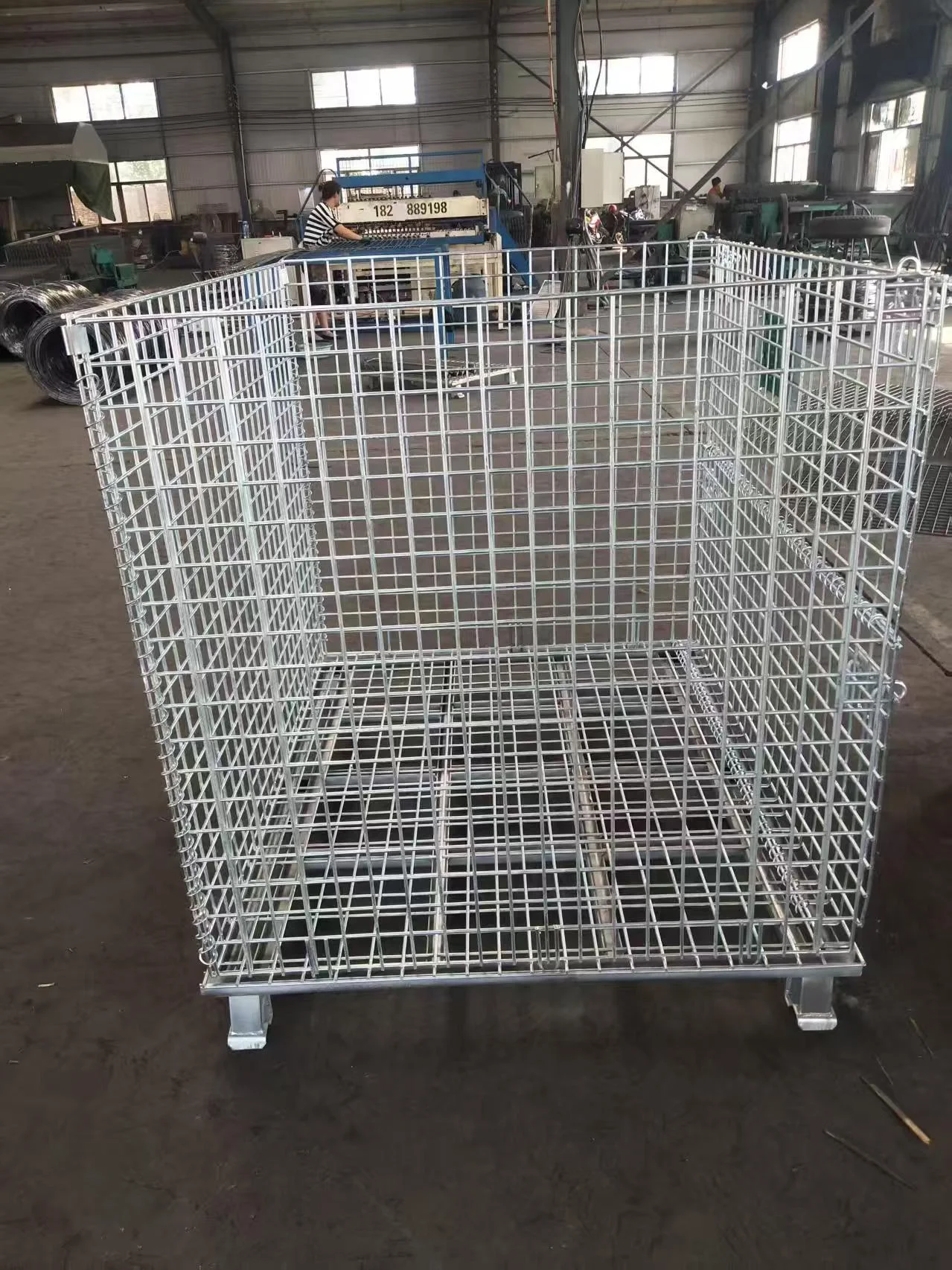
Three limited-reuse jobs where a mesh cage pays for itself
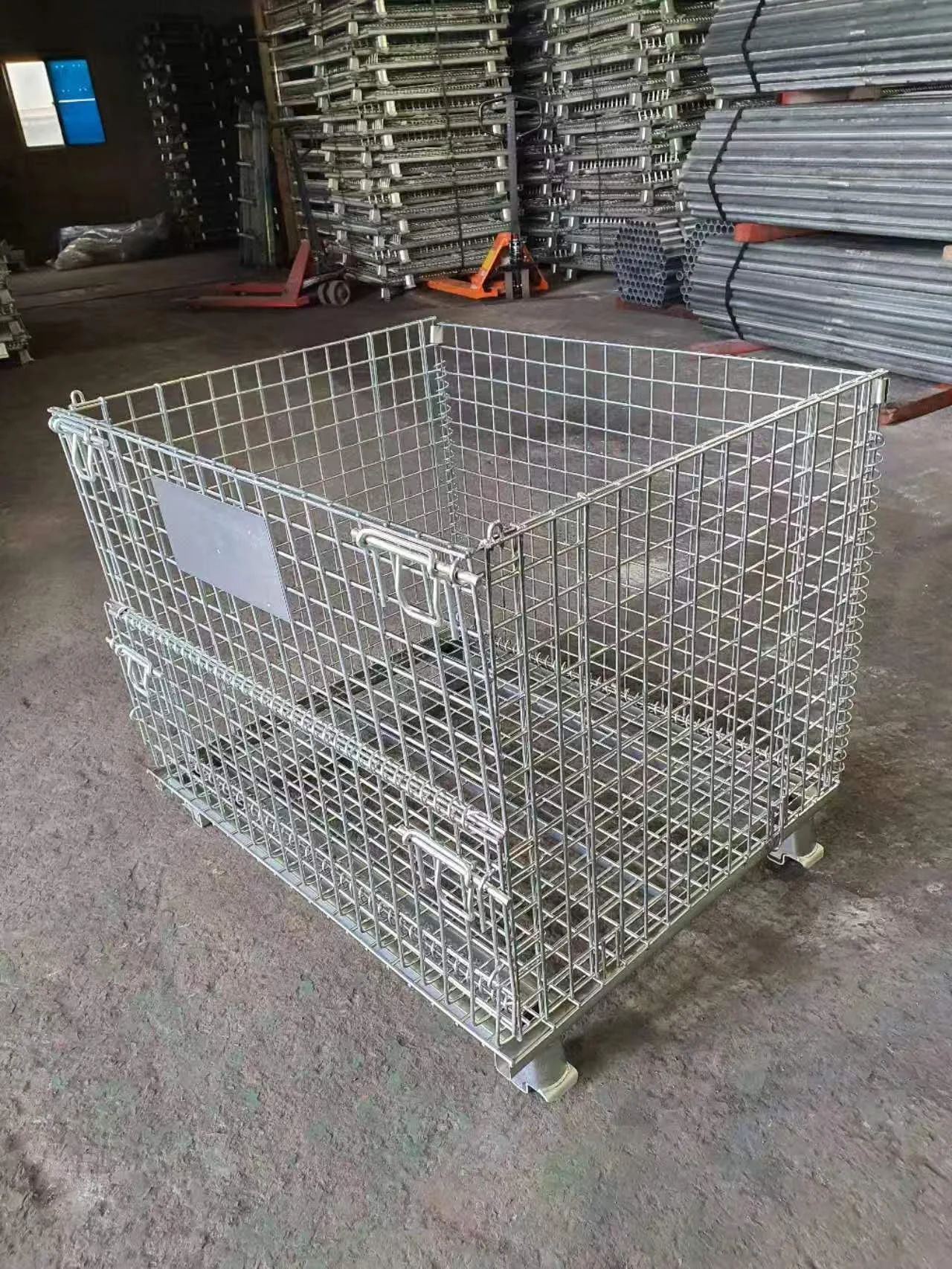
Staging bay
Delivery staging at the door
Parts arrive from machining, get loaded once and leave with the consignment. The cage does the job of a rigid, stackable, see-through container for one outbound cycle and then folds away.
- Open at one side through the half-drop front gate, so the picker reaches the load without lifting the cage
- Forklift and pallet-jack handling, with the base frame recorded for four-way entry in the project drawings
- Yard or covered staging is workable when the finish is matched to the exposure — see the finish note in the FAQ
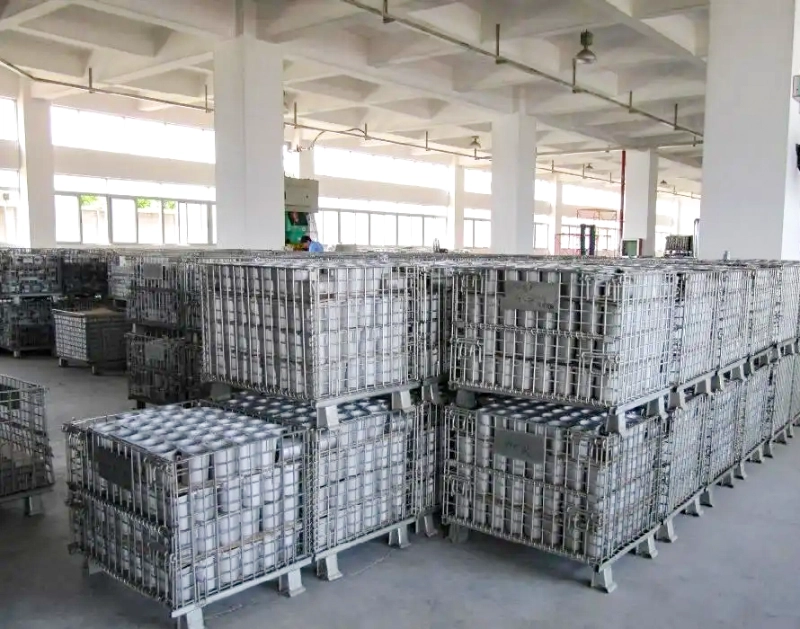
Short-term buffer
Temporary warehouse buffer
Project overspill, a seasonal peak or an overflow aisle that exists for one quarter. The buffer has to be stackable and visible for counting, but it does not have to survive ten years of daily handling.
- 50 x 50 mm mesh gives visual stock-taking and ventilation without opening the box
- Two-high loaded stacks are routine practice; the approved layer count and the upper-layer weight limit come from the project record, not from the catalogue
- Empty cages fold and clear the aisle in a fraction of the footprint
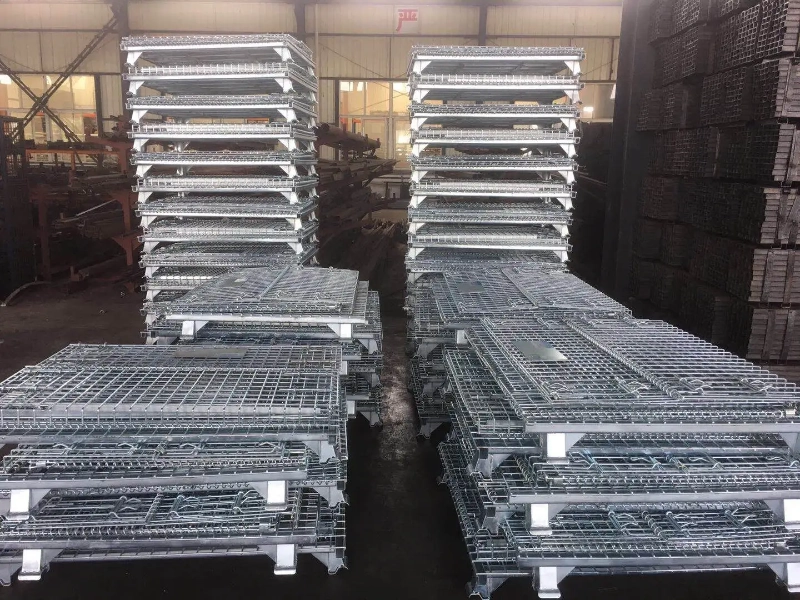
Volume despatch
Batch despatch, flat-folded return
Large export orders and freight-sensitive destinations, where the folded package decides the freight bill. Two hundred extra units in one 40 ft container changes the delivered cost of the whole order.
- One project record documents a 190 mm folded height on an 800 x 1200 x 890 mm cage
- The same record packs ten empty units into a 1240 x 1240 x 1600 mm stack block
- Our demonstration comparison puts roughly 360 mesh cages against roughly 160 square-tube boxes in a 40 ft container — a planning reference, not a guaranteed loading quantity
Four numbers decide this purchase — none of them is the unit price
Expected reuse count
One delivery, a small number of cycles, or continuous turnover. We publish no cycle life for this product and will not invent one; the honest answer is that the cage is positioned for one-time or limited use, so a high reuse count moves the decision to the square-tube frame box. Reuse-cycle arithmetic →
Combined stacked payload
In a loaded stack the bottom cage carries every level above it. One project record specifies no more than four layers with each upper cage at or below 500 kg; two other records use upper-layer totals of 1200 kg and 2000 kg. Those belong to their own drawings and are never merged into a catalogue figure.
Where the load travels
The load path runs through mesh panels, edge members and the base frame. That is why the unit is light and folds flat, and also why side-mesh deformation is the failure mode to watch. Under a load above roughly one tonne, or a load that varies, the square-tube frame carries the load through its own uprights instead.
Delivered cost per usable unit
Our comparison material states that the mesh cage carries a higher unit price than the square-tube box. It is still the cheaper container in short-cycle work once fold-down volume, freight per unit and replacement exposure are counted together — and the opposite is true when the same cage is replaced again and again.
Four answers from your side, one written conclusion from ours
State the reuse count
How many times will each cage be loaded and moved — once per consignment, a handful of cycles, or continuous. A range is enough to start; the number is what separates the two products.
State the stacking condition
Will units stand on the floor single-high, or will loaded cages be stacked, and how many levels. Give the maximum material weight per cage so the combined payload above the bottom unit can be calculated.
Fix one project record
External size, wire diameter, finish, mesh opening, gate side and base reinforcement are agreed as one drawing. We do not mix a size from one record with a load figure from another, and neither should a purchase order.
Receive both conclusions in writing
We return an applicability conclusion for the mesh cage and for the square-tube frame box against your stated inputs, including the conditions under which each one should not be used.
The three questions every short-cycle buyer asks
How many times can I realistically reuse one cage?
No cycle count is published for this product, and any number quoted without your operating data would be invented. The defensible statement is the positioning: in our product comparison the mesh cage is described as a one-time or limited-use solution. Send your expected reuse count and the answer becomes a comparison — below a handful of cycles the cage is the economic choice; for recurring turnover the square-tube box spreads its higher durability across more uses.
Can it be stacked loaded for the long term?
Stacking is supported, but loaded stacking and empty stacking are different conditions. An empty three-level stack is demonstrated in our material; that demonstration does not certify a loaded stack of the same height. For loaded stacks the controlling figure is the combined payload carried by the bottom cage, and the per-project limits in our records are four layers maximum with upper-layer limits of 500 kg, 1200 kg or 2000 kg depending on the drawing. Long-term loaded stacking with heavy or growing payload is the condition where we point you to the square-tube frame box.
Which working conditions should switch me to the square-tube frame box?
Six of them: maximum load per cage above roughly one tonne; loaded units stacked with a combined payload beyond the approved limit; frequent, repeated turnover of the same units; a load that varies enough that you want structural margin; a fixed long-term handling position where service life outweighs purchase price; and any application where visible mesh deformation would stop the line. In those cases the square-tube uprights carry the stacked load and the frame, not the mesh, is the load path.
Why do your records show 1000 kg, 1400 kg and 1000 kg for the same product?
Because they are three different project drawings, not one catalogue model: 800 x 1200 x 890 mm with 5.8 mm wire, 1000 x 800 x 840 mm with 6 mm wire, and 1050 x 1050 x 1000 mm with 6.0 +/- 0.1 mm wire, at 47 kg, 42 kg and 53 kg respectively. Load figures must be read as static, dynamic or uniformly distributed, and confirmed on the drawing you order. Treating the highest figure as a general rating is how a cage gets specified into the wrong job.
Does the galvanised finish make it an outdoor product?
One project record specifies electro-galvanised at a minimum of 8 micrometres and describes outdoor use with rain resistance; two others record cold zinc at about 10 micrometres, with hot-dip offered as an alternative at roughly 40 micrometres. Plating and hot-dip galvanising are different processes, so the process, thickness, acceptance standard and any corrosion evidence are fixed per order. No long-term anti-rust life is promised for a coastal, humid or chemical environment without that specification.
What do you need from me to close this out?
Three inputs: the expected number of reuse cycles per cage, whether loaded units will be stacked and how many levels, and the maximum material weight per cage including any concentrated or offset load. With those, we return the applicability conclusion for both this mesh cage and the square-tube frame box, plus the drawing route for whichever one fits. Send the three inputs →