

Three Stbox project records carry three different coating statements. Project 13967 was quoted electro-galvanized at a zinc layer of at least 8 μm. Project 15217 was quoted cold zinc at 10 μm. Project 15059 asked for both hot-dip and cold zinc prices and carries a table note holding a 10 μm and a 40 μm value. A buyer comparing those three lines as “galvanized cage, three prices” is comparing a floor against a nominal against an unassigned pair.
The working rule is short: specify the coating process and the acceptance method for each project, separately. The sections below set out exactly what each record states, which words cannot be swapped between them, how the intended storage environment changes the amount of verification, and how to word the coating clause when the file contains no salt-spray grade and no test method.
What each of the three project records actually states
The three files were written for three different customers with three different requirements. Read them as three separate specifications, never as one product with a finish option.
| Project | Process recorded | Thickness recorded | Environment wording in the file | Not recorded |
|---|---|---|---|---|
| 13967 | Electro-galvanized (电镀锌) | Zinc layer ≥8 μm, described as uniform and complete coverage | The technical proposal states that the cage can be used in the open air and has a usable resistance to rain corrosion | Salt-spray grade, exposure duration, test method, any service-life figure |
| 15217 | Cold zinc (冷镀) | Zinc coating 10 μm | None. The customer specified cold galvanizing; no storage condition is recorded | Salt-spray grade, test method, coverage requirements at welds and cut edges |
| 15059 | Hot-dip and cold zinc, both priced | Table note records a zinc film thickness of 10 μm and 40 μm as a pair | None. The customer asked for both finishes in order to compare price | Which thickness belongs to which process, salt-spray grade, test method |
Two consequences follow at once. First, the ≥8 μm on 13967 is a floor: a single reading below it fails, whatever the average of the batch is. The 10 μm on 15217 is written as a value, not a floor, so it needs a tolerance and defined measuring points before anyone can accept or reject a delivery against it. Second, the open-air wording on 13967 belongs to that project file and that quoted process. It is not a statement that every Stbox coating, at every thickness, is suitable for open storage.
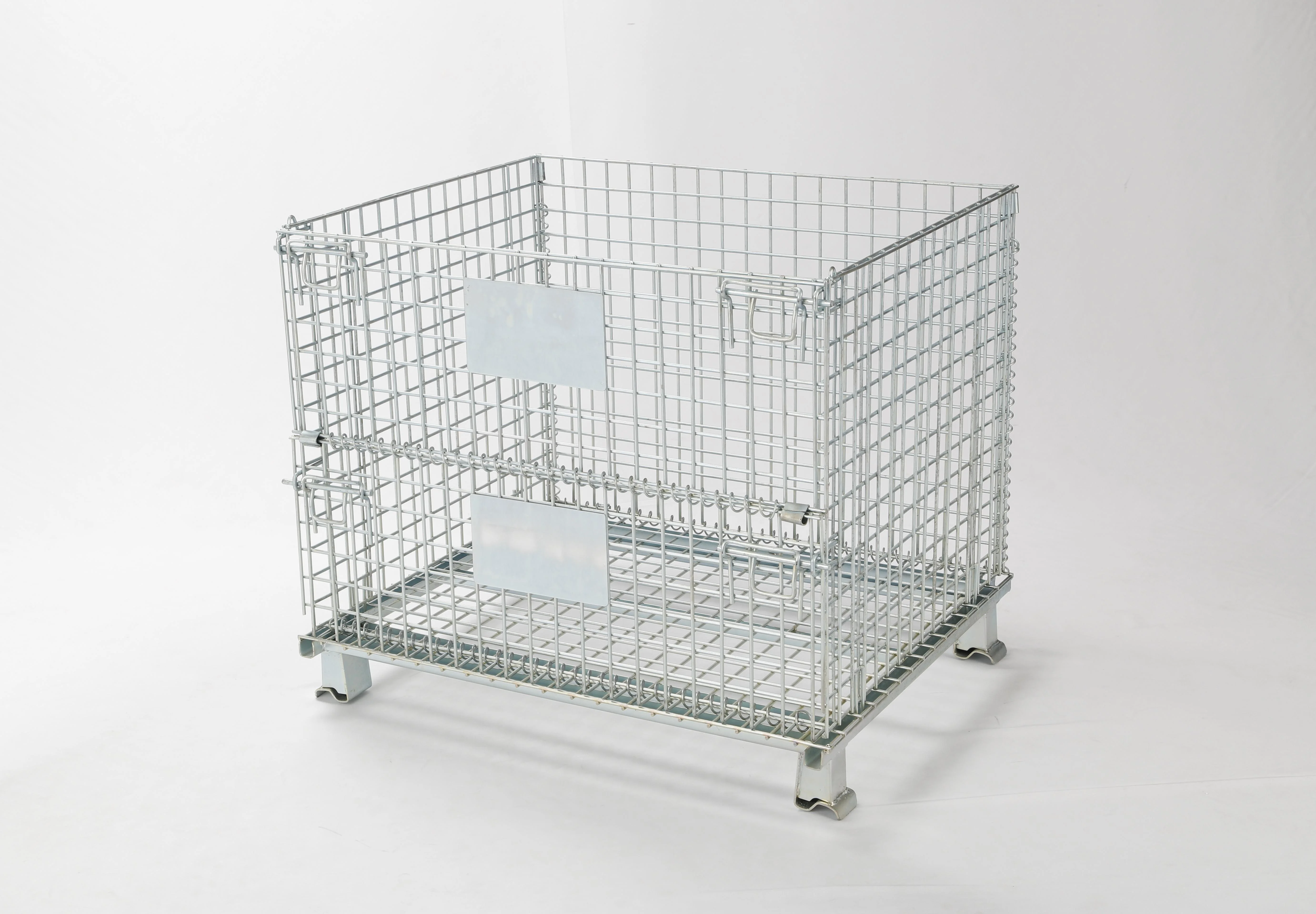
The rear view above is useful when the coating clause is drafted, because it shows the places where a zinc layer is hardest to keep continuous: the coiled hinge wire along each panel joint, the weld points where wire crosses wire, the cut wire ends at panel edges, and the formed stacking feet. A thickness reading taken in the middle of a flat mesh panel says nothing about those locations, and they are the ones that see abrasion on every fork entry and every gate cycle.
Coating is also only one of several variables keeping these files apart. Size, single-unit load, upper-tier load under stacking and folded height differ between 13967, 15059 and 15217. Coating thickness must not be carried across from one project to another on the assumption that they share a structure, because they do not share an approved drawing.
Term pairs that cannot be used interchangeably
Most coating disputes on this product start in the wording of the quotation, not in the plant. Each pair below is a place where a term borrowed from a neighbouring specification will fail at incoming inspection.
| Pair | Why the two are not equivalent | What to write instead |
|---|---|---|
| “Galvanized” alone versus a named process | The single word covers electro-galvanizing, cold zinc and hot-dip routes. A line item reading only “galvanized” cannot be measured or rejected | Process name plus thickness plus unit, on the drawing and in the order |
| Electro-galvanizing versus cold galvanizing | Both words appear in our own records: 13967 is electro-galvanized, 15217 and 15059 are cold zinc. They are different process routes with their own achievable thickness range | Carry the exact route word from the project record into the purchase order, unchanged |
| Hot-dip versus cold zinc | 15059 prices both routes side by side because the customer wanted a comparison. Two routes quoted for one job are alternatives, not two names for one specification | State which route is ordered and which thickness applies to that route |
| Zinc thickness in μm versus zinc mass in g/m² | Different quantities, different instruments. A clause written in one unit cannot be closed with a measurement in the other | One unit, one instrument, one method, stated in the clause |
| A minimum versus a nominal value | ≥8 μm means every recorded reading must reach 8. A nominal 10 μm needs a stated tolerance, a sample size and measuring points before it means anything | Say “minimum” or say “nominal” and then define the tolerance |
| Passivation versus zinc thickness | Colour passivation is a surface treatment applied after zinc. It changes appearance and handling behaviour; it adds no measurable zinc thickness | Treat passivation as a separate line item, not as extra coating |
The 10 μm and 40 μm pair on project 15059 stays unassigned
The 15059 table note records the two thickness values together without stating which process each one belongs to. A reading that assumes cold zinc means 10 μm and hot-dip means 40 μm may match your expectation, and it may match common practice, but that pairing is not written in the file. It therefore cannot be used as the basis of a quotation, a price comparison or an incoming inspection until the correspondence is confirmed for that project.
Until it is confirmed, quote and accept by process name plus the thickness written on the approved drawing. Do not lift 40 μm out of the note and apply it to a cold-zinc route as a general commitment, and do not treat 10 μm from 15217 as interchangeable with the 10 μm in the 15059 note just because the number matches. Same figure, different project, different drawing.
This is the point where a price comparison is most often distorted. A hot-dip line and a cold-zinc line quoted for the same cage are not a premium and a standard version of one article. They are two process routes with different thickness ceilings, different handling of weld and edge coverage, and different acceptance instruments.
How the storage environment changes what you have to verify
The environment does not simply raise or lower a number. It changes which verification is meaningful. A dry indoor warehouse and an open coastal yard can both receive a galvanized cage, and they still need different acceptance clauses.
| Storage condition | What the environment changes | Verification to write into the order |
|---|---|---|
| Dry indoor warehouse, sealed floor | Zinc mainly guards condensation and handling abrasion rather than rain | Process, minimum thickness, measuring points and appearance acceptance |
| Covered but open-sided yard, daily condensation | Horizontal wires, hinge wire, cut ends and the inside of the feet hold moisture longest | Coverage acceptance at those named locations plus a written touch-up rule |
| Open yard, direct rain | Water collects in the base channel and in the stacking feet, so drainage matters as much as coating | Process, thickness, drainage review, accelerated-corrosion evidence and a stated inspection interval |
| Coastal site, salt fog or de-icing salt route | Thickness alone stops being a sufficient pass criterion | Salt-spray test standard, exposure duration, specimen and acceptance result, named explicitly |
| Chemical splash, washdown or humid process area | The coating has to be checked against that specific chemical or cleaning regime | Coating compatibility statement, plus a repair and re-inspection procedure |
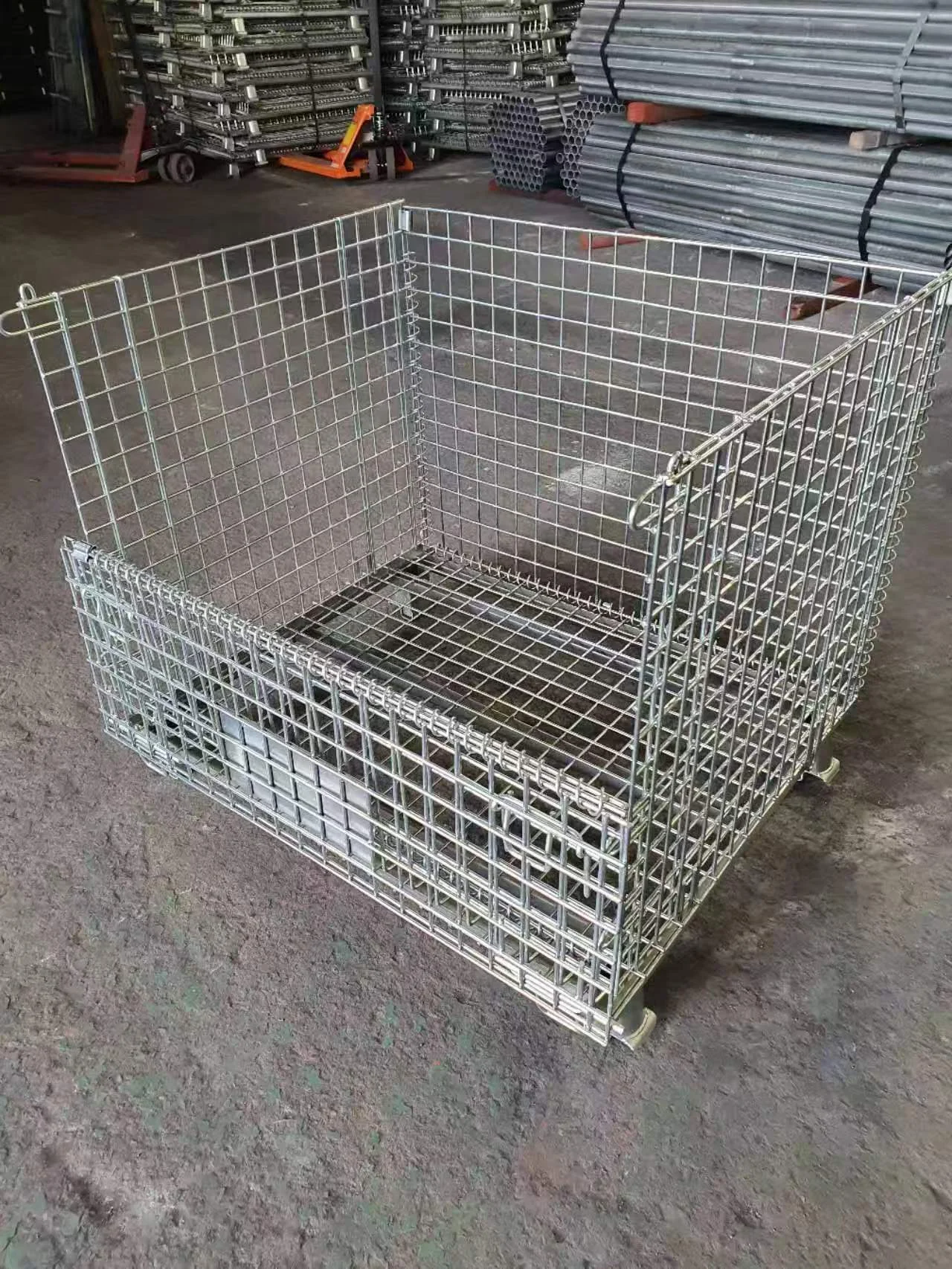
Handling belongs in the same table. Fork entry, pallet-jack entry and gate operation abrade the same few points on every cycle, and the lowered drop gate in the photo above is one of them: the gate frame, the latch area and the hinge wire take repeated contact that no flat-panel reading will detect. Project 13967’s risk note already asks for smooth fork entry and for periodic checks of the base and mesh; the coating clause should name the same locations so that damage is caught during inspection rather than after a corrosion complaint.
How to word the clause when there is no salt-spray grade and no test method
None of the three permitted project records contains a salt-spray grade, an exposure duration or a test method. That is a gap in the specification, not a finding about the product. The wording has to make the gap visible instead of converting it into an implied promise.
A clause that closes the gap without inventing anything reads like this:
Coating process: ______. Minimum zinc thickness: ______ μm, measured by ______ at the points marked on the drawing. Acceptance: every recorded reading is at or above the stated minimum. Coverage at welds, hinge wire, cut edges, stacking feet and gate frame: ______. Corrosion test: not recorded on this project and not claimed; if required, add the test standard, exposure duration, specimen and acceptance ______. Repair of damaged coating: ______. Documentation: ______.
- Write “not recorded” and “not claimed” as statements of fact, and keep them distinct from “not compliant”, which is a different conclusion.
- Strike any sentence that promises a number of years of anti-rust service, because no record supports one.
- Strike “passes salt spray” unless the standard, the duration and the result are named in the same document.
- Strike “suitable for outdoor use” when no process, thickness and acceptance method sit behind the sentence.
The distinction matters commercially. A project file with no salt-spray requirement is not a rejected product; it is an order where the requirement was never set. Naming that openly lets the buyer add a test if the site needs one, and it stops a supplier sentence about open-air use from being read later as a corrosion warranty.
What goes into the coating acceptance clause
Nine items turn a coating description into something a quality team can inspect at goods-in.
- The process route, named exactly as ordered, with no shorthand
- A minimum zinc thickness with its unit, and the instrument used to measure it
- The measuring points and the number of readings per unit
- Coverage requirements at welds, hinge wire, cut edges, stacking feet and gate frame
- Whether passivation is included, and if so as a separate line item
- The permitted repair method and the limit on repaired area
- Appearance acceptance for colour, roughness and surface defects
- A salt-spray or accelerated-corrosion test standard, duration, specimen and result, when the site requires one
- Packing protection and the surface damage that will be rejected on arrival
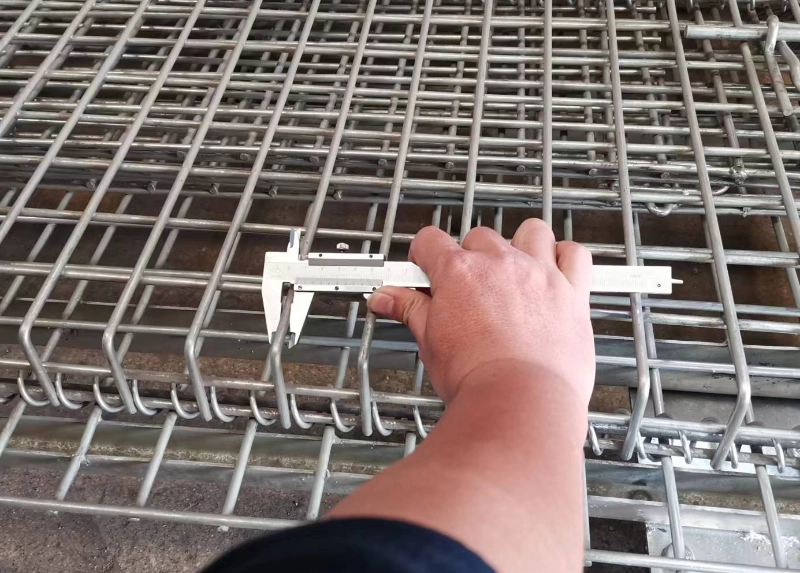
The inspection photo above is a dimensional check on wire gauge, and it is deliberately not presented as a coating measurement. It illustrates the discipline the clause needs: a defined instrument, a defined point and a recorded reading. Coating thickness requires its own gauge and its own recorded readings, and a wire-diameter report cannot stand in for either.
Preguntas frecuentes
Is hot-dip galvanizing always the better choice for outdoor storage?
No blanket answer is available. Hot-dip and cold zinc are different routes with different thickness ranges and different edge and weld behaviour. Which one fits depends on the environment, the acceptance method you can actually apply, and how much abrasion the cage sees. Project 15059 priced both routes for exactly this reason: the comparison belongs to the project, and the decision has to be made there.
Can we be quoted 40 μm on a cold-zinc route?
Thickness has to be matched to the route project by project. The 10 μm and 40 μm values in the 15059 note are recorded as a pair without their processes, so the correspondence has to be confirmed before either figure is written into a quotation. We do not confirm a thickness to a process in advance of that confirmation.
What happens if our specification only says “galvanized”?
Then the specification is incomplete, and we return a confirmation list instead of a price. Normally that list covers the process route, the target thickness and unit, the measuring method, the coverage points, any corrosion test the site requires, and the repair rule for transport damage.
Do these records let us promise a corrosion life in our own customer’s contract?
No. None of the three files records a salt-spray grade, a test method or a service-life figure, so no service life can be derived from them. If your customer requires a corrosion life, the test standard and the basis of that claim have to be agreed in writing before the order is placed.
What to send with a coating inquiry
Send the exposure environment first: indoor, covered, open yard, coastal, or a chemical and washdown regime. Then the coating target: process route, thickness and unit. Then the acceptance method you intend to apply at goods-in, including the instrument, the measuring points, any salt-spray standard and duration, the repair rule and the documentation you need. Add the load, stacking condition and preferred size, because coating is decided together with structure, not after it.
Those inputs come back as a technical confirmation list plus the drawing items that have to be fixed before a coating line is quoted. The same record structure sits behind the Stbox product page and the three underlying projects, so a confirmation returned on one project is not automatically valid on another.
¿Necesita una Solución de Almacenamiento a Medida?
Hable directamente con nuestros ingenieros técnicos. Ofrecemos diseños estructurales gratuitos, evaluaciones de catálogos para cargas pesadas y cotizaciones de precios B2B rápidas.
Solicitar un Presupuesto Ahora →