
A steel wire mesh cage rarely fails in an open yard because the steel was too thin. It fails because the finish was decided after the drawing, from a photograph, and never matched to the number of weeks a year that cage actually stands in the rain. By the time the first brown run appears along a weld, the order is paid for and the specification is already fixed.
So the order of decisions matters more than the coating brand: first the exposure, then the finish family, then the zinc thickness written on the drawing, and finally the acceptance wording that lets a QC team reject a bad batch. This article walks that sequence for collapsible mesh containers, and explains why a powder-coated square-tube frame and a galvanised mesh cage are not interchangeable answers to the same question.
Start With the Exposure Band, Not the Coating Name
Before comparing finishes, put the container in one of three exposure bands. Open yard: direct rain, overnight condensation, ground splash and standing water around the feet, with no roof and no drying airflow. Semi-enclosed or high humidity: a covered area or a plant with washing processes, where the cage stays damp for long periods but sees no direct rain. Dry indoor: a workshop or finished-goods hall where the cage is dry most of the year and mainly meets abrasion from handling.
A fourth case sits outside those three: the export leg. An empty folded cage travels in a closed container across climate zones, and condensation inside a container is still water on steel. The finish decision therefore has to cover the return journey, not only the months the cage spends loaded in your plant.
Geometry then separates the two finish families. A square-tube frame is a closed profile with broad, continuous, flat faces, which is what a paint or powder film needs to stay unbroken. A wire mesh container is a lattice of welded wire with cut ends, spiral hinge coils, formed stacking feet and a fold line on every panel joint. There are simply more places for a barrier film to thin out, chip, or be rubbed away every time the cage is folded and reopened. That is why the exposure band has to be read against the actual component, not against the steel grade.
Galvanised Mesh: Three Recorded Finishes From Three Different Projects
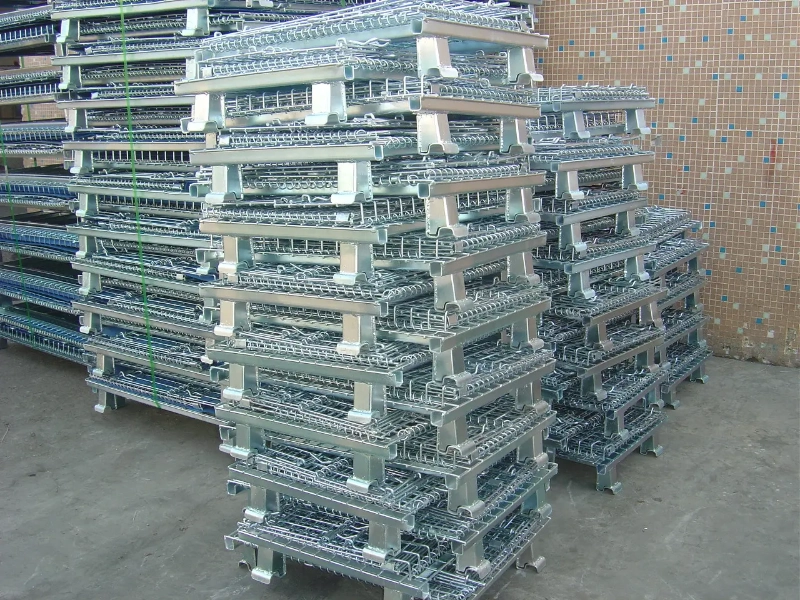
Our project records contain three different zinc figures, and they come from three different cages, not from one product with three upgrade levels. Opportunity 13967 covers an 800 × 1200 × 890 mm folding container with a 190 mm folded height, 5.8 mm wire, 50 × 50 mm mesh, 1,000 kg per cage and 47 kg tare, recorded with an electro-galvanised coating of ≥ 8 µm (the recorded dimension orientation still needs drawing confirmation on that one). Opportunity 15217 covers a 1050 × 1050 × 1000 mm cage, 50 × 50 mm mesh, Φ6.0 ± 0.1 mm wire, 1,000 kg per cage, four-high stacking with an upper-cage load limit of 1,200 kg and 53 kg tare, recorded with cold galvanising at 10 µm. Opportunity 15059 covers a 1000 × 800 × 840 mm cage, 50 × 50 mm mesh, Φ6 mm wire, Q235, 1,400 kg per cage, four-high stacking with an upper-cage limit of 2,000 kg and 42 kg tare, recorded with cold or hot galvanising at 10 µm or 40 µm.
Read those three lines the way an engineer reads them: as project outcomes, not as a ladder from cheap to best. A buyer who copies the 8 µm figure onto a cage that will stand outside for years has chosen a number from a different brief. A buyer who writes 40 µm onto an indoor WIP cage may be buying coating build that the process never needed. Cold and hot galvanising are also not interchangeable words, and which one a given design can actually be produced with has to be confirmed on the drawing and in the acceptance discussion, not inferred from a blog post.
Where a Standard Powder-Coated Square-Tube Frame Still Fits
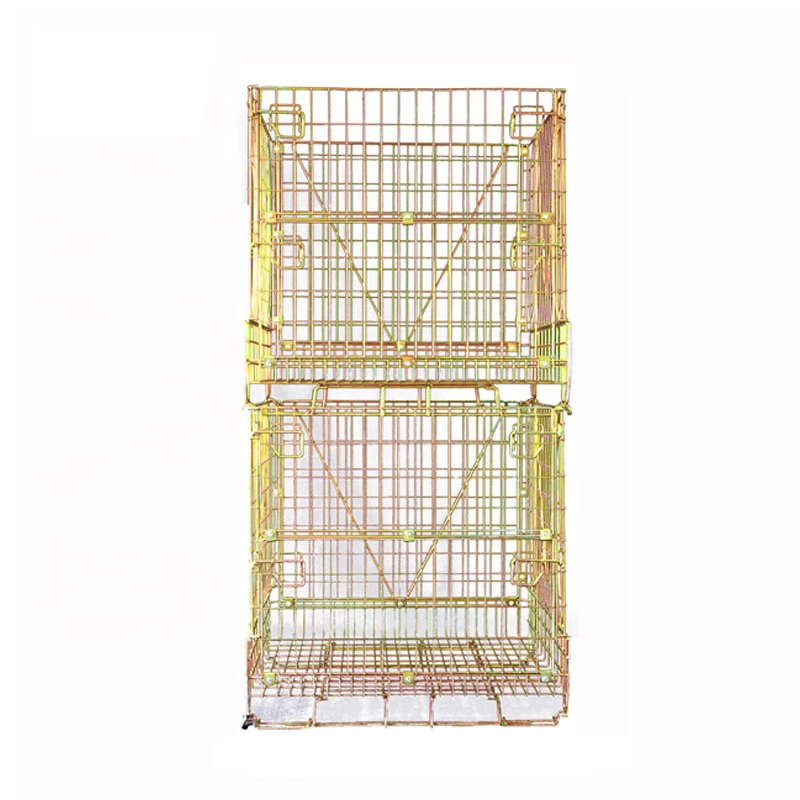
Powder coating is a barrier film. It keeps water off steel as long as the film stays whole, and it gives a clean, uniform, coloured surface that holds up well in a dry hall where the main threat is scuffing rather than moisture. For a folding box that lives indoors, moves between dry stations and is judged partly on appearance, that is a reasonable engineering choice, and it is why square-tube folding boxes exist alongside mesh cages.
What a standard powder-coated frame is not is a sacrificial coating. Once the film is broken, at a fork pocket entry, a chip on a fold edge, a weld seam or a scored side panel, the exposed steel has no zinc left to corrode in preference to it, and rust starts from that point outward. On a mesh cage there is an additional abrasion source the frame does not have: the panels fold against each other and the hinges travel on every cycle, so the finish at those joints is being worked mechanically as well as wetted. If a container is going to sit in an open yard, be dragged across wet concrete and be handled by forklift several times a day, the honest answer is galvanising first and appearance second, not a standard powder coat presented as weather protection.
We will not claim that every galvanised cage is suitable for permanent outdoor service either. The finish family gets you into the conversation; the thickness, the drainage behaviour of the base and the inspection routine decide whether it survives. The related comparison between a mesh cage and a square-tube folding box is covered in more detail in STBOX vs. MYBOX: choosing between a collapsible mesh cage and a square-tube folding box.
How to Write Zinc Thickness Into a Project Specification
A zinc figure is only enforceable if it is written with its measurement rules. Copying “galvanised” or “10 µm” onto a purchase order leaves the supplier free to measure where it suits them, and leaves your incoming inspection with nothing to reject against. Six items make the requirement usable:
- Name the process, not the colour. Electro-galvanised, cold galvanising and hot-dip galvanising produce different zinc build and must be stated as the process the drawing was costed against.
- State a minimum thickness in µm, with the unit. A recorded figure such as ≥ 8 µm, 10 µm, or 10 µm / 40 µm for cold versus hot is a project requirement; the minimum, not an average, is what inspection can hold.
- Define where it is measured. Readings belong on representative mesh surfaces and frame faces, agreed in advance with the way welds, cut wire ends and fold edges are handled, because those are the locations that decide whether water reaches bare steel.
- Fix the reading count and the accept/reject rule. How many points per cage, per batch or per lot, who measures, and what happens if one point falls below the minimum.
- Extend the requirement to the whole item. Hinges, stacking feet, the underside of the base and the inside of the cage are the parts that fail first in a yard, and a specification that only covers the outside of the side panels is not a specification.
- Keep salt spray and corrosion years out unless your own project defines them. A test standard, a duration, a laboratory and a service life have to come from a project acceptance document. None of our three records carries a salt spray grade or a corrosion-year figure, and we will not invent one to fill a table.
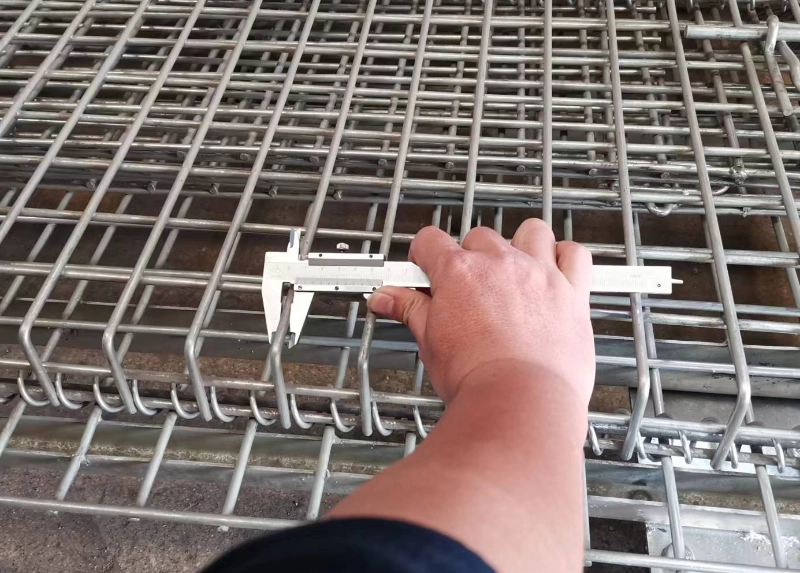
Note what the inspection photograph above shows: wire diameter being checked with a caliper, which is a separate control point from coating thickness. A supplier who measures wire carefully is not automatically proving zinc build, and a project that cares about outdoor life should ask for both, each with its own method.
Why We Will Not Quote One Anti-Rust Life for Every Yard
The same coating thickness can give two very different service outcomes because the variables that decide corrosion are not in the coating number. Wet hours per year, whether the base traps water behind the channel reinforcement, chloride load from coastal air or road salt, grit abrasion from forks and from dragging on concrete, the number of fold cycles the hinges see, how empty cages are stacked so that water drains or pools, and damage from strapping or from a fork entering at an angle: all of these act on the finish after it leaves the line. Two identical cages can leave the same galvanising bath and be judged one year and four years later.
That is not a reason to avoid specifying the finish. It is a reason to specify it correctly and then inspect it. For an outdoor fleet, the practical package is a named process, a minimum thickness with measurement points, coverage of hinges, feet and base, and a scheduled visual check of those same locations so that a fault is found while it is still cosmetic instead of structural. Buyers who want a single number in years should treat that number as a commercial assumption they carry themselves, not as something a supplier can honestly put in writing.
A Short Selection Rule for Yards, Docks and Sea Freight
- Open yard, rain all year: choose a galvanised mesh cage, and fix the zinc requirement in writing with the measurement points before the order. Decide at the same time how empty cages will be stacked so the base can drain.
- Coastal yard or road-salt exposure: treat the coating as a project-specific corrosion requirement, agreed and accepted separately. Our standard records do not cover chloride service and cannot be extended to it.
- Mixed plant: one finish per exposure band rather than one finish for the whole fleet, so the indoor cages do not carry the cost of the outdoor requirement or the reverse.
- Dry indoor workshop: a powder-coated square-tube frame is a fit where appearance and colour matter and abrasion is controlled, provided nobody expects it to behave like zinc once the film is damaged.
- Export and return leg: the folded empty cage is also exposed, so the finish decision covers transport and return, not only the loaded months. Loading plans for folded units are discussed in folded height and container count planning.
- Repeat-use fleets: check welds, hinges and feet as wear items during the same inspection that checks the coating; reuse cycle counts and container economics explains why the surviving finish, not the purchase price, drives the cost per shipment.
Questions Buyers Ask Before Approving the Finish
Which finish should we choose for an open yard?
For a container that stands in the open through the rainy season, a galvanised finish on a mesh cage is the starting point, not a standard powder coat on a square-tube frame. Galvanising gives zinc that corrodes in preference to the steel at damaged points; a paint or powder film relies on staying whole. Then write the zinc thickness, the measurement points and the coverage of hinges, feet and base into the order, and agree drainage and stacking practice for the empty units.
What zinc thickness can we put in the purchase order?
Our records show three project outcomes: ≥ 8 µm electro-galvanised on one container, 10 µm cold galvanising on another, and 10 µm or 40 µm for cold or hot galvanising on a third. Each belongs to a specific size, load and finish brief. Choose the one that matches your exposure and confirm with the drawing before quoting, rather than treating any of the three as the general figure for the product. If your service is coastal, or the cage is expected to sit outside for years, the requirement has to be agreed as a separate corrosion specification with its own acceptance wording.
Why can you not give a single anti-rust life in years?
Because the permitted project records contain coating thickness measurements, not weathering test results: no salt spray grade, no test laboratory and no service-life figure. Service life is set by wet hours, chloride, abrasion, fold cycles and how water drains from the base, not by the coating number alone. What we can put in writing is the process, the minimum thickness with measurement points, the inspection locations and the intervals at which you should re-check them.
What to Send for a Finish Recommendation
Four items are enough for a usable answer: where the cage will be stored and for how many weeks a year, whether chloride is present, how it will be handled and how often it will be folded, and whether the coating must pass your own incoming inspection. With those on the table, the finish family and the zinc wording can be fixed before the drawing is released. If your enquiry has already gone out under the wrong product name, the terminology patterns behind that are described in customer terminology errors that misroute folding cage inquiries, and it is worth resolving before a finish is specified.
¿Necesita una Solución de Almacenamiento a Medida?
Hable directamente con nuestros ingenieros técnicos. Ofrecemos diseños estructurales gratuitos, evaluaciones de catálogos para cargas pesadas y cotizaciones de precios B2B rápidas.
Solicitar un Presupuesto Ahora →