
Lagergeführte Kabeltrommel-Abwicklung – Rollenlager-Regal
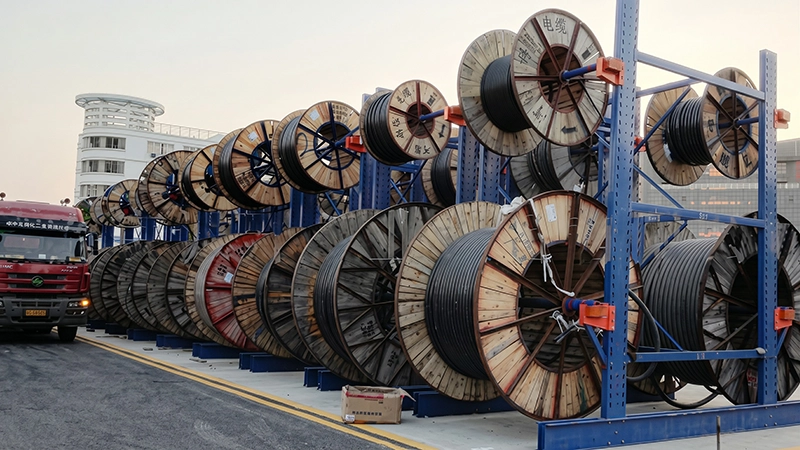
Rollenlager-Stützen lassen eine Kabeltrommel im Regal rotieren, während Kabel abgezogen wird — kein Abheben der Trommel zum Abrollen. Keine automatische Bremse oder Drehsicherung; die Abwicklung wird vom Bediener gesteuert. Konfiguriert aus Ihrer Trommelliste, mit dokumentierten Projektreferenzen für Zwei-Ebenen-Bänder und verzinkte Außenlagerung.
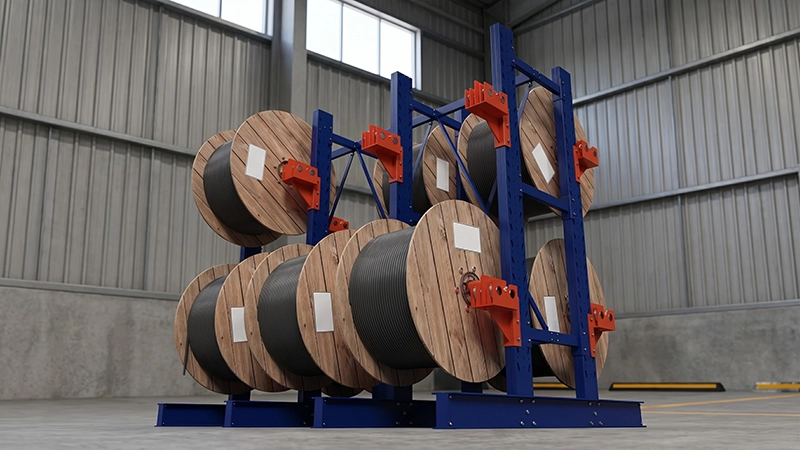
Kabel von der Trommel abrollen, ohne die Trommel aus dem Regal zu nehmen
Carack ist ein modulares Stahltrommel-Regal. Wenn ein Arbeitsplatz Kabel abziehen muss, die Trommel aber in ihrem Fach bleibt, liegt die Trommel auf einem Paar Rollenlager-Stützen, die an den Ständern verschraubt sind – so dreht sich die Trommel im Regal, anstatt abgehoben, umgesetzt und erneut aufgebaut zu werden.
Die Lagerstützen sind ein Handhabungshilfsmittel, kein Antrieb. Sie tragen die Trommel und lassen sie rotieren; sie ziehen das Kabel nicht, halten keine Spannung und bremsen die Trommel nicht selbst. Abwickelgeschwindigkeit, Start und Stopp werden vom Bediener gesteuert. Die Stützhöhe wird über gestanzte Ständerbohrungen eingestellt – die dokumentierten Ausführungen verwenden einen Lochabstand von 100 mm – und die Anzahl der Ebenen, Fächer und Rahmen ergibt sich aus Ihrer Trommelliste, nicht aus einem festen Katalogmodell. Wenn der Prozess erfordert, dass die gesamte Trommel aus dem Regal genommen wird, wird derselbe Rahmen um die Gabelstaplerfreiheit und den Herausnahmepfad herum geplant statt um die Abwicklung.
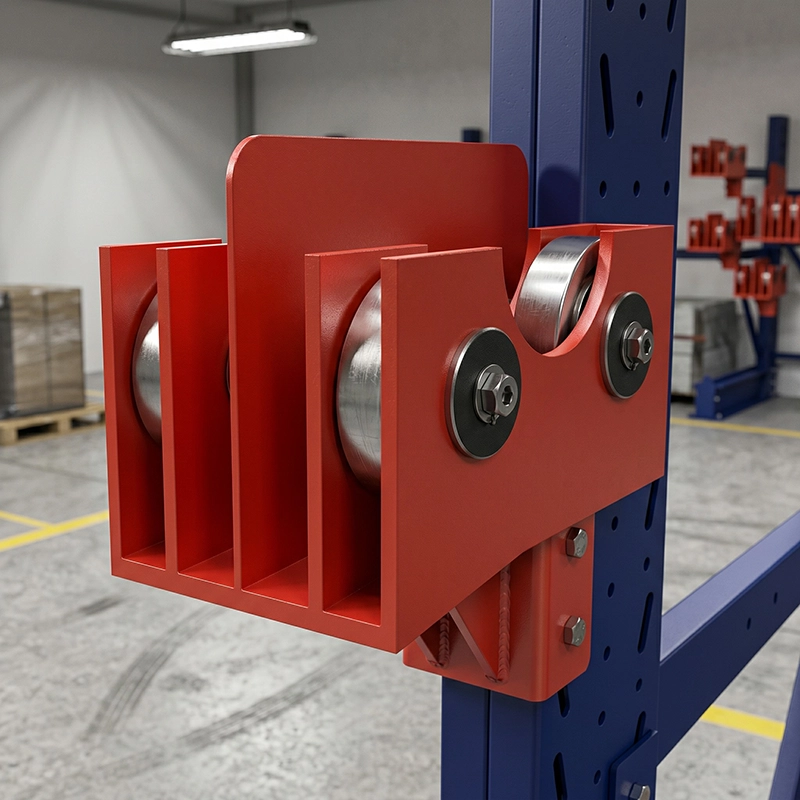
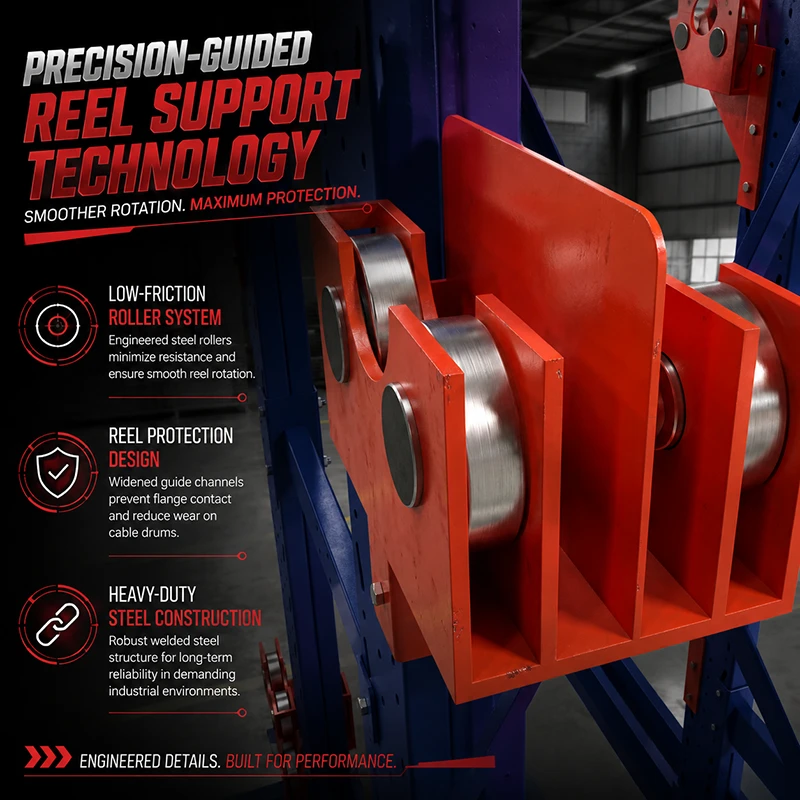
- Rollenlager-Stützen: Zwillings-Stahlrollen pro Konsole lassen die Trommel in ihrem Fach rotieren, während Kabel abgezogen wird.
- Stützhöhe an gestanzten Ständern: 100 mm Lochabstand in den dokumentierten Projekten, sodass die Abwickelhöhe dem Trommeldurchmesser folgt.
- Hauptrahmen plus Hilfsrahmen: Ein Hilfsrahmen mit einer einzelnen Ständersäule kann nicht eigenständig verwendet werden; er ist auf die andere Seite des Hauptrahmens angewiesen.
- Durchmesserbänder: Kleinere Trommeln in Zwei-Ebenen-Fächern, große Durchmesser in Ein-Ebenen-Fächern, festgelegt anhand Ihrer eigenen Trommelliste.
Drei Möglichkeiten, dasselbe Fach zu bauen – wählen Sie nach der Art, wie das Kabel die Trommel verlässt
Abwicklung im Lager
Rollenlager-Stützfach
Die Trommel bleibt in ihrem Fach und dreht sich auf Zwillingsrollen, während am Arbeitsplatz Kabel abgezogen wird. Geeignet für kurze, wiederholte Abzugs Vorgänge, bei denen das Umsetzen einer vollen Trommel in einen anderen Bereich ein zusätzlicher Handhabungsschritt wäre.
 Ganztrommel-Handhabung
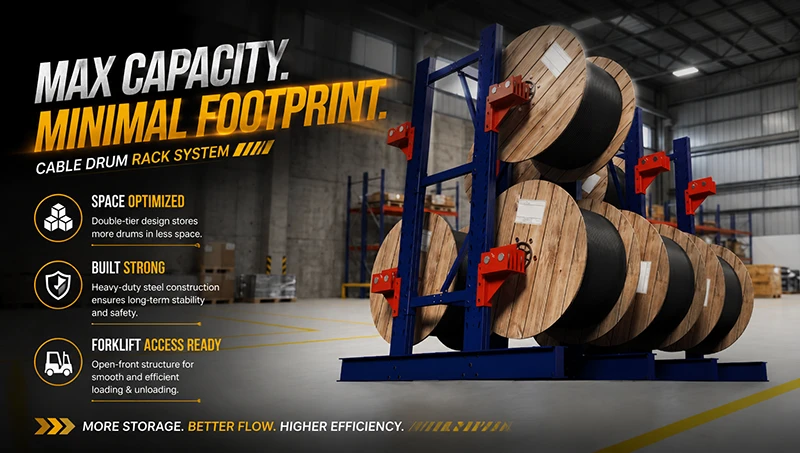
Statisches Stützfach für Gabelstapler-Entnahme
When the drum is lifted off and moved to another area, the bay is planned around forklift clearance and the removal path rather than around the unwinding. A roller bearing support is not required if the drum never rotates on the rack.
 Free storage
Galvanized outdoor unwinding station
Projektreferenz 14554 war ein Außenlager mit Abwicklungsanforderung: Trommeln mit Ø1.400 mm × 800 mm, ein Hauptrahmen plus zwei Hilfsrahmen sowie eine für diesen Standort spezifizierte verzinkte Oberfläche.
A storage support, described as a storage support
Rotation, not automation
The roller bearing bracket lets the drum rotate. There is no automatic brake, no rotation lock, and no tension control in the documented configuration, so the drum can keep turning due to its own inertia and the operator controls the tension. A process that requires holding torque or a blocked drum needs a separate device, which is confirmed during the inquiry phase.
Configured according to your drum list
Ein dokumentiertes Projekt umfasste 22 Trommeltypen: 500–3.000 kg, Ø737–2.007 mm, Trommelhöhe 610–1.118 mm. Es wurde in einen zweistöckigen Bereich mit vier Trommelpositionen pro Rahmen und einen einstöckigen Bereich mit zwei Positionen aufgeteilt. Dies sind die Werte dieses Projekts, nicht eine Katalogkapazität.
Unwinding height follows the drum
Die Stützen sind gelocht, sodass die Stützkonsolen versetzt werden können: 100 mm Lochabstand in den dokumentierten Konstruktionen. So bedient eine Regalreihe mehrere Durchmesser ohne ein zweites Satz von Fächern – der endgültige Abstand und Bereich werden in der Zeichnung für Ihre Konfiguration bestätigt.
Technical elaboration before quotation
For Carack, no universal nominal load capacity, standard overall size, or stacking limit is published. Each bay is checked against the actual drum weight, the support spacing, and the load path, and anything that cannot be confirmed from your data is phrased as to be confirmed, not offered as standard.
From the drum list to the installed unwinding station
Send the drum list
Per drum type: outer diameter, drum width, center bore, weight, and quantity – as well as which drums are actually unwound on site and which are only stored.
Layout and support selection
Number of bays, single or double stack, single or double sided, roller bearing or static support, and the aisle you need to keep clear for the forklift.
Drawing and quotation
Project drawing with support positions, payout heights, forklift clearance and surface finish. Load ratings are confirmed against your drum list, not taken from a catalogue number.
Manufacturing, delivery, installation
Die Regale werden zerlegt versandt und vor Ort montiert. Als Referenz wurde das Freilandprojekt 14554 mit etwa 1 m³ pro Regalgruppe und einem längsten Teil von 3.000 mm versendet.
Questions this page needs to answer
Do the bearing cradles brake or lock the drum automatically?
No. These are rolling bearing cradles: they carry the roll and let it rotate, and nothing in the documented configuration brakes it, locks it against rotation or holds it under tension. A loaded drum can keep turning on its own momentum after the pull stops, so payout is controlled by the operator. If your process needs holding torque, a locked drum or controlled deceleration, that is a separate device and must be specified as its own line item.
How is this different from a pay-off machine or an A-frame de-reeler?
A pay-off machine or de-reeler is built around a single roll – spindle, guide and often drive or tension control – for continuous payout. Carack is a storage rack: the roll keeps its bay and the drum turns on the cradles when someone pulls cable from it. There is no motor, no capstan, no tension control and no guarantee of continuous high-speed payout. If payout runs from one roll for a whole shift, a de-reeler is the right machine; if rolls are stored and retrieved a few times a day, the rack does both jobs.
Which sites suit a rack with payout?
Sites where cable is pulled from stored rolls at access height, which hold several roll diameters in a row, and where lifting a full drum off the rack and transporting it to a payout area is an avoidable extra handling step. It also suits sites where the payout position is the storage position – cable is taken where the roll already stands.
When is this the wrong choice?
When payout is continuous or fast, when tension or braking control is part of the process, when a drum must be held on a slope, or when a roll is de-reeled from a fixed stand for a whole shift – all of these point to a dedicated pay-off machine. And if whole rolls are only ever removed by forklift on site, the roller bearing option adds cost without benefit: a static cradle is enough.
Can the payout bays be installed outdoors?
Yes, with the surface finish agreed for that site. Project 14554 was an outdoor store with a payout requirement and a galvanised finish specified for that project – that finish is a project requirement, not standard on every Carack rack. An outdoor rack also needs drainage, cut-edge protection and a maintenance inspection: standing water in a hollow section shortens service life.
Is there a published load capacity per roll position?
Nein. Es gibt keine universelle Carack-Belastungstabelle, daher wird hier keine Tragfähigkeit angegeben. Die dokumentierten Projekte tragen Rollengewichte bis zu 3.000 kg, aber das ist die Rollenliste eines Projekts, keine Regal-Tragfähigkeit. Jede Aufnahme wird vor der Angebotserstellung gegen das tatsächliche Rollengewicht, den Aufnahmeabstand und die Rahmenkonfiguration geprüft.
What do I need to provide for a payout layout?
Your roll list (diameter, drum width, centre bore, weight, quantity per type), which rolls are de-reeled on site, the floor area or hall dimensions with the aisle to keep clear, your forklift data (capacity, fork length, lift height, turning radius) and whether the rack stands indoors, under cover or outdoors.