
Bearing-Supported Cable Reel Rack for Payout While Stored
Rolling-bearing supports let a cable drum turn on the rack while cable is drawn off — no lifting the reel off to pay it out. No automatic brake or anti-rotation lock; payout is operator-controlled. Configured from your reel list, with documented project references for two-level bands and outdoor galvanized storage.
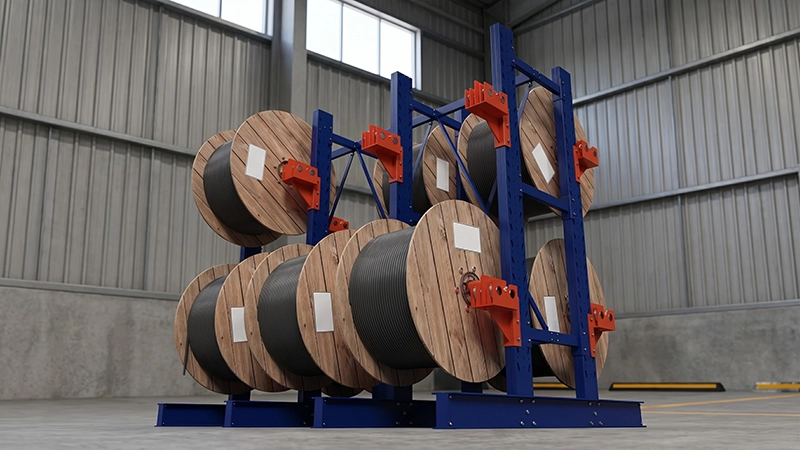
Take cable off the drum without taking the drum off the rack
Carack is a modular steel cable drum rack. When a workstation has to pull cable while the reel stays in its bay, the drum is carried on a pair of rolling-bearing supports bolted to the uprights, so the reel turns on the rack instead of being lifted off, moved and set up again.
The bearing supports are a handling aid, not a drive. They carry the reel and let it rotate; they do not pull the cable, hold tension or stop the drum by themselves. Payout speed, start and stop are controlled by the operator. Support height is set on punched upright holes — the documented designs use a 100 mm hole pitch — and the number of levels, bays and frames comes from your reel list, not from a fixed catalogue model. Where the process needs the whole reel taken off the rack, the same frame is laid out around fork clearance and the lift-out path instead of around payout.
- Rolling-bearing supports: twin steel rollers per bracket let the drum rotate in its bay while cable is drawn off.
- Support height on punched uprights: 100 mm hole pitch in the documented projects, so the payout height follows the reel diameter.
- Main frame plus auxiliary frames: an auxiliary frame with a single upright column cannot be used on its own; it depends on the main frame’s other side.
- Diameter bands: smaller reels in two-level bays, large diameters in single-level bays, decided from your own reel list.
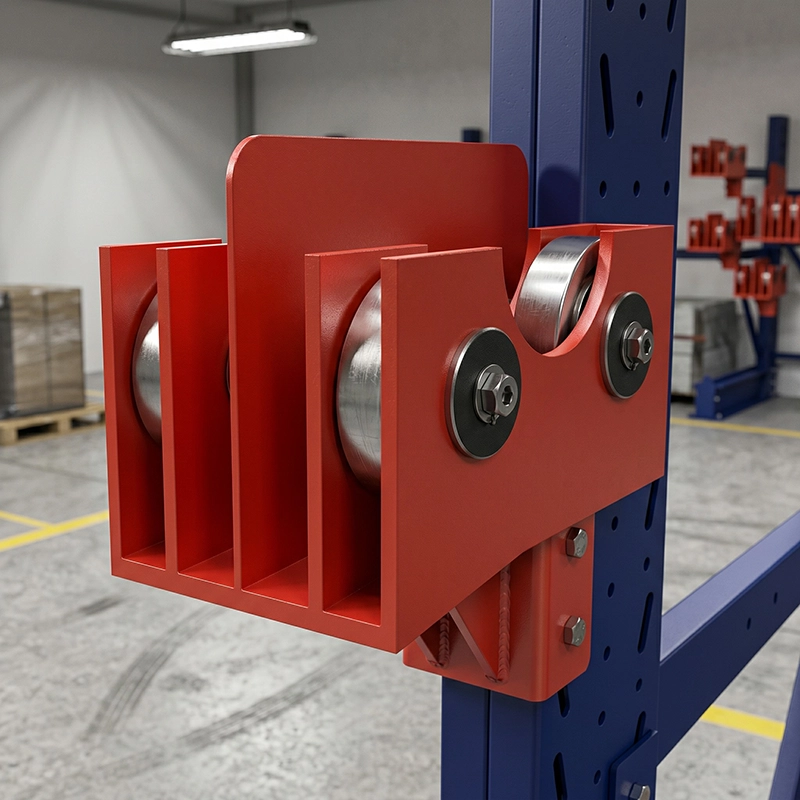
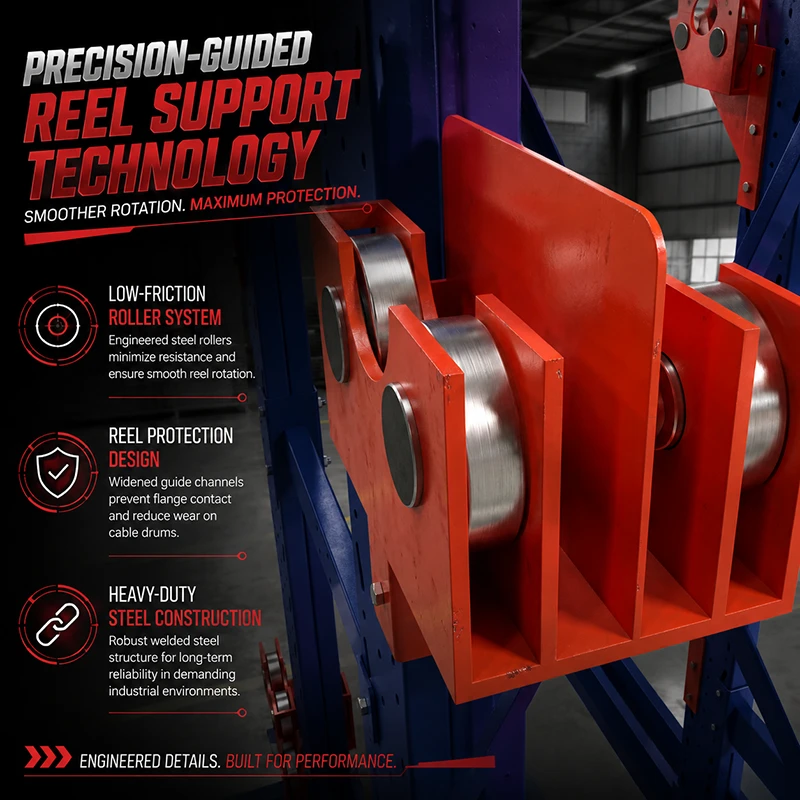
Three ways to build the same bay — pick by how the cable leaves the reel
Payout while stored
Roller-bearing support bay
The reel stays in its bay and turns on twin rollers while cable is drawn off at the workstation. Suited to short, repeated pulls where moving a full drum to another area would be an extra handling step.
Reel position: stays in the bay during payout
Brake / anti-rotation: not included — payout is operator-controlled
Adjustment: support height on punched upright holes
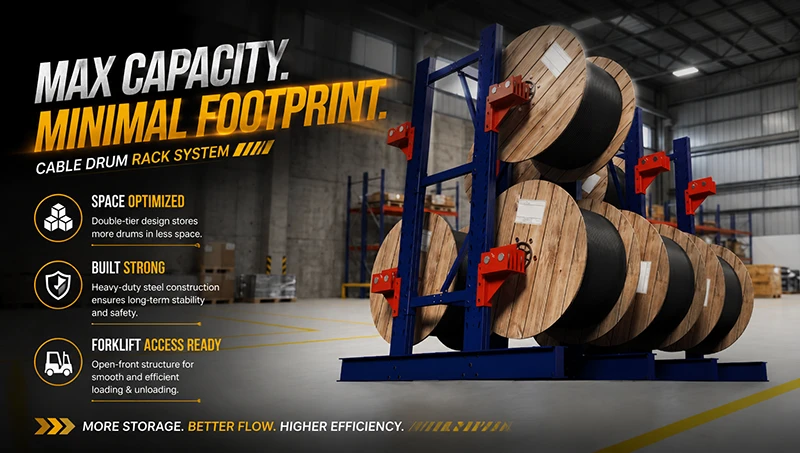
Whole-reel handling
Static support bay for forklift take-off
Where the drum is lifted off and taken to another area, the bay is laid out around fork clearance and the lift-out path rather than around payout. No roller-bearing support is needed if the reel never turns on the rack.
Handling: forklift or a dedicated handling device
To confirm: fork entry, lift height, spindle or centre-hole path, bracket edge clearance
Levels: two-level or single-level by reel diameter band
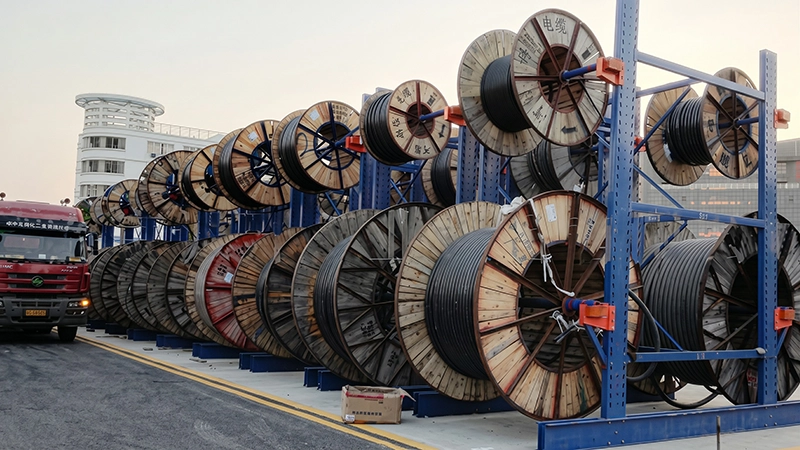
Outdoor yard
Galvanized outdoor payout bay
Project reference 14554 was an outdoor store with a payout requirement: reels of Ø1,400 mm × 800 mm, one main frame plus two auxiliary frames, and a galvanized finish specified for that site.
Structure: main frame + 2 auxiliary frames, 4 reel positions per frame unit
Overall size in that project: 3,000 × 3,000 mm; main frame ≈583 kg, auxiliary ≈302 kg
Finish: galvanized to that project’s requirement — not a standard for every Carack rack
A bearing support, described as a bearing support
Rotation, not automation
The rolling-bearing bracket lets the drum turn. There is no automatic brake, no anti-rotation lock and no tension control in the documented configuration, so the reel can keep turning on its own momentum and the operator controls the pull. A process that needs holding torque or a locked drum needs a separate device, confirmed at inquiry stage.
Configured from your reel list
One documented project carried 22 reel types: 500–3,000 kg, Ø737–2,007 mm, reel height 610–1,118 mm. It was split into a two-level band with four reel positions per frame unit and a single-level band with two. Those are that project’s figures, not a catalogue capacity.
Payout height that follows the reel
The uprights are punched so the support brackets can be moved: 100 mm hole pitch in the documented designs. That is how one rack row serves several diameters without a second set of bays — the final pitch and range are confirmed on the drawing for your configuration.
Engineering before quotation
No universal rated capacity, standard overall size or stack limit is published for Carack. Each bay is checked against the actual reel weight, the support spacing and the load path, and everything that cannot be confirmed from your data is written as to be confirmed rather than quoted as a standard.
From reel list to an installed payout bay
Send the reel list
Per reel type: outer diameter, drum width, centre bore, weight and quantity — plus which reels are actually paid out in place and which are only stored.
Layout and support selection
Bay count, single or two-level, single or double sided, roller-bearing or static support, and the aisle you have to keep clear for the forklift.
Drawing and quotation
Project drawing with support positions, payout heights, fork clearance and surface finish. Capacities are confirmed against your reel list, not taken from a catalogue number.
Manufacture, delivery, installation
Racks ship knocked down and are assembled on site. As a reference, the 14554 outdoor project shipped at about 1 m³ per rack group with a 3,000 mm longest piece.
Questions this page has to answer
Do the bearing supports brake or lock the drum automatically?
No. They are rolling-bearing supports: they carry the reel and let it rotate, and nothing in the documented configuration brakes it, locks it against rotation or holds tension. A loaded drum can keep turning on its own momentum after the pull stops, so payout is operator-controlled. If your process requires holding torque, a locked drum or controlled deceleration, that is a separate device and has to be specified as its own item.
How is this different from a pay-off machine or an A-frame pay-out stand?
A pay-off machine or stand is built around one reel — spindle, guide, and often drive or tension control — for continuous payout. Carack is a storage rack: the reel keeps its bay, and the drum turns on the supports when someone pulls cable off it. There is no motor, no capstan, no tension control and no guarantee of continuous high-speed payout. If payout runs all shift from one reel, a pay-off stand is the right device; if reels are stored and drawn from a few times a day, the rack does both jobs.
Which sites does a bearing-supported rack suit?
Sites that draw cable off stored reels at a walk-up height, that hold several reel diameters in one row, and where lifting a full drum off the rack and moving it to a payout area is an avoidable extra handling step. It also suits sites where the payout position is the storage position — the cable is taken where the reel already sits.
When is this the wrong choice?
When payout is continuous or fast, when tension or brake control is part of the process, when a drum has to be held on a slope, or when one reel is paid out from a fixed stand for a whole shift — those point to a dedicated pay-off machine. And if the site only ever takes whole reels off with a forklift, the roller-bearing option adds cost without adding anything: a static support bay is enough.
Can the payout bays be installed outdoors?
They can, with the surface treatment agreed for that site. Project 14554 was an outdoor store with a payout requirement and a galvanized finish specified for that project — that finish is a project requirement, not a standard on every Carack rack. An outdoor rack also needs drainage, cut-edge protection and a maintenance check: water standing inside a hollow section is what shortens service life.
Is there a published rated capacity per reel position?
No. There is no universal Carack load table, so no rated capacity is quoted here. The documented projects carry reel weights up to 3,000 kg, but that is one project’s reel list, not a rack rating. Each support is checked against the actual reel weight, the support spacing and the frame configuration before a quotation is issued.
What do I have to send to get a payout layout?
Your reel list (diameter, drum width, centre bore, weight, quantity per type), which reels are paid out in place, the floor strip or hall dimensions with the aisle you must keep clear, your forklift data (capacity, fork length, lift height, turning radius), and whether the rack stands indoors, under a canopy or in the open.
B2B Racking Structural Engineering Calculator
Input your structural guidelines below. Our math system calculates material deflection, stress bounds, and recommends optimal profiles.
Click Compute to calculate stress factors and display structural drawing recommendations.