
When a forklift inserts its forks into a stacking rack, the most easily overlooked issue is not the forklift's nominal load capacity, but whether there are sufficiently straight guides on the floor during fork insertion. For warehouse managers, bent floors, damaged upright bases, and weld seam damage rarely result from a single overload, but rather from repeated daily occurrences of angled insertion or excessively fast entry.
In a motorcycle transport rack project (project file 14922), an entry height of 100 mm was documented for the foldable, stackable steel rack from Mytrack. This dimension is to be understood as the entry clearance of the project-specific configuration, not as a general commitment for all sizes and variants. Its practical value lies in providing the forklift driver with an observable, controllable insertion limit: after aligning the forks, insertion occurs at a steady speed, not through a jolt where the forklift literally "spits" the rack.
The 100 mm entry height initially resolves the insertion limit
If the forks are not inserted far enough, the fork tips may only support a small area of the floor; if inserted too deeply or at an unsuitable height, floor beams, upright bases, or weld joints may be struck. The project-specific entry clearance of 100 mm offers the forks a clearly defined vertical insertion zone, allowing the operator to perform insertion slowly, horizontally, and centered. The point is not that the forklift may arbitrarily push against the rack, but rather to turn "where the forks are to be inserted" into an actionable on-site standard.
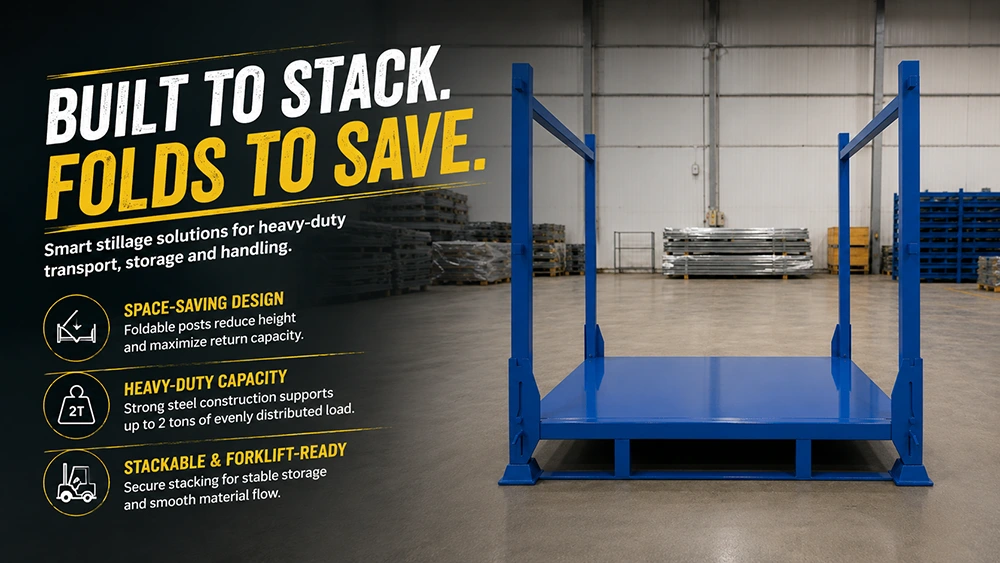
On the unfolded rack, the four corner uprights, the lower support frame, and the forklift entry openings are visible. For the facility manager, the inspection focus lies on whether the forks are fully inserted into the intended support area and whether the forklift mast remains in straight alignment. If fork thickness, fork length, fork spacing, or the forklift's turning radius do not match the operating environment, suitability should not be decided solely based on "100 mm" – first, fork type and fork dimensions must be coordinated with the supplier.
How do you protect the floor, uprights, and welds? The key lies in avoiding impact loads
Floor damage typically occurs at three moments: fork tips strike the floor beam due to misalignment, the forklift drives in hard at speed causing an impact, or one fork enters first while the other continues pushing, creating angled stress. The corresponding protective measures are simple: before insertion, align the rack and forklift approximately parallel; adjust mast and fork height so the forks glide horizontally through the entry clearance; approach at low speed first and then insert steadily; only lift or transport once both forks are evenly loaded and have the same insertion depth.
Mytrack's foldable design with removable and inward-folding uprights serves return transport and storage space optimization; it is not intended as a buffer for forklift impacts. Especially when the rack is folded, the uprights are not in normal working position, or the floor has been raised by foreign objects, forklift operations must be stopped and the condition re-checked. The forklift driver must not align the rack by pushing against the uprights, nor continue accelerating if the forks are angled.
What work steps should the facility manager specify for on-site forklift operations?
It is advisable to incorporate the following sequence into shift handovers, rather than only demanding accountability once cracks become visible on the rack:
- Check first, then insert: Ensure the rack is unfolded and locked, and the entry area is free of cartons, wooden blocks, or other obstacles.
- Approach centered: The forklift stands frontally to the rack, both forks are at the same height; angled insertion, insertion with only one fork, or searching for the entry opening with the fork tip are prohibited.
- Insert at steady speed: Enter the 100 mm project entry clearance with a low, continuous, impact-free motion; stop immediately upon resistance, do not force through.
- Only lift after confirmation: Ensure the forks have fully taken up the floor, personnel have moved out of the danger zone, and only then lift, turn, and stack evenly.
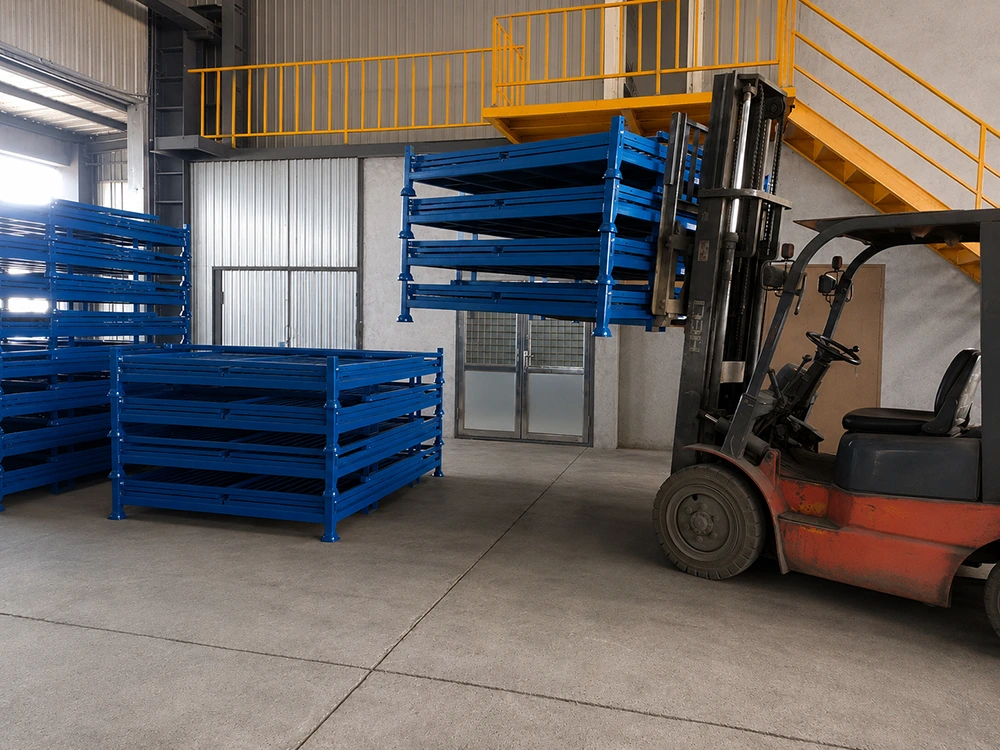
If frequent moving rather than stacking with the forklift is required on site, a mobile variant with wheels may be more suitable; if returning empty racks and space-saving storage are the priority, the foldable design offers greater benefit; if the load must be removed from the side, configurations with articulated cross braces and ring pull bolts can be discussed further. However, these are application decisions – the dimensions, load capacities, or attachments of other variants cannot automatically be transferred to the documented 100 mm entry clearance of this project.
How can the entry design be linked to ongoing maintenance?
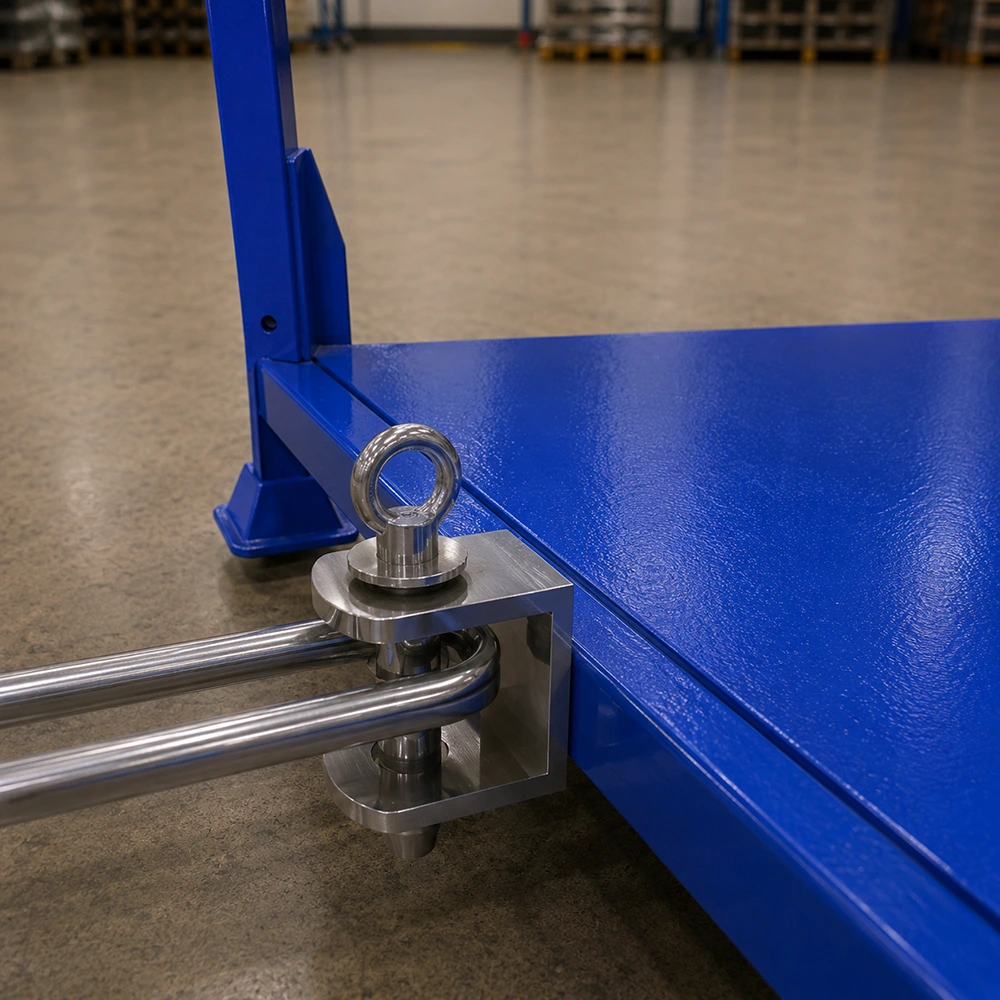
After any collision, jammed forks or exceptional oblique loading, the floor supports, stand feet, pivot points and welds must be visually inspected. In the event of bending, cracks, visible deformation or locking elements that no longer engage properly, the frame must be locked out and must not be stacked further. The following detailed view shows the removable ring pull bolt with tubular cross brace; these connecting elements must remain functional and must not be bypassed by makeshift welding or forceful hammering.
For which deployment locations is the Mytrack 100 mm fork entry height suitable?
- Suitable for warehouses and production lines where the rack is transported, stacked, and handled by forklift and straight, even insertion is possible.
- Suitable for facility managers who fear repeated impacts on the floor and welds and want to standardize operations through clear entry limits.
- Not suitable for adopting the 100 mm configuration without verification, without coordinating fork type, fork dimensions, and floor conditions on site.
- Not suitable for using the rack as a pushing tool or for using angled positions, impacts, or single-tine operations to correct positioning.
Häufig gestellte Fragen
What is the fork entry height of the Mytrack?
In project file 14922, a fork entry height of 100 mm is documented. This value refers to the respective recorded configuration and should be checked together with fork type and fork dimensions before procurement.
How do you protect the floor of a stacking rack?
Align the forklift centrally with the rack, insert the forks horizontally and at a uniform speed; stop immediately if there is resistance – forced insertion, impact on the floor support, or alignment with only one fork is prohibited. After any exceptional impact, check floor supports, upright feet, and welds.
What else should be considered during forklift operation?
Only lift when the rack is unfolded and locked, the entry area is clear, and both forks are flush and fully inserted. For suitability testing, specify fork type, fork length, fork thickness, aisle dimensions, and the type of load in advance.
Does your forklift constantly damage the racks? Tell us the fork type – we will discuss a suitable solution based on the entry limits and the requirements of the on-site workflows.
Melden Sie Ihr GabelstaplermodellBenötigen Sie eine individuelle Lagerlösung?
Sprechen Sie direkt mit unseren technischen Ingenieuren. Wir bieten kostenlose Strukturplanungen, Bewertungen von Hochlast-Katalogen und schnelle B2B-Preisangebote.
Jetzt Angebot anfordern →