
When a factory chooses between a simple stack rack and a stillage with access functions, the first question is not "Which option looks more flexible?" but rather "How will the load be placed, secured, stored, and retrieved?". For collapsible Mytrack stillages, the standard configuration is designed around four corner stacking posts, a steel load base, and forklift access. Side doors, wheel wells, rubber damping, and rollers are customization options that require load data and technical confirmation.
Answer in three seconds: The Mytrack post pallet in the base version does not automatically include a side door. Four posts are generally sufficient for stable vertical storage. A collapsible side opening is added when an internal load needs to be accessed without unloading the upper units; wheel wells are specified when a motorcycle or a rollable item requires controlled positioning; rubber strips should be considered when the contact surface needs additional protection. These features are not standard on every unit.
What the standard four-post configuration is designed for
Mytrack's stackable metal stillage in the base version uses a rectangular steel base, four upright posts, stacking connections, and forklift entry openings. The open post pallet structure gives the forklift clear access to the base and allows units to be stored vertically. The collapsible design also supports empty returns with reduced volume: the posts can be folded down or the frame arranged more compactly, subject to the confirmed model configuration.
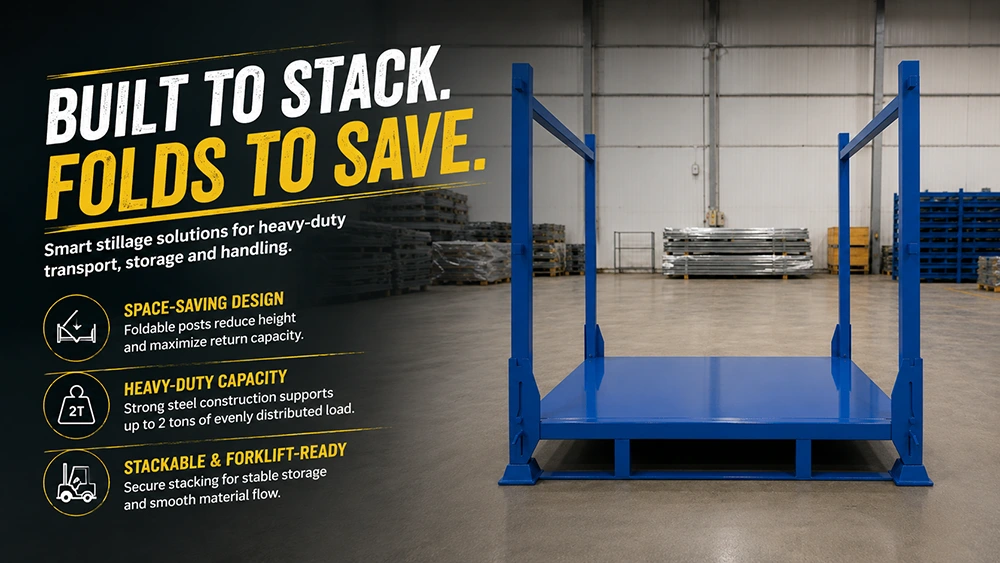
This is the right starting point for packaged components, metal parts, and other loads that can be loaded from the top or from the open sides. The image shows the confirmed four-post structure and the forklift pockets; it does not show a side door, wheel well, or damping strips. This difference matters when comparing a standard quote with a project-specific stillage.
When a collapsible side door is truly worthwhile
A collapsible side stillage makes sense when the handling workflow makes top access inefficient. Examples include long components that must be removed from the side, an inner layer that needs to be inspected while units remain stacked, or a production line where operators repeatedly need access at a fixed height. A side flap can reduce manual reaching and avoid having to dismantle a stack to retrieve just one item.
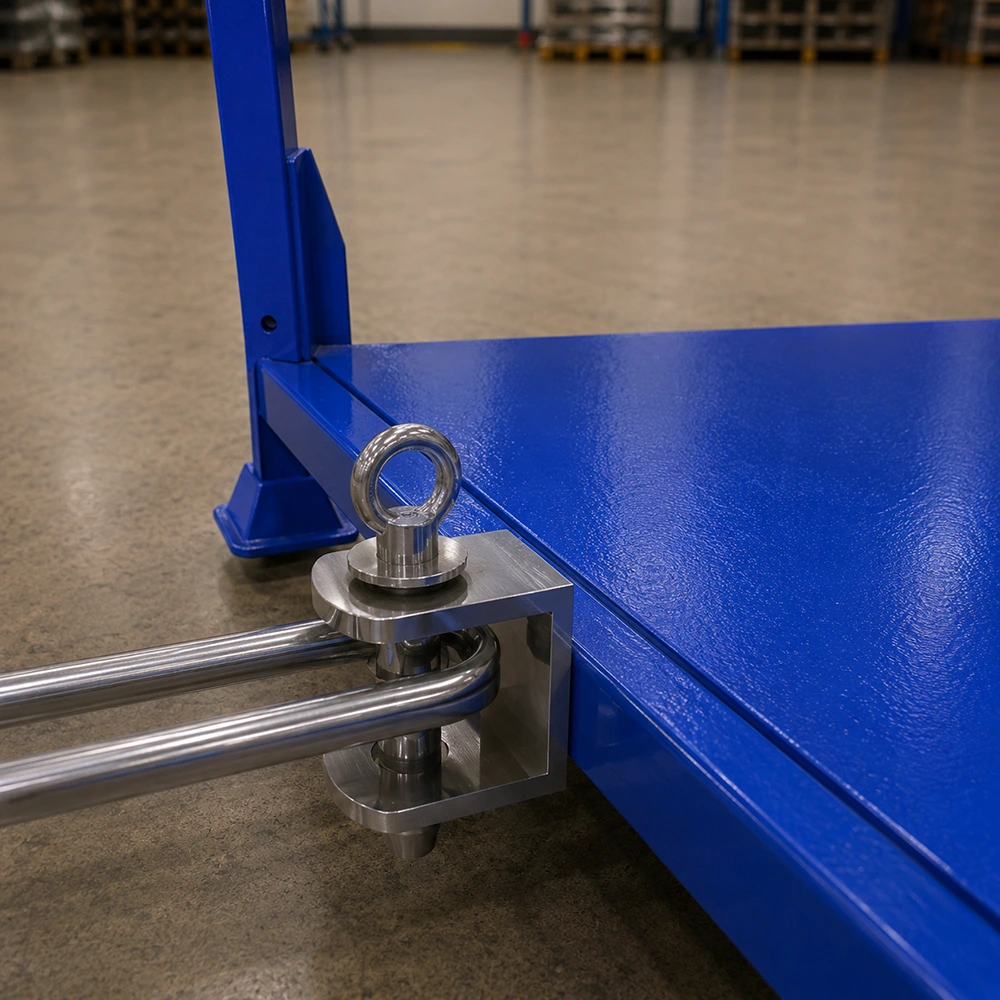
But a visible hinge detail is not proof that every Mytrack unit includes a side door. The optional arrangement requires a review of load weight, center of gravity, opening direction, latch position, clearance between stacked units, and the way a forklift or crane approaches the frame. The photographed pipe rail and ring pull pin illustrate one possible collapsible or removable access arrangement—not a base model specification.
Wheel wells, rubber strips, or a different load surface?
For motorcycles, carts, or products with defined wheels, a dedicated wheel well can help position the load and reduce movement during transport. The geometry of the well should be based on wheel diameter, tire width, axle position, routing of lashing points, and the required forklift or crane clearance. It should be engineered together with the stillage base and the intended transport direction, rather than added as a generic cutout.
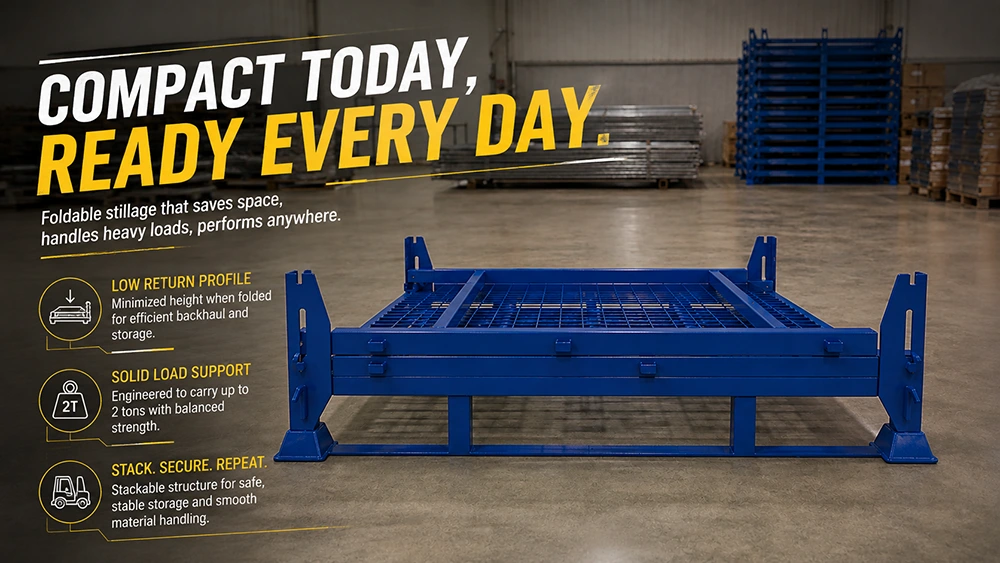
Rubber damping strips serve a different purpose. They can separate a painted, coated, or easily marked product from steel contact points and help control vibration. The technical review should confirm the strip material, thickness, attachment method, compression set under load, cleaning conditions, and whether the damping changes the usable internal dimensions. The image below documents slotted stacking posts and a collapsible steel frame; it confirms neither a rubber strip nor a specific load capacity for every project.
How to choose the configuration
- Choose the standard four-post stillage, when the load is stable, top loading is acceptable, and forklift access is the primary handling requirement. This keeps the design simple and focuses the design on stacking, access, and empty frame storage.
- Request a collapsible side door, when operators need to retrieve internal products from a stacked unit or when side loading is part of the production workflow. Confirm latch security, opening clearance, and access in the stacked condition.
- Request wheel wells or profiles for motorcycles and other rollable products that require repeatable positioning. Provide wheel and lashing information before the frame is finalized.
- Request rubber damping, when surface protection or vibration control is a defined requirement. Identify contact areas as well as cleaning or outdoor use conditions so that the attachment method is suitable.
FAQ: The two decisions buyers ask first
Does the Mytrack base version include a side door?
No. The confirmed base concept is a collapsible, stackable post pallet with corner posts and forklift access. A side door or collapsible rail is a conditional customization, not an automatic feature of every unit.
How do I add wheel slots or rubber strips?
Send the loading drawing or photos, dimensions, weight, center of gravity, handling method, stacking plan, and protection requirements. The technical review can then recommend wheel slot geometry, padding positions, fastening details, and any spacing changes prior to production.
Do you need to choose between stacking posts and access or protection features? Report the load – dimensions, weight, wheel or contact details, handling method, and stacking plan – to receive a Mytrack customization recommendation.
Report your load for a configuration reviewBenötigen Sie eine individuelle Lagerlösung?
Sprechen Sie direkt mit unseren technischen Ingenieuren. Wir bieten kostenlose Strukturplanungen, Bewertungen von Hochlast-Katalogen und schnelle B2B-Preisangebote.
Jetzt Angebot anfordern →