
Empty stillage return shipments can cost more than the loaded outbound leg. In a closed packaging loop, the rack must be transported back to the plant, to the supplier, or to the next loading location after every cycle. If the return fleet carries the same assembled frame height as the delivery, transport capacity and storage space are consumed by air. Mytrack foldable stillages address precisely this return flow: In project dataset 14922, the assembled external height is 1,270 mm and the folded height is 355 mm.
This is not a general statement for every configuration. It is a project-specific result for the referenced motorcycle transport rack. It provides logistics and plant warehouse teams with a measurable starting point for a closed-loop back-calculation.
How much lower is a Mytrack stillage after folding?
Dataset 14922 shows an external size of 2,300 × 2,470 × 1,270 mm, with a usable internal area of 2,116 × 2,410 mm. Once the posts are removed and folded inward, the documented height is 355 mm. The vertical envelope is thus reduced by 915 mm. Calculated solely from the documented heights, the folded profile is about 28 % of the assembled height, or around 72 % lower.
This is why collapsible posts are crucial in closed-loop logistics. The return problem is not solved by changing the loaded handling, but by changing the transport profile of the empty rack. The design uses removable posts that can be lifted out and folded inward. The rack remains a steel transport unit for the loaded cycle and becomes a significantly flatter return transport package after unloading.
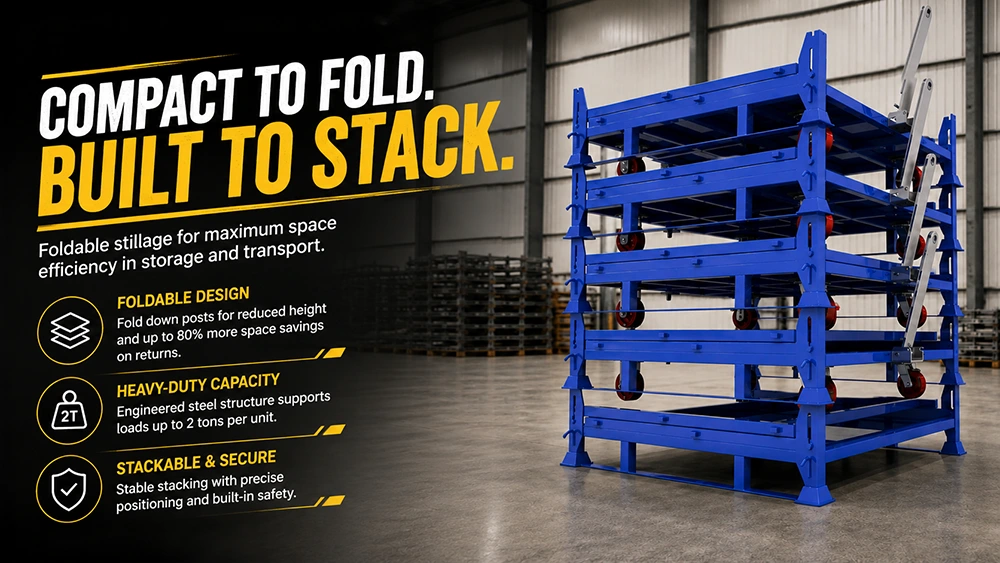
Why the return volume saving is nearly a quarter
A height ratio is not the same as a guaranteed truck load ratio. Trailer geometry, rack orientation, floor loading, stacking rules, aisle access, and local transport regulations continue to determine the final count. But the documented change from 1,270 to 355 mm explains the order of magnitude: If length and width remain unchanged and the return transport plan can efficiently use the reduced height, the simple height-based volume proxy of the empty rack is about 355 ÷ 1,270, or 0.28. That is approximately one quarter to one third of the assembled vertical envelope.
The same project dataset provides two helpful planning references: Eight assembled racks can be arranged within a height constraint of 2,560 mm, while a 40-foot high-cube container is documented for 32 racks. These values belong to project 14922 and should be checked against the final packaging drawing before procurement. They should not be adopted as universal Mytrack fleet capacity.
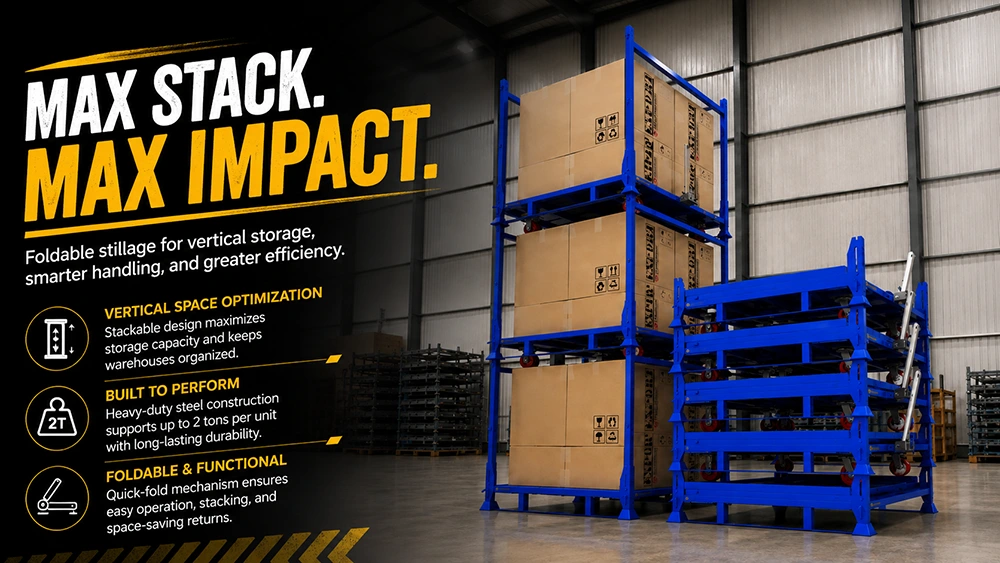
How the saving feeds into a closed-loop logistics plan
Start with the return flow, not the product brochure. Record the number of empty racks released per shift, the return frequency, the available internal height of the trailer or container, and the current freight costs for loaded versus empty. Then separate the operating modes: assembled racks for loading and unloading as well as approved stacking; folded racks for empty-goods return transport and storage.
At the plant, a level folding zone should be set up. Unload the cargo, remove the posts according to the specified handling method, fold them inward, and keep the folded units aligned for forklift access. The project dataset specifies a fork entry height of 100 mm and a rack tare weight of 300 kg; these are design inputs for the referenced project and must be confirmed against the released drawing status and the forklift arrangement. A level floor and a suitable forklift are required. Do not regard the folded state as permission to drag the rack, carry it manually, or stack it beyond the approved operating instructions.
At the receiving point, reverse the process: Position the folded base rack, reinsert the posts, check the locking points, and release the rack only after the frame is ready for the next loading cycle. This simple standard work instruction makes foldability a repeatable return cost control rather than an occasional space-saving trick.
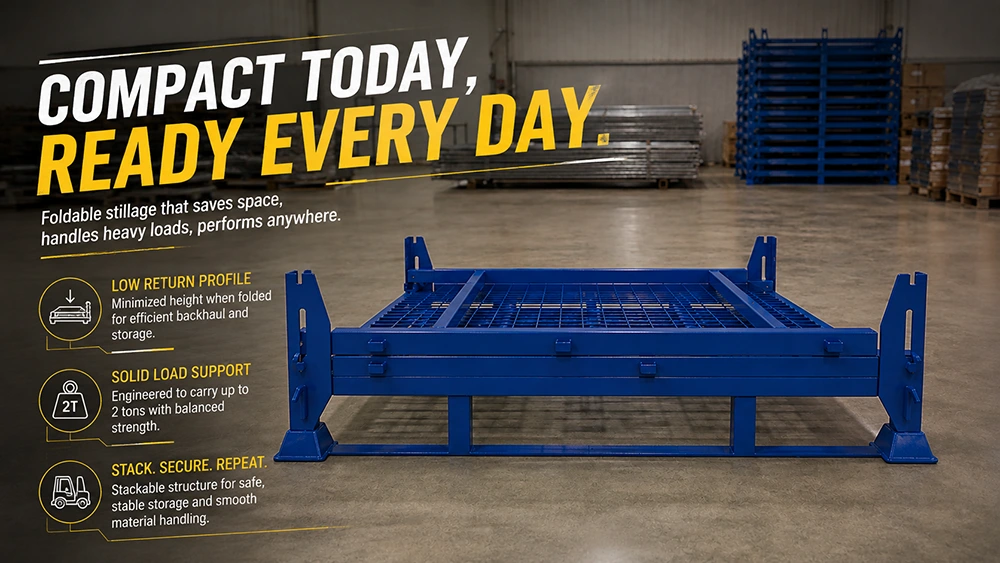
Which return option fits your operation?
- Steel stillages with extended post position: suitable when racks are loaded, when the loop has no return freight pressure, or when the handling layout does not allow folding. You retain the working configuration but consume more empty transport height.
- Stillages with collapsible posts: suitable when the same racks repeatedly travel empty between plant, distribution point, and supplier. Mytrack is relevant when the dimensions 1,270 mm assembled and 355 mm folded fit the handling and packaging conditions of the route.
- Demountable post pallets: useful when posts need to be removed for dense stacking of the bases, but they require a controlled process for post storage and reassembly. Before this option, check whether the additional handling is acceptable.
- Standard flat steel pallets: suitable for stable, flat loads without support from posts. They are not a substitute for a dedicated stillage when the load requires post positioning, vertical restraint, or repeatable closed-loop protection.
FAQ: Mytrack folding height and return volume
What is the height of the Mytrack stillage when folded?
For project dataset 14922, the folded height is 355 mm. The unfolded outer height is 1,270 mm. These dimensions are project-specific and must be confirmed for the final configuration.
How much return volume do the foldable posts save?
Using the recorded heights as a planning basis, the folded profile is approximately 28 % of the unfolded height – corresponding to a reduction in height profile of around 72 %. The actual savings for trucks or containers depends on the approved pack layout, stacking limits, and route equipment.
Empty stillage returns over budget? Provide your lock frequency, current return equipment, and available trailer or container height. We can create a folding return estimate for your route based on the project dimensions.
Request folding return estimateBenötigen Sie eine individuelle Lagerlösung?
Sprechen Sie direkt mit unseren technischen Ingenieuren. Wir bieten kostenlose Strukturplanungen, Bewertungen von Hochlast-Katalogen und schnelle B2B-Preisangebote.
Jetzt Angebot anfordern →