
Devoluções de gaiolas vazias podem custar mais do que o transporte de saída carregado. Em um sistema de embalagem em circuito fechado, a estrutura deve retornar à planta, fornecedor ou próximo ponto de carregamento após cada ciclo. Se a frota de retorno transportar a mesma altura expandida do quadro que na rota de entrega, a capacidade de transporte e o espaço no chão do armazém são consumidos por ar. As gaiolas dobráveis Mytrack resolvem especificamente essa perna de retorno: no registro do projeto 14922, a altura externa expandida é de 1.270 mm e a altura dobrada é de 355 mm.
Essa não é uma afirmação genérica para todas as configurações. É um resultado de registro de projeto para o projeto referenciado de rack de transporte de motocicletas. Ele fornece às equipes de logística e armazém fabril um ponto de partida mensurável para um cálculo de retorno em circuito fechado.
Quanto menor fica uma gaiola Mytrack após ser dobrada?
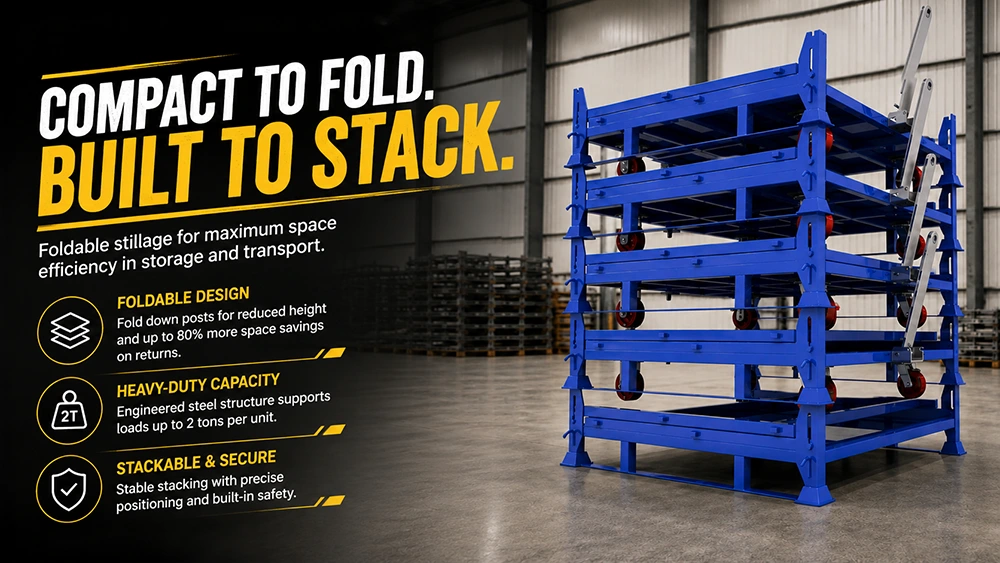
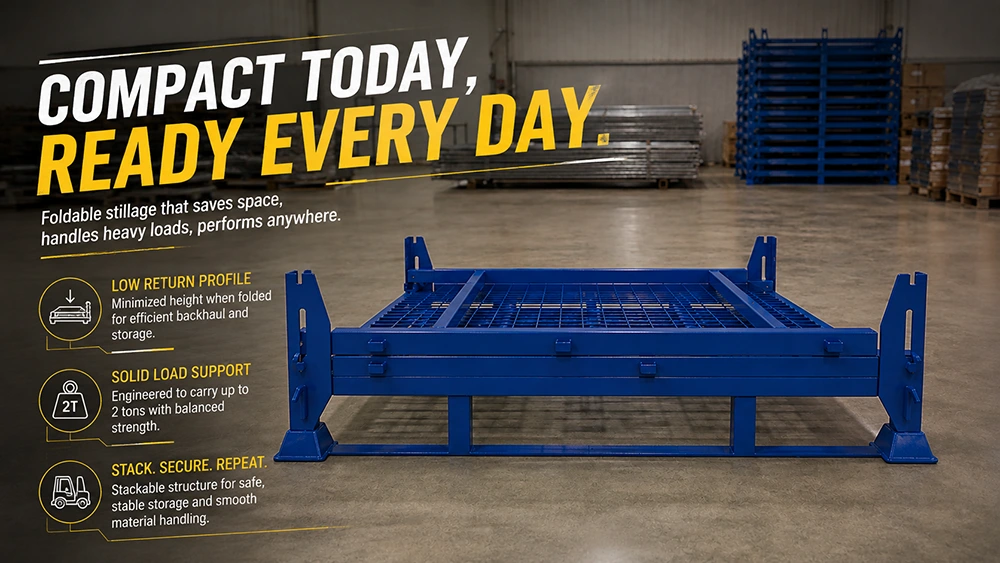
O registro 14922 lista um tamanho externo de 2.300 × 2.470 × 1.270 mm, com uma área útil interna de 2.116 × 2.410 mm. Quando os postes são removidos e dobrados para dentro, a altura registrada é de 355 mm. Portanto, a envelope vertical cai em 915 mm. Calculado apenas a partir das alturas registradas, o perfil dobrado tem cerca de 28% da altura expandida, ou aproximadamente 72% menor.
Esse é o motivo pelo qual os postes rebatíveis são importantes na logística em circuito fechado. O problema do retorno não é resolvido alterando o método de manuseio da carga; é resolvido alterando o perfil de transporte da estrutura vazia. O projeto utiliza postes removíveis que podem ser retirados e dobrados para dentro. A estrutura permanece como uma unidade de manuseio em aço para o ciclo carregado e, em seguida, torna-se um pacote de retorno muito mais baixo após o descarregamento.
Por que a economia de volume de retorno se aproxima de um quarto
A height ratio is not the same as a guaranteed truck fill ratio. Trailer geometry, frame orientation, floor loading, stacking rules, aisle access, and local transport regulations still control the final count. But the recorded change from 1,270 to 355 mm explains the order of magnitude: if length and width remain fixed and the return plan can use the reduced height efficiently, the volume proxy based only on the empty frame height is about 355 ÷ 1,270, or 0.28. That is roughly one quarter to one third of the expanded vertical envelope.
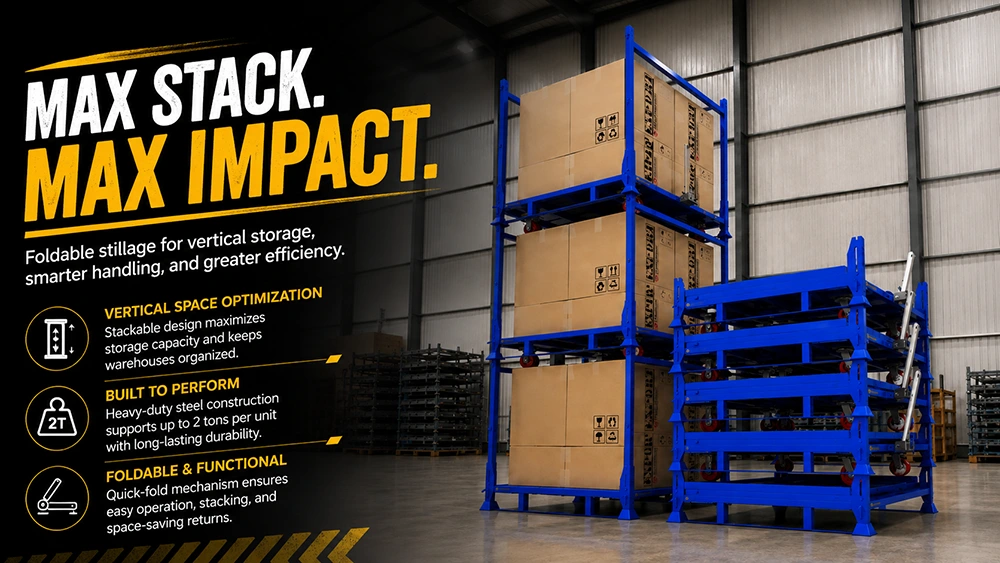
The same project record provides two useful planning references: eight expanded frames can be arranged within a 2,560 mm height condition, while a 40-foot high cube container is recorded for 32 frames. These numbers belong to project 14922 and should be verified against the final packaging drawing before purchase. They should not be copied as a universal capacity for the Mytrack fleet.
How to apply the savings in a closed-loop logistics plan
Start with the return leg, not the product catalog. Record the number of empty frames released per shift, the return frequency, the available internal height of the trailer or container, and the current cost of loaded versus empty freight. Then separate the operating modes: expanded frames for loading, unloading, and approved stacking; folded frames for the empty return and the storage period in the warehouse.
At the plant, designate a level folding zone. Unload the load, remove the posts using the specified handling method, fold them in, and keep the folded units aligned for forklift access. The project record notes 100 mm fork entry and 300 kg self-weight of the structure; these are design parameters for the referenced project and must be confirmed against the released drawing and forklift configuration. Flat floor and suitable forklift are required. Do not treat the folded state as permission to drag, manually load, or stack beyond the approved operating instructions.
At the receiving point, reverse the process: position the folded base, reinstall the posts, verify the locking points, and release the structure only after the frame is ready for the next load cycle. This simple standard operating procedure turns folding capability into a repeatable return-cost control rather than an occasional space-saving trick.
Which return option fits your operation?
- Expanded steel cages: suitable when racks are loaded, when the circuit has no return freight pressure, or when the handling layout does not allow folding. They preserve the working configuration but consume more empty transport height.
- Cages with fold-down posts: suitable when the same racks travel repeatedly empty between a factory, distribution point, and supplier. Mytrack is relevant when the project dimensions of 1,270 mm expanded and 355 mm folded match the route's handling and packaging constraints.
- Pallets with removable posts: useful where the posts need to be removed for dense stacking of the base, but they require a controlled process for storing and reassembling the posts. Confirm whether this extra handling is acceptable before choosing this route.
- Standard flat steel pallets: Suitable for stable, flat loads that do not require vertical retention. They do not replace a purpose-designed cage where the load needs post location, vertical containment, or repeatable closed-loop protection.
FAQ: Mytrack folded height and return volume
What is the folded height of the Mytrack cage?
For design record 14922, the folded height is 355 mm. The expanded outer height is 1,270 mm. These dimensions are design-specific and should be confirmed for the final configuration.
How much return volume can drop posts save?
Usando as alturas registradas como referência de planejamento, o perfil dobrado é cerca de 28% da altura expandida — aproximadamente uma redução de 72% no envelope de altura. A economia real em caminhão ou contêiner depende do layout de embalagem aprovado, limites de empilhamento e equipamento da rota.
Are empty cage returns over budget? Tell us your circuit frequency, current return equipment, and available trailer or container height. We can use the design dimensions to build a folded return estimate for your route.
Request a folded return estimatePrecisa de uma Solução de Armazenamento Personalizada?
Fale diretamente com nossos engenheiros técnicos. Oferecemos projetos estruturais gratuitos, avaliações de catálogos de alta capacidade e orçamentos rápidos para B2B.
Solicite um Orçamento Agora →