
How Mybox reduces space during empty returns after folding
For companies operating a cycle with collapsible containers , the hard costs are rarely just the purchase price. The real bill appears when empty units come back from customers: they continue to occupy storage space, truck capacity, and handling time in the warehouse. Mybox was developed precisely for this problem. In the reference configuration, when folded, the container profile drops to approximately 330 mm, allowing a reusable cycle to reclaim a large portion of the return volume instead of shipping full-height mesh boxes back home.
This is where the common claim of 60–80% space savingscomes from. It is not a fixed promise for every SKU; it is a practical range when comparing the folded state with the erected state of the same container under the same loading method. The exact result depends on body length, lid option, roller equipment, and whether units are returned as flat packs, stacked, or as bundled pallet groups.
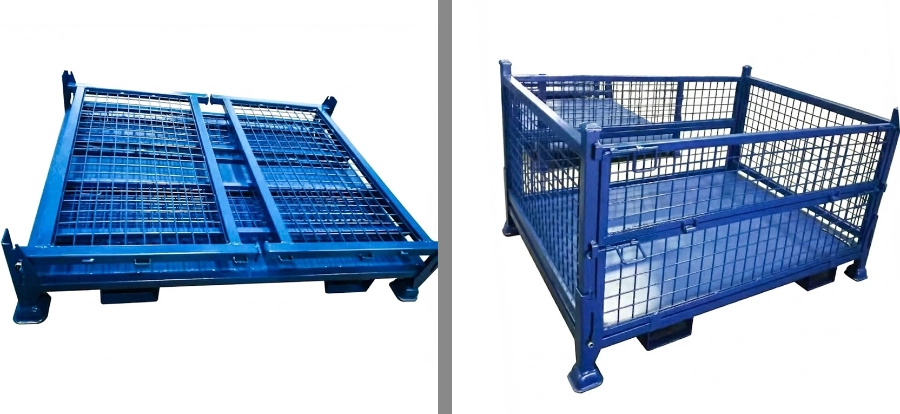
How much space does Mybox save after folding?
With a rigid wire mesh container, the side walls remain upright for the entire return trip to your site. This means the empty return journey takes up almost the same cubic space as a loaded outbound trip. Mybox changes this logic. When the panels fold down, the container travels home in a much flatter profile, turning the return load into a volume problem you can actually control.
For many reusable packaging programs, this means the folded unit requires only 20–40% of the volume of the erected unit. In other words, the space savings typically amount to 60–80% compared to a non-collapsible mesh box. If your current system uses a fixed wire basket, pallet box, or stackable container that cannot be folded, the return freight penalty is usually paid in every cycle.
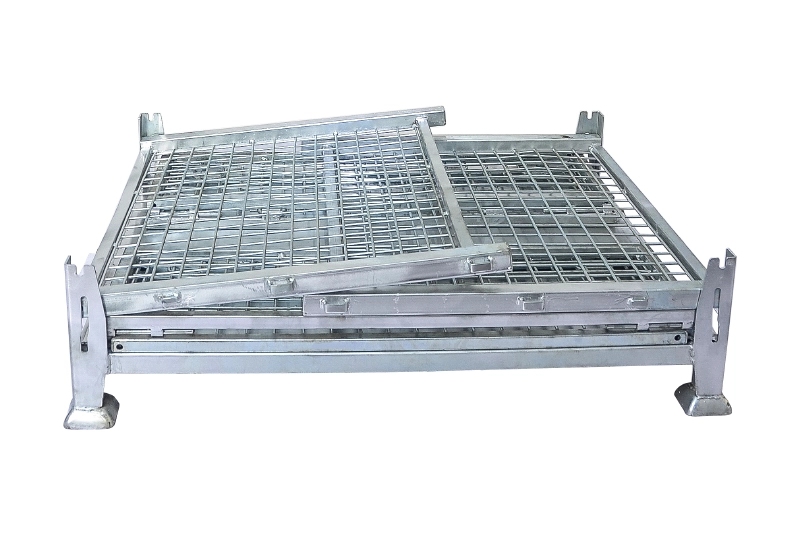
Why a non-collapsible mesh box wastes more than just storage space
The problem is not only floor space. A full-height return cage also consumes truck lane depth, reduces the number of units per line haul, and creates more yard idle time, as empty inventory still needs to be counted, moved, and staged. If you serve a customer loop, a production shuttle, or a distribution return route, this wasted volume becomes recurring operating costs.
Mybox addresses this by combining a collapsible frame with a reusable metal structure that can be returned, stored, and redeployed instead of being discarded. For internal loops, this means less clutter in the warehouse. For outdoor or mixed weather conditions, the surface can be specified as feuerverzinkt oder powder-coated depending on corrosion exposure and branding requirements. If you need to push boxes with hand pallet trucks or pallet jacks, the optional roller equipment makes transporting the empty return easier.
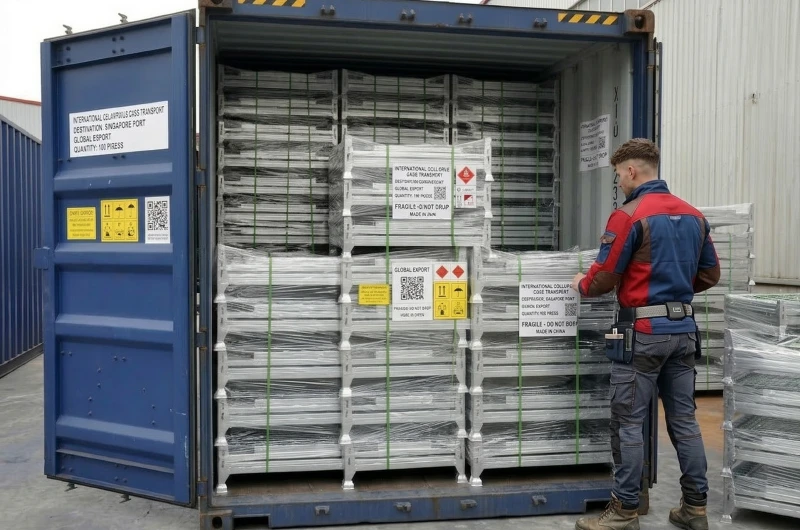
What the 40HQ / 192-unit example actually means
The reference loading case for this product is simple: when the container is in its folded state and the loading pattern is correctly planned, a 40HQ can hold 192 unitsThis is a measured example, not a blanket guarantee. It should be read alongside the actual external dimensions, stacking method, lashing strategy, and door opening height of your own project.
Use the 192-unit figure as a planning benchmark when comparing return freight options. If your current rigid container can only be sent back in partial loads, the return transport cost per unit is typically far worse. In contrast, a flat-folded return stack can often make a full container or truck line haul profitable again, especially for circulation between factory, warehouse, and regional customer sites.
Where Mybox fits – and where it does not
- Best suited for: closed loops, component returns, outsourced return packaging, factory-to-warehouse shuttles, and seasonal reverse logistics.
- Best suited for: Programs that require stackable and collapsible return packaging without giving up a welded steel frame.
- Best suited for: Outdoor or mixed-environment loops when you specify galvanized or powder-coated protection.
- Not ideal: single-use packaging or any task requiring full sealing and tamper resistance, unless you choose a lidded variant or an inner liner.
- Not ideal: extremely small loose parts without dividers, inner bags, or cardboard inserts.
In short, Mybox works when empty returns matter. If your current problem is not just storage but also the cost of transporting empty containers back, the collapsible form offers a cleaner solution than a rigid mesh box or a fixed stackable container.
FAQ
Is the 60–80% savings fixed?
No. It is a reference range based on comparing the folded and erected states of the same product family. Your exact result depends on container size, folded profile, presence of a lid, and the loading plan for the return trip.
Should I choose Mybox for every return loop?
No. If your application requires permanent sealing, single-use packaging, or handling loose small parts without an inner bag, you should first specify the right variant. However, if the actual goal is circular reuse, reducing empty returns, and simpler yard handling, then Mybox is the right starting point.
If you are planning a return project, let us know your target height in the collapsed state, your empty return route, and your loading standard. We will help you determine the right Mybox configuration and compare it with your current rigid mesh box or stackable container.
Benötigen Sie eine individuelle Lagerlösung?
Sprechen Sie direkt mit unseren technischen Ingenieuren. Wir bieten kostenlose Strukturplanungen, Bewertungen von Hochlast-Katalogen und schnelle B2B-Preisangebote.
Jetzt Angebot anfordern →