
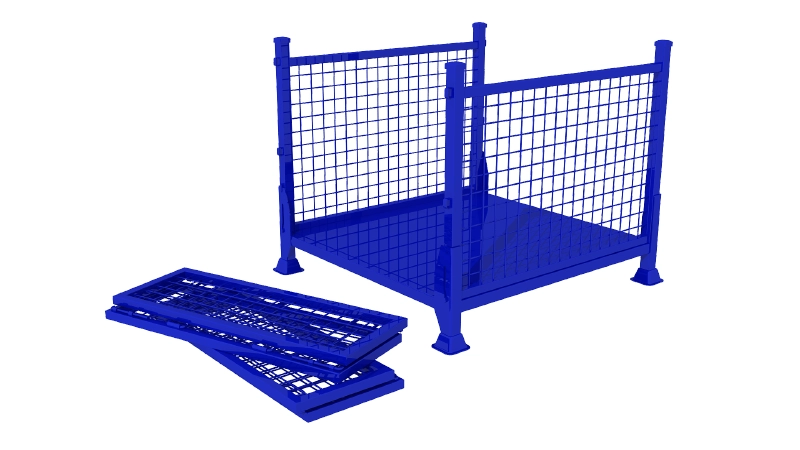
A 400 mm wide metal pallet box can pass through a 500 mm gangway and still be impossible to fold on the same floor. Buyers usually size a collapsible steel stillage from the outside footprint that has to clear a door, an aisle or a container opening, and then assume the fold comes with it. The fold has its own envelope, and on a narrow body that envelope is set by panel height against base width, not by the footprint that was measured against the doorway.
This article sets out what actually decides whether a narrow steel pallet cage can fold, how to check interference in both the erected and the folded condition before a drawing is released, and when a fixed box or a resized body is the more honest answer than forcing hinges into a shape that cannot complete the movement.
Why a body that fits the passage may still not fold
On a collapsible cage pallet, a folding side panel turns about a hinge line at the bottom of the body and, in the folded state, has to lie flat inside the base rectangle. While it moves, that panel sweeps through an arc whose radius is the panel height. If the panel height is greater than the usable width of the deck, the panel cannot land flat: it overhangs the base, hangs past the pallet footprint, or has to be folded in two leaves that stack on top of each other. Any of those outcomes changes the promise the buyer was relying on. The empty box no longer occupies a folded footprint close to its base size, so the folded stack becomes taller and wider than planned, and the saving on empty return volume shrinks.
The same ratio matters in the other direction. A tall body on a narrow base is a high centre of gravity carried on a short support rectangle. Loaded and stacked, that body has less resistance to tipping than a squarer box of the same capacity, so the proportions have to be reviewed for their behaviour, not only for their volume. Strictly speaking, base width and panel height are not two separate checks: they are the same check read once with the load on and once with the panels empty.
The 1200 × 400 × 1000 mm project record: a quoted folding box that came back fixed
Our file for opportunity 14896 is a clear example of the problem being caught in engineering review rather than on the customer’s floor. The buyer asked for a metal pallet container rated 500 kg, stacked four layers, with mesh sides and a steel plate bottom, and explicitly asked for a foldable body, in two external sizes: 1200 × 400 × 1000 mm and 1200 × 800 × 1000 mm, with container loading quoted for each. Recorded project figures for the 1200 × 400 × 1000 mm body are a self weight of about 96 kg, a 500 kg load, four stacking layers and 161 units in a 40HQ plan.
The wide version was built as a folding container. The narrow one could not be made to fold, for two stated reasons: the side door height on that body is larger than the base width, so the panel cannot complete the fold within the deck; and the same height-to-width ratio makes the loaded body unstable in service. The file also records that on this family the two side doors sit one above the other instead of being mirrored left and right, which is a consequence of the body being much taller than it is wide. Nothing about that outcome says every narrow box is unbuildable — it says that on this ratio, with a full-height panel, the fold could not be delivered. Treat it as one reviewed case, not as a category rule.

One more caution for anyone working from that file: its parameter table lists the internal dimensions as 1200 × 400 × 1000 mm, identical to the external ones, so the table cannot be copied into a drawing or a quotation unchecked. Wall thickness and any internal allowance have to be re-confirmed on the approved drawing before a production release, exactly as the empty-return figures have to be given per project rather than per product family.
Checking interference in both states, before the drawing is released
The practical method is to check the box twice — once as it will stand loaded and once as it will sit folded — and to record both checks in writing. In the erected state, confirm the outside footprint against the narrowest passage on the actual route, including door frames, pallet racking uprights, container door openings and lift gates; confirm the load path with the gate closed and latched, because an unlatched drop gate carries no load into the frame; and confirm how a loaded box is lifted, since a body with casters and a body with forklift pockets are handled on different routes. In the folded state, confirm the folded envelope with the panels actually lowered, not assumed from a photo of a different size; confirm how many folded bodies stack and to what height; and confirm that the folded stack can be lifted without the panels slipping.
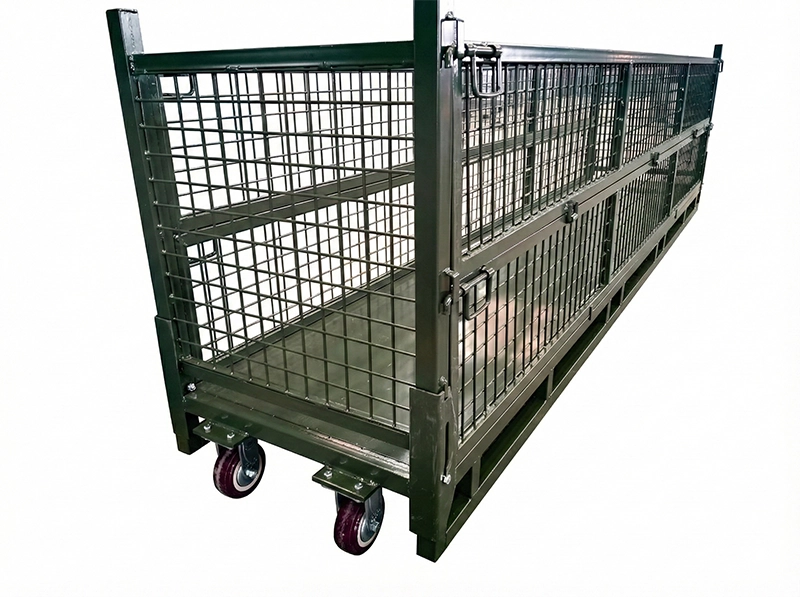
Two of those checks decide most narrow-body arguments. The first is the panel-to-deck ratio described above: if the panel cannot lie flat within the base, then whatever the drawing shows, the fold will intrude into the height allowance or the side clearance. The second is the gate type. A half-drop gate that folds down over the base, and a full-height side panel that folds into the body, produce different folded envelopes and different working clearances at the aisle side, so the gate has to be chosen with the fold, not after it.
How to test the fold on paper and on the floor
- Write down the external base width and the full panel height of every folding face. If a panel height is larger than the deck width it must lie on, the fold cannot sit flat and needs a different panel split or a different body proportion.
- Draw the folded envelope, not the erected one. Overlay the lowered panels on the base outline and mark what overhangs; that outline is the one that has to fit your empty-return storage and your container.
- Check the folded stack, not the single folded box. Stack height, the way one folded body sits on the next and the way the stack is strapped decide the empty transport volume far more than one box does.
- Repeat both checks against the real route: narrowest doorway, pallet racking bay, container opening, lift gate, and the turning space needed to fold the panels down while the box stands on the floor.
- Ask for the drawing revision that contains the fold, and confirm wall thickness, internal dimensions, hinge position and gate type on it. Where an earlier parameter table disagrees with itself, the drawing wins and the table is corrected before release.
When a fixed box, or a different set of dimensions, is the better answer
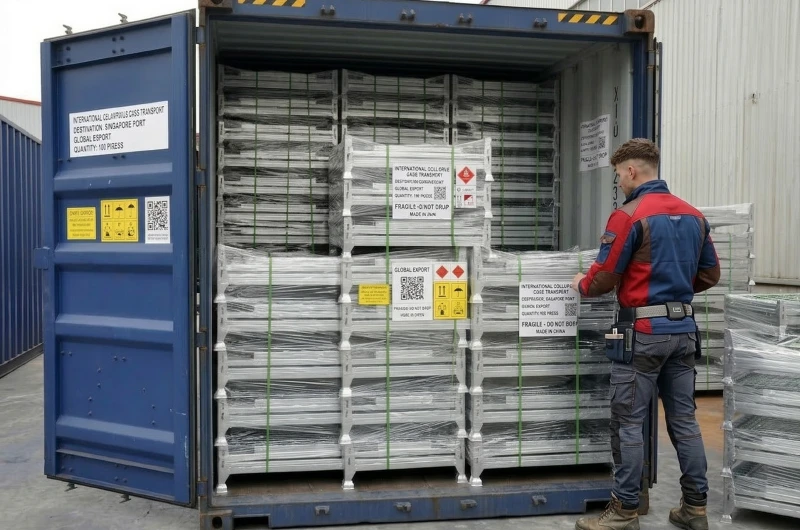
If the fold is not the point of the project, a fixed steel pallet container is often the cheaper and more stable container: a rigid body with a drop gate gives you the same access at the aisle side without the hinge line and the folded envelope you would be paying for. That is the right call when empty boxes never travel, when the body is stored loaded and reused in place, or when the operation is dominated by loaded moves and not by return freight.
If the fold is genuinely needed, change the proportions rather than the promise. Widening the base gives the panel something flat to land on. Reducing the body height shortens the panel and brings the fold inside the deck. Splitting a very long body into two folding bays, or into two boxes, can keep the fold workable where one tall narrow body cannot. Changing the gate arrangement — a half-drop front gate instead of a full-height folding side — can also deliver the access that motivated the fold, at a footprint that still stacks flat. What should not happen is a quotation that shows a folded state the geometry cannot reach; the empty-return saving then disappears at the first container loading, not at the design stage.
Where internal dimensions, rather than folding, are the deciding constraint on a narrow body, the follow-on discussion in this series is the place to continue. Our page on the collapsible steel stillage and pallet box range shows the body, gate and caster options that these decisions are made from.
What to send for a structural feasibility answer
Send the internal dimensions and the external dimensions you need, the narrowest passage the box has to pass, and your folding target in concrete terms — either the folded height per box or the folded height of the stack you intend to ship. Add the load per box, the number of loaded layers, the handling method (forklift, crane, or casters), the finish and the storage environment, and the destination container. With those in hand we can tell you whether a foldable steel pallet cage is achievable on that proportion, which faces can fold, and what the folded envelope and empty-return volume would be. If the proportion will not fold, you will get that answer with the reason and the nearest workable alternatives, rather than a drawing that cannot be built.
Buyer questions on narrow folding boxes
Can any narrow metal pallet box be made collapsible if the panels are split?
Splitting a tall panel into two leaves reduces the swept radius and is one of the tools we use, and it is what the 14896 family does by stacking the two side doors vertically instead of mirroring them. It is not a universal fix: split leaves increase folded stack height, add hinges and latches, and still have to land within the base if the folded footprint is to stay predictable. On the 1200 × 400 × 1000 mm proportion the file records the fold as not achievable within the deck rather than achievable with more hinges.
Does a folded box always save the same empty space?
No. The saving is the difference between the erected height and the folded stack height, so it is a per-project figure that moves with the body, the panel split and the gate type. Our general project records for this family show folded heights in the region of 330 to 370 mm on bodies around 900 to 1100 mm tall, but those are recorded project values, not a guarantee for a narrow body of a different proportion. Confirm the folded envelope on the approved drawing.
What if the box fits the aisle but the panels cannot be lowered in place?
Folding needs working clearance at the side as well as the footprint, because the operator has to swing the panel down and the panel needs room to travel. If the box only just passes the aisle, the fold will usually have to be done in a wider bay or during loading and unloading, not in position. That operational cost is worth writing down before the fold is quoted as a benefit.
Benötigen Sie eine individuelle Lagerlösung?
Sprechen Sie direkt mit unseren technischen Ingenieuren. Wir bieten kostenlose Strukturplanungen, Bewertungen von Hochlast-Katalogen und schnelle B2B-Preisangebote.
Jetzt Angebot anfordern →