
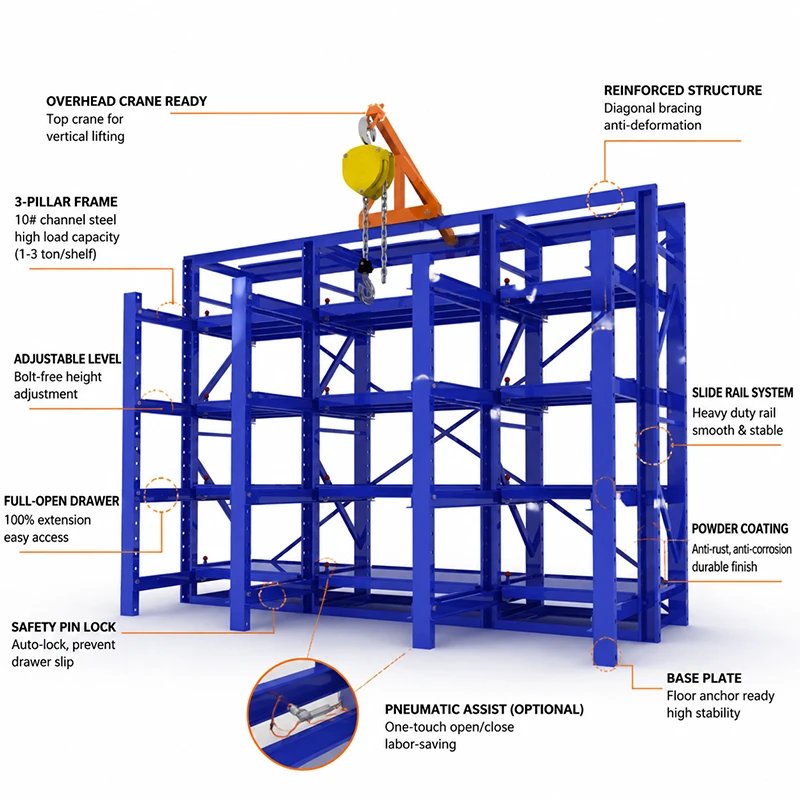
For a workshop manager, a mold change can become a risk event before the crane even moves: The right mold is buried in a floor stack, the lifting path is blocked, or a drawer is pulled out without sufficient control over the shifted load. The question is not simply whether a rack can hold a heavy mold. It is about whether the storage method gives the team a repeatable way to identify, expose, secure, and lift one mold at a time.
A three-column pull-out mold rack addresses this workflow with a fully extendable drawer, independent compartment access, and a support structure designed for controlled heavy tool removal. Erack is specified for 0.5–3 tons per level, with 2–4 levels, safety pins, mechanical stops, rear bracing, guide rail control, and floor anchoring. These features can support a more disciplined SMED sequence, but only if the rack is matched to the mold inventory, the hardened floor, the lifting equipment, and the approved operating method.
Why the three-column support changes the stability question
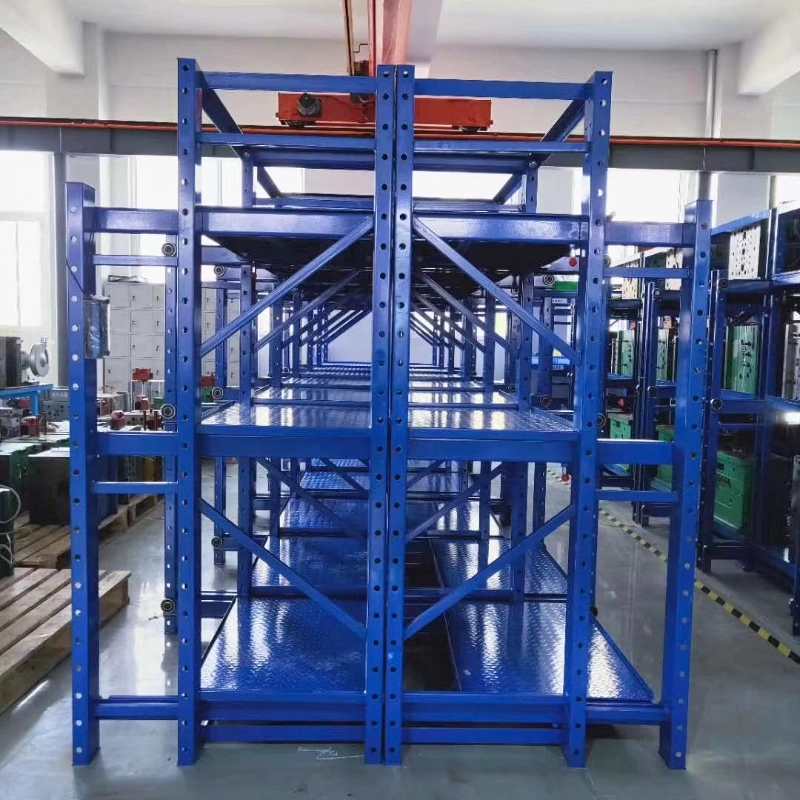
A two-column arrangement has fewer support points around a fully extended drawer. A three-column arrangement adds a third column to the load path, so the drawer and its guide system are supported across a broader structural layout while the mold is brought forward. That does not make an overloaded or unanchored rack safe; it is a structural advantage that must be checked against the actual mold weight, drawer size, center of gravity, and extension condition. Erack's stability control is a system and not just an isolated column: safety pins and mechanical stops control the drawer, rear bracing resists frame movement, guide rails control travel, and floor anchor bolts secure the rack to a hardened floor. For a buyer comparing two-column and three-column mold racks, ask for the rated load per level and the conditions behind that rating – not just the number of columns.
How full extension makes the right mold easier to reach
Full extension changes access from reaching into a deep rack to bringing the selected mold position into the working aisle. Since each drawer is an independent compartment, the team can identify a mold, pull out that level, adjust the lifting method, and leave adjacent compartments undisturbed. The ball-bearing guide rails convert sliding friction into rolling friction, while the fully opened layout creates a direct vertical lifting path for a bridge crane, chain hoist, manual hoist, or electric hoist. This is not a promise of automatic removal: The mold still requires clear identification, a verified load, correctly positioned lifting equipment, engaged safety pins, and a controlled exclusion zone. But it eliminates the repeated handling and searching associated with moving multiple floor-stacked molds to reach the one needed for the change.
What the drawer and storage system contribute to SMED
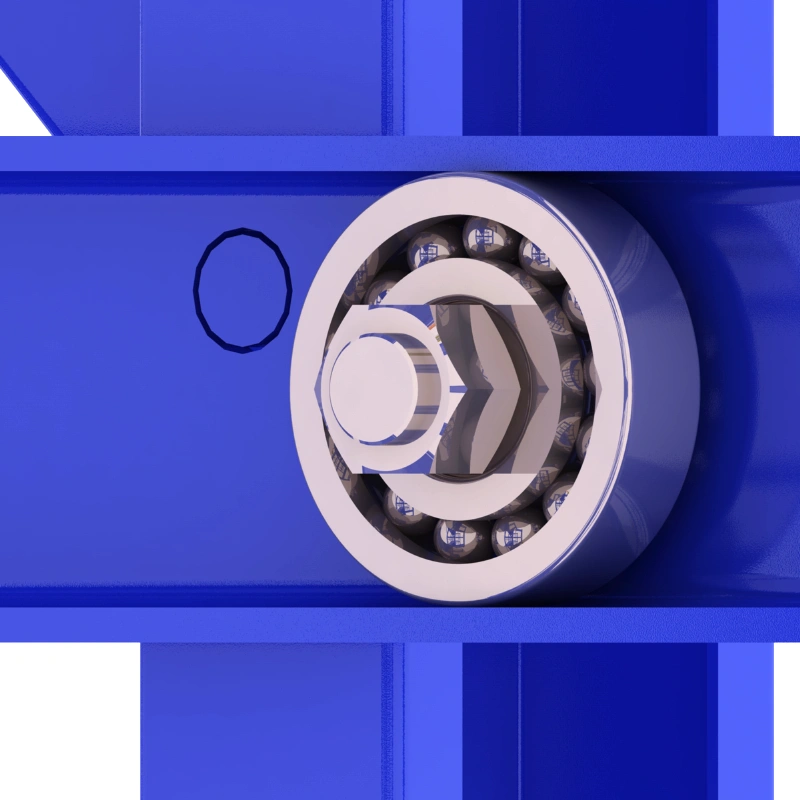
SMED depends on shifting preparation work outside the machine stop and making the remaining internal work predictable. A pull-out mold rack can support this method in three practical ways: storing the next mold in a known compartment, exposing it independently before the change window, and aligning the extended drawer with the lifting path above. The bearing and guide rail assembly helps the operator move a heavy drawer with controlled rolling motion instead of pulling a loaded platform. The detailed bearing assembly shown below is a useful inspection point when comparing a heavy-duty mold rack. It should be reviewed together with safety interlock, mechanical stop, floor anchoring, load capacity, and site operating instructions. Measure the result with your own changeover data; the rack is an enabling control, not a substitute for SMED standard work.
Where a three-column pull-out mold rack fits – and where it does not
- Fits for injection molding and stamping workshops that store heavy molds or tools in a designated mold room, change zone, repair area, or reserve tool area.
- Fits for sites with hardened floors, floor anchoring capability, and a bridge crane, chain hoist, manual hoist, or electric hoist with a lifting path that can be kept clear.
- Fits for mixed inventories when drawer dimensions, level spacing, and the 2–4-level layout are designed around the actual molds; Erack drawer sizes can be configured from approximately 850 × 850 mm to 1350 × 1250 mm.
- Does not fit as a universal light-duty shelf, as a crane-free handling method, or as a replacement for load calculations and site procedures. Do not use any configuration until its load per level, center of gravity, floor condition, anchoring, lifting equipment, and exclusion zone controls are verified.
Questions supervisors should ask before specifying a three-column mold rack
Is a three-column mold rack automatically safer than a two-column rack?
No. The third column provides an additional support point and can improve the controlled load path during full drawer extension, but safety depends on the entire configuration: rated load, drawer geometry, mold center of gravity, safety pins, mechanical stops, bracing, guide rails, floor anchoring, and operating instructions. Compare verified conditions, not just the number of columns.
Does full extension guarantee a faster changeover?
No. The full extension can reduce searches and unnecessary movements by exposing a selected mold and creating a crane access path, which supports SMED preparation. The actual improvement depends on mold identification, preparation, lifting equipment, operator training, aisle clearance, and the site's standard work. Record your current retrieval and changeover times before setting a target.
Benötigen Sie eine individuelle Lagerlösung?
Sprechen Sie direkt mit unseren technischen Ingenieuren. Wir bieten kostenlose Strukturplanungen, Bewertungen von Hochlast-Katalogen und schnelle B2B-Preisangebote.
Jetzt Angebot anfordern →