
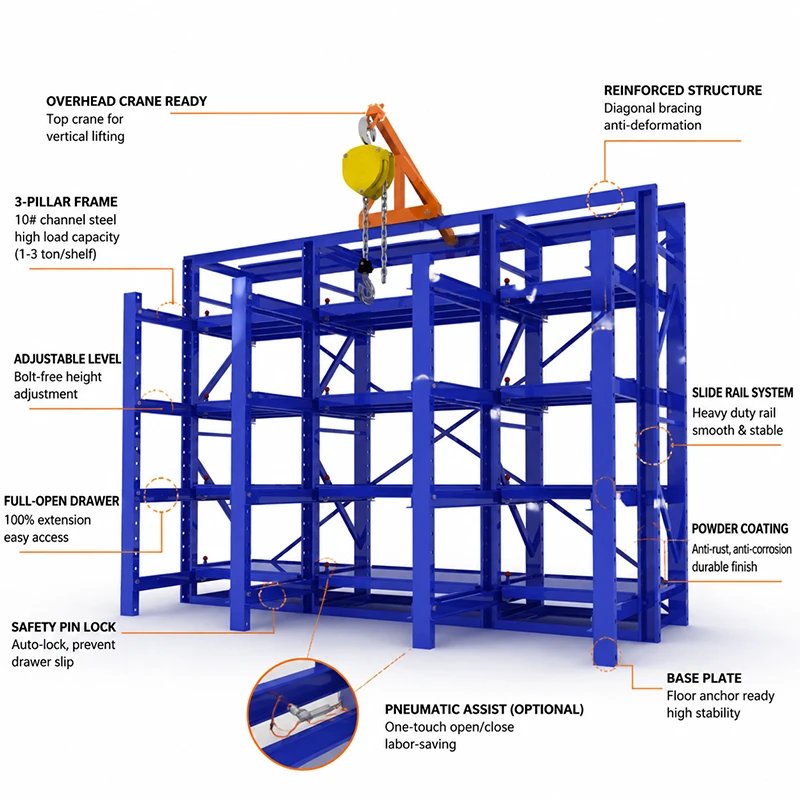
For a workshop supervisor, a mold change can become a risk event before the hoist even moves: the right die is buried in a floor stack, the lifting path is obstructed, or a drawer is pulled out without enough control of the shifted load. The question is not simply whether a rack can hold a heavy mold. It is whether the storage method gives the team a repeatable way to identify, expose, secure, and lift one mold at a time.
A three-post roll-out mold rack addresses that workflow with a full-extension drawer, independent bay access, and a support structure intended for controlled heavy-tool retrieval. Erack is specified for 0.5–3 tons per level, with 2–4 layers, safety pins, mechanical limits, back bracing, guide-rail control, and floor anchoring. Those features can support a more disciplined SMED sequence, but only when the rack is matched to the mold inventory, hardened floor, lifting equipment, and approved operating method.
Why three-post support changes the stability question
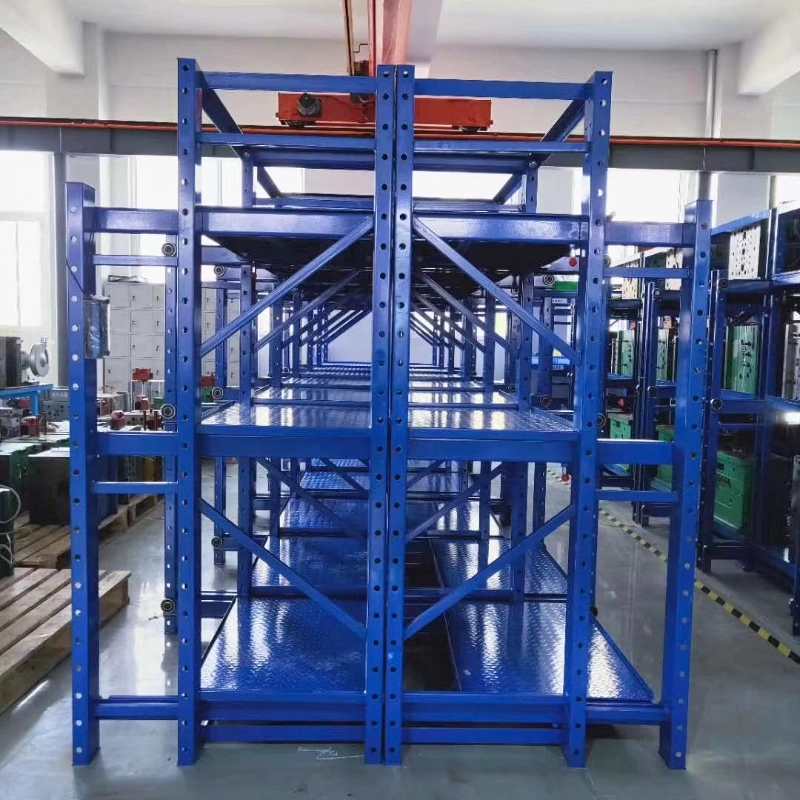
A two-post arrangement has fewer support points around a fully extended drawer. A three-post arrangement adds a third upright to the load path, so the drawer and its guide system are supported across a wider structural arrangement while the mold is brought forward. That does not make an overloaded or unanchored rack safe; it is a structural advantage to be checked against the actual mold weight, drawer size, center of gravity, and extension condition. Erack’s stability control is a system rather than one isolated post: safety pins and mechanical limits control the drawer, back bracing resists frame movement, guide rails control travel, and floor anchor bolts secure the rack to a hardened floor. For a buyer comparing two-post and three-post mold racks, ask for the rated load per level and the conditions behind that rating—not only the number of posts.
How full extension makes the right mold easier to reach
Full extension changes access from reaching into a deep rack to bringing the selected mold position into the working aisle. Because each drawer is an independent bay, the team can identify one mold, pull out that level, fit the lifting method, and leave neighboring bays undisturbed. The bearing-assisted guide rails convert sliding friction into rolling friction, while the full-open layout creates a direct vertical lifting path for an overhead crane, chain hoist, manual hoist, or electric hoist. This is not a promise of automatic retrieval: the mold still needs clear identification, a verified load, correctly positioned lifting gear, safety-pin engagement, and a controlled exclusion zone. But it removes the repeated handling and searching associated with moving several floor-stacked molds to reach the one required for changeover.
What the drawer and bearing system contribute to SMED
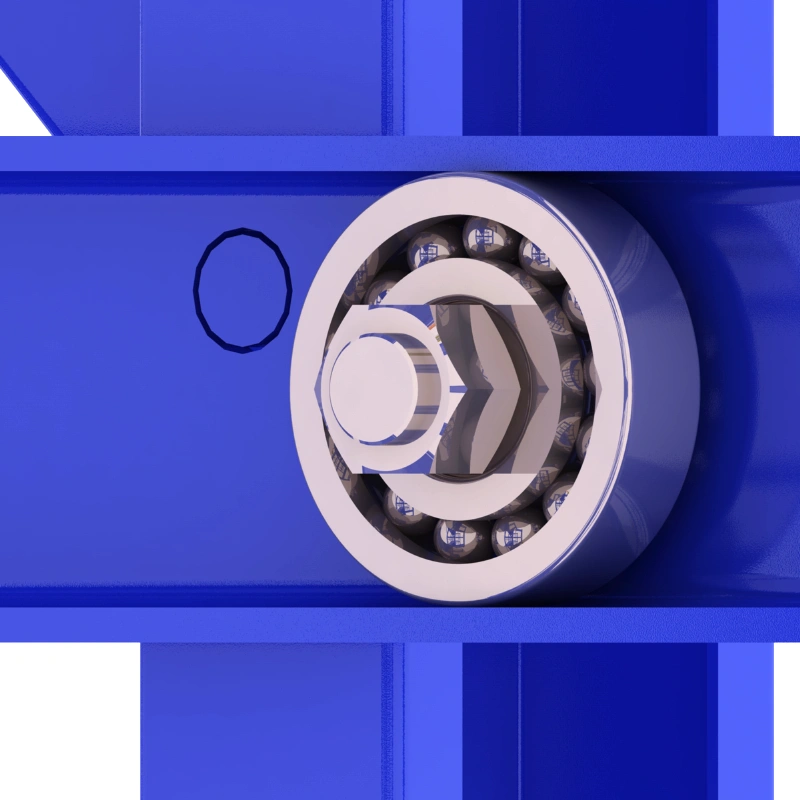
SMED depends on moving preparation work outside the machine stop and making the remaining internal work predictable. A roll-out mold rack can support that method in three practical ways: store the next mold in a known bay, expose it independently before the changeover window, and align the extended drawer with the overhead lifting path. The bearing and guide-rail assembly helps the operator move a heavy drawer with controlled rolling motion rather than dragging a loaded platform. The detailed bearing assembly below is a useful inspection point when comparing a heavy duty mold rack. It should be reviewed together with the safety lock, mechanical stop, base anchoring, lifting capacity, and site operating procedure. Measure the result with your own changeover data; the rack is an enabling control, not a substitute for SMED standard work.
Where a three-post roll-out mold rack fits—and where it does not
- Fits injection molding and stamping workshops that store heavy dies or molds in a designated mold room, changeover zone, repair area, or backup-tool area.
- Fits sites with hardened floors, floor-anchor capability, and an overhead crane, chain hoist, manual hoist, or electric hoist with a lifting path that can be kept clear.
- Fits mixed inventories when drawer dimensions, layer spacing, and the 2–4 layer layout are designed around the actual molds; Erack drawer sizes can be configured from about 850 × 850 mm to 1350 × 1250 mm.
- Does not fit as a universal light-duty shelf, a crane-free handling method, or a replacement for load calculations and site procedures. Do not use a configuration until its per-level load, center of gravity, floor condition, anchoring, lifting gear, and exclusion-zone controls are verified.
Questions supervisors ask before specifying a three-post mold rack
Is a three-post mold rack automatically safer than a two-post rack?
No. The third upright provides an additional support point and can improve the controlled load path during full drawer extension, but safety depends on the complete configuration: rated load, drawer geometry, mold center of gravity, safety pins, mechanical limits, bracing, guide rails, floor anchoring, and operating procedure. Compare verified conditions, not post count alone.
Does full extension guarantee faster changeover?
No. Full extension can reduce searching and unnecessary movement by exposing one selected bay and creating a crane-access path, which supports SMED preparation. Actual improvement depends on mold identification, pre-staging, lifting equipment, operator training, aisle clearance, and the site’s standard work. Record your current retrieval and changeover times before setting a target.
Need a Custom Storage Solution?
Speak directly with our technical engineers. We offer free structural designs, heavy-duty catalog evaluations, and quick B2B price quotations.
Request a Quote Now →