
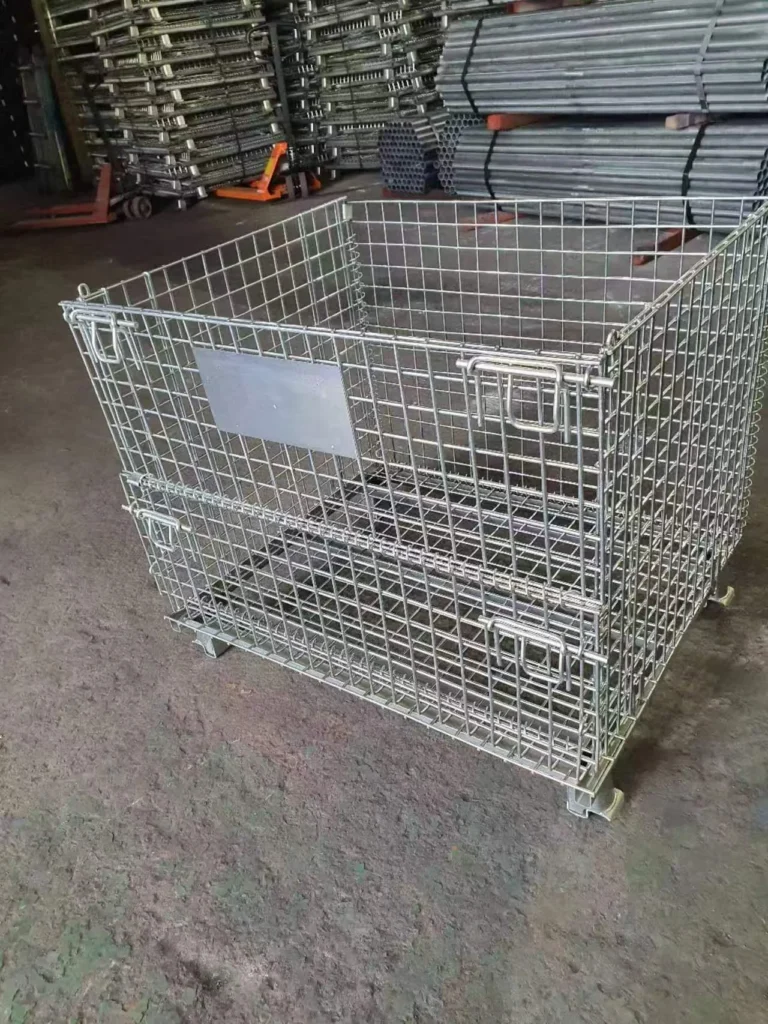
When engineers select a wire mesh container for heavy parts, the first question is often: Will the cage be strong enough? Wire diameter and mesh opening are important, but neither can be used alone to determine a safe load. The base, welds, corner posts, stacking interface, load distribution, and handling method all influence the outcome.
For Stbox selection, use the wire mesh as part of a load path. A thicker wire generally resists bending and impact better; a tighter opening reduces the unsupported span and helps retain smaller parts. The final choice should still be verified against the lower channel steel structure, the intended stacking limit, and the actual load geometry.
How much wire diameter is enough? Start with the load case, not a guess.
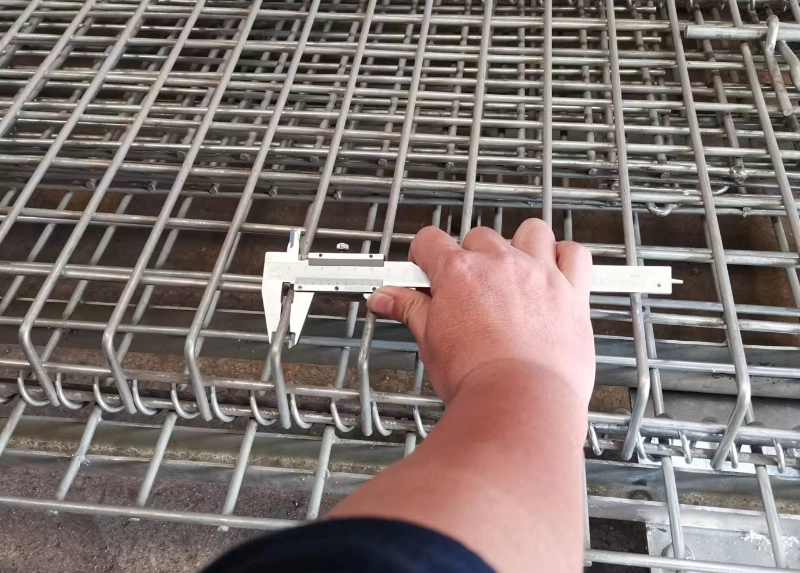
There is no single wire diameter that is sufficient for every application. Ask how heavy each part is, whether the load is concentrated at few points, whether the box is moved fully loaded, and whether loaded units are stacked. For demanding parts storage applications, the delivered project references use wire specifications of at least 5.9 mm and at least 6.0 mm. These are project-specific selection examples, not a universal rated capacity. A thicker wire can improve resistance to local bending, impact, and panel deflection, but weld quality and under-panel support must also carry the load. Use the wire diameter requirement as a starting point for engineering review, then verify the full configuration.
What does mesh opening change? Retention, stiffness, and access.
Mesh opening controls more than just visibility. A smaller opening helps prevent small components from falling through, improves separation of irregular parts, and reduces the unsupported span of each wire between intersections. This can make a panel feel stiffer when wire diameter and welding method are comparable. A larger opening can improve access, ventilation, and visual inspection, but may be unsuitable for small parts or point loads that can locally deform the mesh. The image index shows an example with a 50 × 50 mm configuration; treat it as an example of a specific design, not a standard for every Stbox. Choose the opening based on the smallest part dimension, the risk of falling through, and the way the load contacts the floor and side walls.
What actually determines load capacity? Follow the full load path.
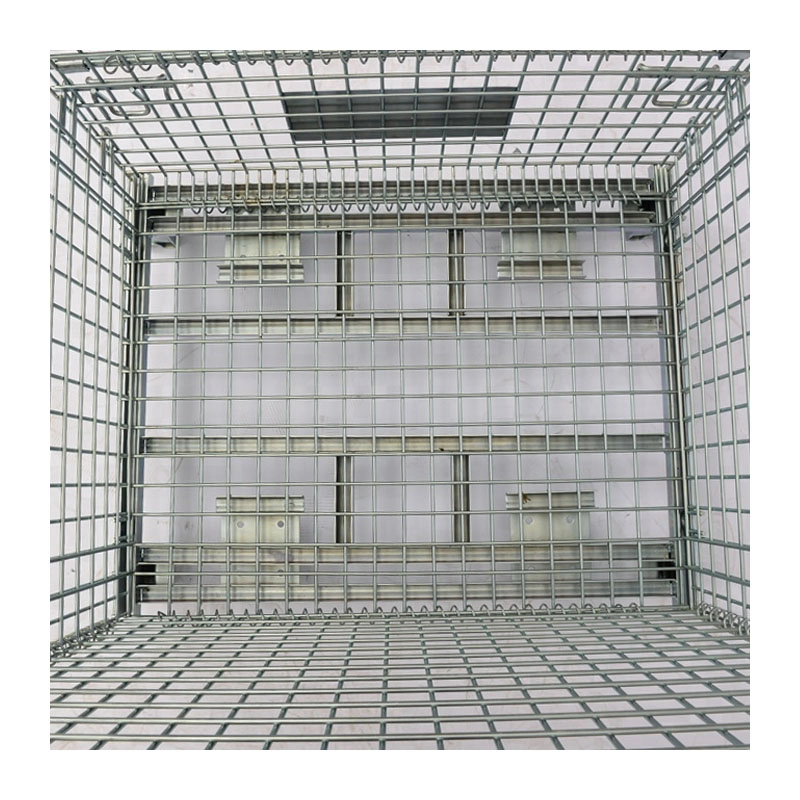
Practical load testing has several parts: wire diameter and opening, panel welding and frame, lower channel steel reinforcement, corner feet and stacking interlock, and the weight distribution and center of gravity of the contents. A concentrated motor or casting load can be more demanding than the same total mass spread across the base. Forklift or pallet jack entry also introduces impact and dynamic effects, while stacking adds compression and alignment requirements. Stbox configurations use reinforced base structures and four-way handling access, but the allowable working load and stacking limit must be confirmed for the selected size, base, load, and operating method. Do not use visual stacking height or a single wire measurement as a substitute for this review.
Use this checklist before requesting a quote for a wire mesh container
- Heavy castings or automotive parts: Describe the heaviest piece, the contact points, and whether the load is distributed with an insert or support plate.
- Small hardware or irregular components: Choose an opening that prevents falling through, then check whether an insert is needed for scratch and dust protection.
- Stacked storage: Define the loaded stacking arrangement, floor condition, alignment, and maximum stacking limit; do not derive a safe limit from an empty stack.
- Internal transport: Confirm forklift or pallet jack entry, turning clearances, ramp conditions, and whether the cage is moved full or empty.
FAQ: Wire diameter, mesh opening, and load selection
Which wire diameter should I choose for a heavy wire mesh container?
Choose it from the load case, not from a generic number. Project examples delivered on this topic use at least 5.9 mm and at least 6.0 mm wire, but these values are not universal ratings. The correct diameter depends on part weight, concentrated loading, handling impact, stacking, panel welding, and the reinforced base. Share these conditions so the full Stbox configuration can be reviewed.
Does a smaller mesh opening automatically mean higher load capacity?
No. A smaller opening can improve retention and reduce unsupported span, but overall load performance also depends on wire diameter, welds, frame, lower channel steel, corner feet, stacking interlock, and load distribution. A dense mesh is not a substitute for a properly designed base or a confirmed stacking limit.
Benötigen Sie eine individuelle Lagerlösung?
Sprechen Sie direkt mit unseren technischen Ingenieuren. Wir bieten kostenlose Strukturplanungen, Bewertungen von Hochlast-Katalogen und schnelle B2B-Preisangebote.
Jetzt Angebot anfordern →