
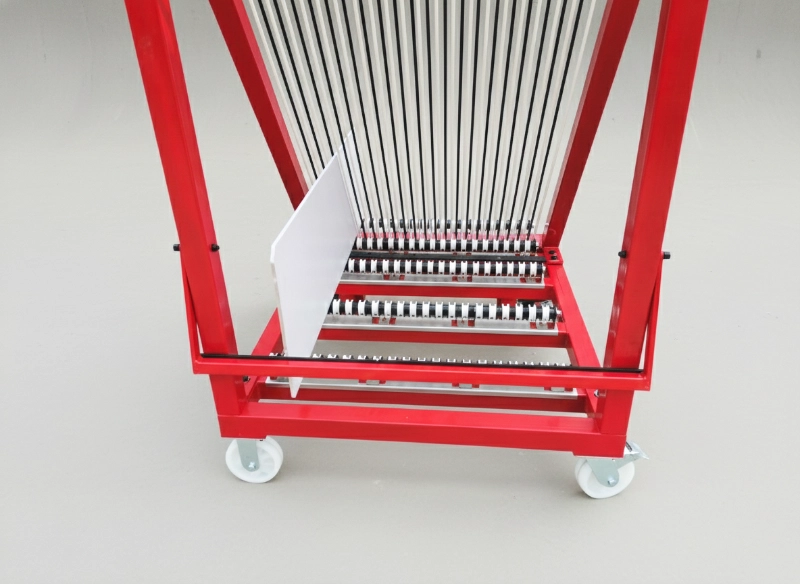
Ihr CNC-Schneidetisch läuft non-stop, aber fertige Aufträge häufen sich und verursachen einen Engpass. Standard-A-Rahmen zerkratzen teure Low-E-Beschichtungen, und diese hohen, schmalen Scheiben für das neue Architekturprojekt sind eine Kippgefahr. Sie verlieren Zeit, Material und Geld zwischen den Produktionsstufen. Es ist an der Zeit, das Chaos nicht mehr zu verwalten, sondern den Workflow zu konstruieren.
Warum Ihre Standardgestelle Sie mehr kosten als nur Bodenfläche
In einem Glasverarbeitungsbetrieb mit hohem Volumen ist der Raum zwischen den Maschinen, wo Gewinne geschützt oder verloren gehen. Traditionelle Lagerlösungen, oft umfunktioniert oder für die dynamischen Anforderungen der Sonderglasfertigung ungeeignet, führen Risiken ein, die direkt auf Ihre Gewinnmarge durchschlagen. Während Sie vielleicht nach Lieferanten für Sonderausrüstung suchen, ist das Verständnis der spezifischen Schwachstellen in Ihrem aktuellen Prozess der erste Schritt zu einer echten Lösung.
Die hohen Kosten eines "Beinahe-Unfalls": Mikrorisse und zerkratzte Beschichtungen
Betrachten Sie die Produktion von Insulated Glass Units (IGUs). You’re handling thin lites, often 6mm or less. When placed in a standard rack with wide, one-size-fits-all slots, these lites rattle and vibrate during every innerbetrieblichen Transports. This movement can cause invisible micro-cracks that lead to failure after installation. For high-value materials like Low-E glass, every scrape from an unprotected metal divider means a costly reject. These aren’t just operational hiccups; they are direct hits to your profitability and reputation.
“The Leaning Tower of Glass”: The Unstable Reality of Non-Standard Lites
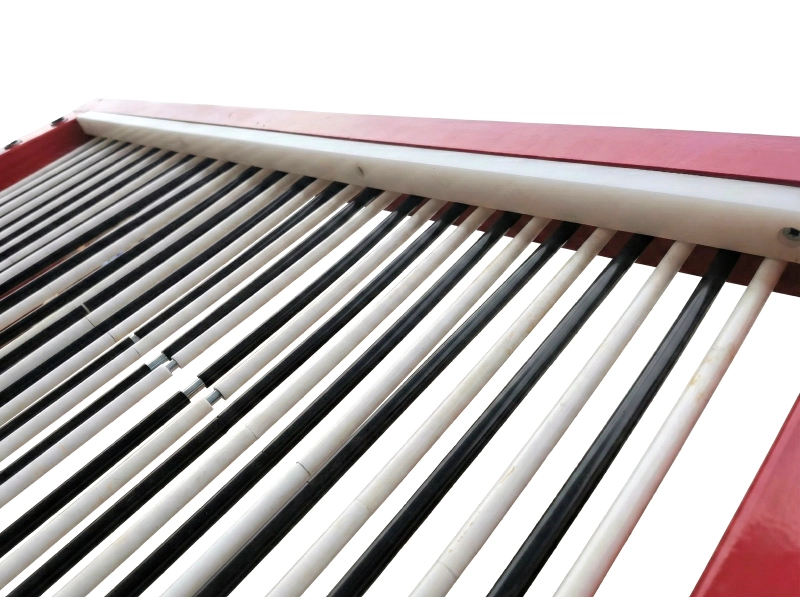
Architectural projects increasingly demand custom, non-standard dimensions—especially tall, narrow glass panels. On a conventional roller-base rack, these pieces only make contact with one or two rollers, creating a dangerously unstable load. The risk of a tip-over is immense, threatening employee safety and the loss of thousands of dollars in tempered or laminated glass. Your ability to confidently take on lucrative custom jobs is limited by your shop’s ability to handle them safely.
The Harp Rack: A Mobile Work-in-Progress Station, Not Just Storage
The solution is to rethink the rack not as a storage shelf, but as a dynamic tool for workflow optimization. Our Harp Racks are purpose-built for the glass fabrication environment, functioning as mobile Work-in-Progress (WIP) buffer stations that bridge the gaps in your production line. Each design feature is a direct response to a real-world fabrication challenge.
Structure-Driven Value: How Each Component Protects Your Bottom Line
Every element is engineered to solve a specific problem in the glass handling process, turning potential liabilities into streamlined assets.
- Vollstahlbasis mit Schlitzen: Unlike roller bases that create precarious pressure points, our Harfenregale mit Vollbasis provide continuous, edge-to-edge support. This design completely neutralizes the stability risk for short or narrow glass lites, allowing you to handle diverse custom orders without hesitation.
- PVC-beschichtete Stahltrennwände: The core of our system for das Sortieren von Glaseinheiten safely. A rigid steel core provides the strength to separate heavy glass plates, while the thick, soft PVC casing ensures that delicate surfaces and expensive coatings remain pristine from the cutting table to the assembly line.
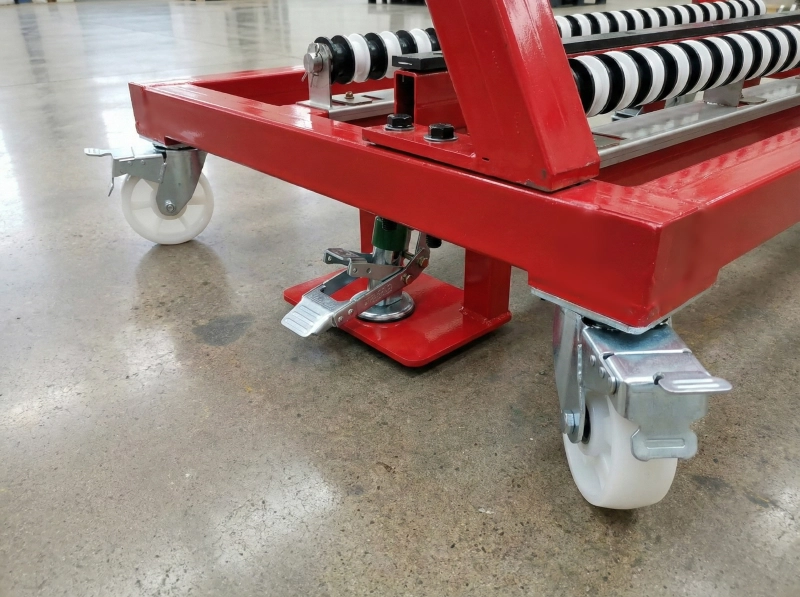
- Foot-Actuated Lifting Mechanism: Safety during movement is non-negotiable. Before transport, a simple step on the pedal lifts the entire load slightly, locking it securely against a fixed rubber buffer. This eliminates any chance of the glass shifting or sliding during transit, protecting both your product and your people.
Tailored to Your Workflow: Customization That Matters
No two glass fabrication plants are identical. We provide custom solutions built on a proven, robust platform. Whether you need to reduce the slot width to a precise 8mm for thin IGU lites or color-code your racks by production line using the RAL color system, we engineer the equipment to fit your process, not the other way around. Our designs are manufactured to a strict GB/T1804-m tolerance standard using high-precision laser cutting and full-welding processes for maximum durability.
| Modell | Dimensions (L×W×H, Inches) | Schlitzkapazität | Glass Thickness (Inches) | Dynamische Belastung (lbs) |
|---|---|---|---|---|
| HR-40 | 59″ × 39,4″ × 71″ | 40 | ≤ 0,47″ | 3300 |
| HR-84 | 59″ × 47,2″ × 70,9″ | 84 | 0 – 0.31″ | 3300 |
| HR-40 (Schmal) | 39,4″ × 47,2″ × 70,9″ | 40 | 0.31″ – 0.47″ | 3300 |
| Benutzerdefiniert Groß | 102,4″ × 94,5″ × 74,8″ | 80 | ≤ 0.98″ | >5500 |
Beyond the Factory Floor: Smarter Logistics from Day One
Slashing Freight Costs with Knock-Down Design
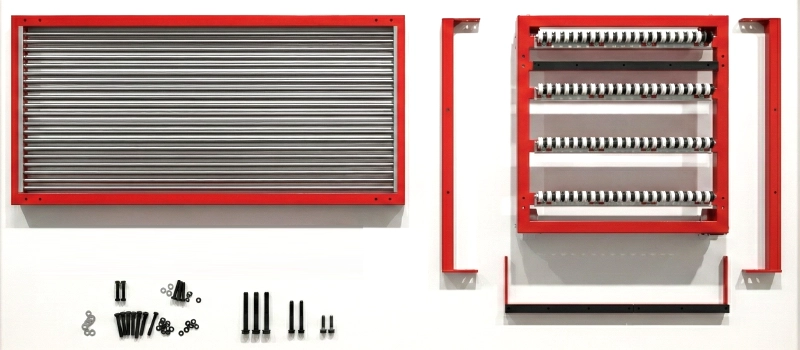
Your investment shouldn’t be consumed by shipping costs. Our Harfen-Rack für Glas features a bolted, knock-down assembly structure. We ship the components flat-packed, dramatically increasing the number of units that can fit into a single container. This intelligent design significantly reduces international and domestic freight costs, making it easier to deploy a fleet of racks across your facility or multiple locations. Assembly on-site is straightforward, allowing for quick deployment into your workflow.
Häufig gestellte Fragen
1. What is the main difference between a Harp Rack and the A-Frame racks we already use?
A-Frames are excellent for bulk, static storage of same-sized glass packs. A Harp Rack is a dynamic production tool. Its key advantages are high-density storage for individual lites, the ability to safely sort and pair glass for jobs (like IGUs), and its mobility as a WIP cart that moves between workstations, actively improving your process flow.
2. Can we customize the slot spacing for very thin (e.g., 4mm) or very thick (e.g., 25mm) laminated glass?
Absolutely. Customization is one of our core strengths. We can engineer the slot width on our full-base models to your exact specifications, ensuring a snug, secure fit that prevents movement for thin glass and provides adequate space for thick, multi-layered assemblies.
3. How does the bolted knock-down structure compare to a fully welded frame in terms of strength and durability?
Our bolted structures are engineered for industrial use. We use high-tensile strength bolts and a design that locks together to provide immense structural integrity, fully capable of handling the specified dynamic load of 3300 lbs or more. The manufacturing process, including full welding on sub-assemblies and precision laser cutting, ensures that when assembled, the rack is just as robust and durable as a welded unit, with the added benefit of lower shipping costs.
4. Can this rack be moved with a forklift when fully loaded?
Yes. The base is designed with integrated forklift entrances (fork pockets). This allows for safe and efficient movement of fully loaded racks over longer distances within your facility, complementing the manual push-and-pull handling for short transfers between adjacent machines.
5. What is the typical lead time for a custom order?
Lead times can vary based on the level of customization and order volume. However, because we operate with a modular design and an efficient manufacturing process, we can often deliver custom solutions faster than industry standard. For a precise quote and delivery schedule, please contact our solutions experts directly.
Benötigen Sie eine individuelle Lagerlösung?
Sprechen Sie direkt mit unseren technischen Ingenieuren. Wir bieten kostenlose Strukturplanungen, Bewertungen von Hochlast-Katalogen und schnelle B2B-Preisangebote.
Jetzt Angebot anfordern →