
 |
En apariencia, la mayoría carro de 2 niveles con ruedas se ven similares. Están hechos de acero y tienen cuatro ruedas. Pero la diferencia entre un carro que dura 12 meses y uno que dura 10 años es invisible: está en el proceso de fabricación. Un verdadero carro de taller industrial se define por *cómo* está construido. |
El problema de la "Caja Negra" con los Carros de Acero
Muchos proveedores son solo ensambladores o revendedores. No pueden decirle *cómo* está soldado el bastidor ni *cómo* se trata el acero. Esto es una "caja negra". El comprador solo descubre la mala calidad seis meses después, cuando una soldadura se agrieta bajo una carga pesada o el acabado comienza a descamarse, exponiendo óxido. En un entorno industrial, esto no es solo un costo de reemplazo; es una falla de seguridad y confiabilidad.
Una Mirada al Interior de un Proceso de Fabricación E-E-A-T (Experiencia, Autoridad, Confiabilidad)
Un fabricante profesional puede señalar su proceso como una garantía de calidad. Dos procesos no son negociables para equipos de trabajo pesado: la soldadura y el acabado superficial.
La Soldadura: Soldadura Blindada con Gas CO2 (MIG/MAG)
Un carro barato a menudo está "soldado por puntos" o mal unido con puntos de soldadura. Un bastidor industrial se basa en la soldadura blindada con gas CO2 (MIG/MAG). Este proceso utiliza un alimentador continuo de alambre y un gas protector para crear una soldadura profunda y consistente. Los beneficios son críticos:
- Penetración Profunda: La soldadura fusiona el metal, no solo se asienta sobre él. Esto es lo que le da a un carro con capacidad de 600 kg su verdadera resistencia.
- Menos Deformación: El calor se concentra, evitando que el tubo de acero se deforme, asegurando que el bastidor esté cuadrado y alineado.
- Resistencia Superior: La costura de soldadura resultante es increíblemente fuerte y resistente al agrietamiento, la vibración y el estrés dinámico que soporta un carro en movimiento.
El Acabado: Más que Solo Pintura
Una simple lata de pintura en aerosol no proporciona protección alguna. Un verdadero acabado industrial es un proceso químico de múltiples etapas. El estándar de oro es la pulverización electrostática (recubrimiento en polvo).
- Pretratamiento (El Paso Más Importante): El bastidor de acero en bruto se limpia y se trata, a menudo con un lavado ácido (decapado) y un baño de fosfatado. Este proceso elimina todos los aceites y graba microscópicamente el acero, creando una superficie perfecta para la adhesión.
- Aplicación Electrostática: El polímero en polvo recibe una carga eléctrica y el bastidor del carro está conectado a tierra. El polvo se siente atraído hacia el acero, envolviendo las esquinas y adhiriéndose de manera uniforme.
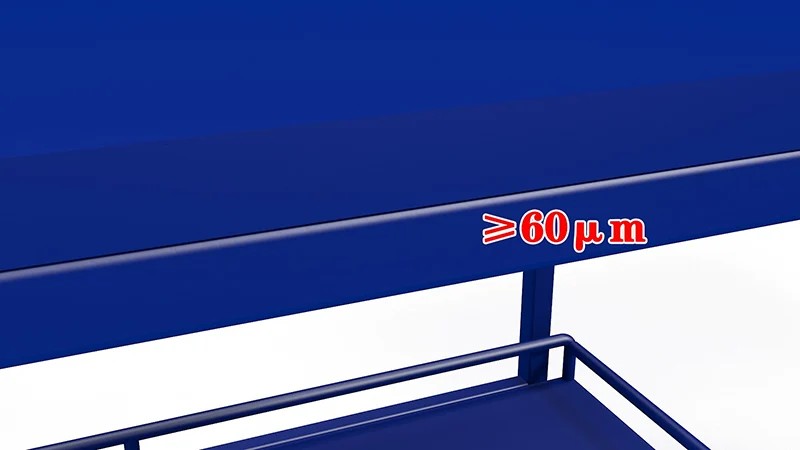
- La pieza recubierta se hornea en un horno industrial. El calor funde el polvo, haciendo que fluya formando una película lisa y continua que se cura en un acabado duro y duradero. Un espesor de recubrimiento estándar industrial de 60μm o más garantiza una barrera sustancial contra los elementos. El carro se hornea, lo que funde el polvo en una capa gruesa, uniforme e increíblemente dura (a menudo de 60 micras).
Este proceso hace que el acabado sea resistente a astilladuras, productos químicos y rayones, y es la única forma confiable de prevenir el óxido.
Por Qué Este Proceso es Su Garantía
Entender *cómo* está hecho un 2 tier trolley on wheels es la única forma de confiar en sus especificaciones. Una capacidad de 600 kg no tiene sentido si las soldaduras son débiles. Una promesa de "durabilidad" es vacía si es solo pintura en aerosol. Este nivel de detalle de fabricación es la diferencia entre una herramienta desechable y una inversión de capital a largo plazo.
Preguntas Frecuentes
P: ¿Qué es la soldadura blindada con gas CO2?
R: También conocida como soldadura MIG o MAG, es un proceso avanzado que utiliza un gas protector para proteger la soldadura de la contaminación. Esto crea una soldadura mucho más fuerte, profunda y consistente que la soldadura por puntos básica, y es esencial para equipos de carga pesada.
P: ¿Qué es la pulverización electrostática (recubrimiento en polvo)?
R: Es un proceso de acabado de alta tecnología donde un plástico en polvo se adhiere eléctricamente al metal y luego se hornea. Crea un acabado que es significativamente más grueso, más duro y más resistente al óxido y las astilladuras que la pintura líquida convencional.
P: ¿Por qué es tan importante el pretratamiento (como el fosfatado) para el acabado?
R: El pretratamiento es el paso más crítico para la durabilidad. Limpia todas las impurezas del acero en bruto y graba la superficie, lo que permite que el recubrimiento en polvo forme un enlace químico permanente con el metal. Sin él, el acabado se desprendería o descamaría fácilmente.
P: ¿Cómo afecta este proceso de fabricación a la capacidad de 600 kg del carro?
R: La capacidad de 600 kg es un resultado directo de estos procesos. La soldadura con CO2 asegura que las uniones del bastidor sean lo suficientemente fuertes para soportar el estrés dinámico de una carga de 600 kg, mientras que el recubrimiento en polvo protege el acero estructural del óxido y la degradación.
P: ¿Es este carro de taller industrial resistente a productos químicos o aceites?
R: Sí. El acabado de recubrimiento en polvo de alta calidad es no poroso y altamente resistente a productos químicos industriales comunes, aceites y solventes de limpieza, lo que facilita su limpieza y lo hace ideal para un entorno de taller.
¿Necesita una Solución de Almacenamiento a Medida?
Hable directamente con nuestros ingenieros técnicos. Ofrecemos diseños estructurales gratuitos, evaluaciones de catálogos para cargas pesadas y cotizaciones de precios B2B rápidas.
Solicitar un Presupuesto Ahora →