
Why frequent order picking works better with a four-sided open Mybox
When a warehouse accesses the same container dozens of times per shift, the opening face becomes the bottleneck. The worker does not lose time because the parts are heavy; they lose time because each extraction starts with the same small sequence: walk, turn, open, reach, close, and move away. In a parts room or a kitting cell, that wasted motion accumulates faster than most teams expect.
That is why a four-sided open Mybox is not just a container choice. It is a workflow choice. The goal is to keep the extraction point as close as possible to the operator, while using a wire mesh container that can be stacked, moved, and returned empty without creating additional handling work.
Why the opening face becomes the bottleneck
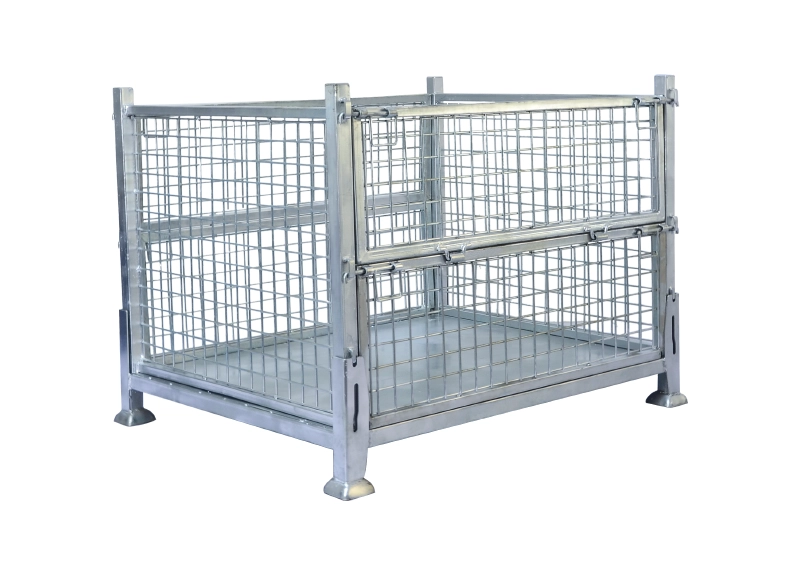
A single front door works well when access is occasional. It starts to feel slow when the same box is touched all day. A fixed opening face forces the operator to approach from the same direction every time, creating aisle congestion, awkward reach angles, and small delays that repeat throughout the shift. In high-frequency order picking, the problem is not the door itself; it is that the door is always in the wrong place for at least part of the workflow. The galvanized container in this catalog, with stacking legs and a half-drop gate, clearly shows the basic logic: the structure is built to hold its shape, but the access point remains concentrated on one face.
How four-sided opening changes the workflow
Four-sided opening helps because the container adapts to the station instead of forcing the station to adapt to the container. The operator can work from the nearest side, keep the box aligned with the bench, and reduce the need to walk around the unit just to reach a label, a bin, or a picked part. In small-parts logistics, that matters more than dramatic capacity claims. A better extraction path is often better than a larger box. This is also why a four-sided open design is often a better choice for order picking, replenishment loops, and kitting cells than a fixed front-opening cage pallet.
If you want to compare product construction and workflow design side by side, see PDP-02 for product detail and PAGE-01 for design logic. The point is not to force every warehouse into one configuration. The point is to match access with the real movement pattern on the floor.
Can you still pick when boxes are stacked?
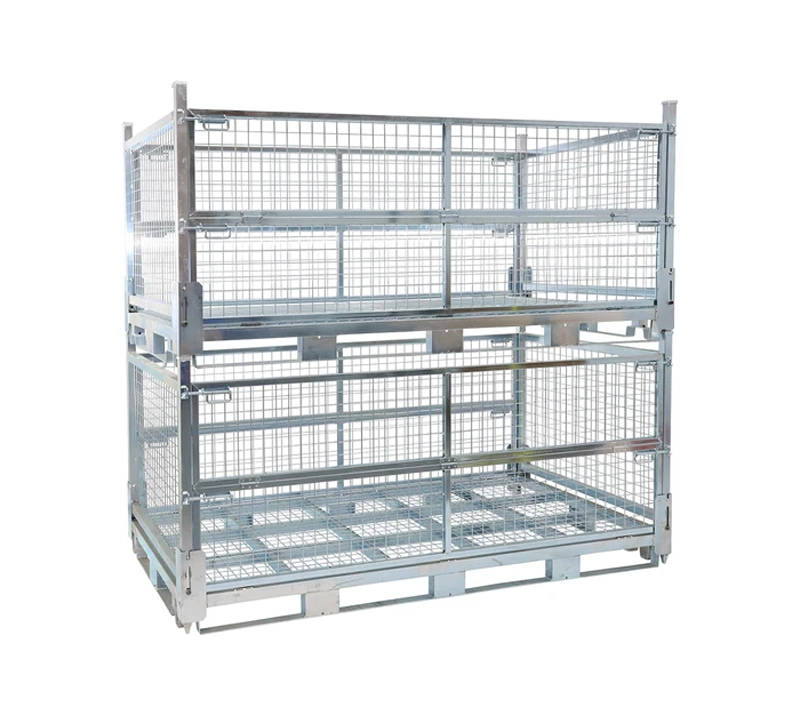
Yes, but only when stacking is planned around access. The two-level example in this catalog shows the right scenario: a low stack near the work area, with the active face still reachable. In that configuration, the worker can keep picking without fully breaking down the stack. Once the container is buried in deep pallet racking, surrounded by adjacent units, or positioned so that no working side remains open, four-sided access loses most of its value. At that point, you are no longer solving an extraction problem; you are solving a storage density problem. They are not the same.
This is also where the choice between an open cage and a lidded cage matters. If the priority is dust cover, weather protection, or secure storage, a lidded Mybox is usually the best choice. If the priority is speed and frequent access, four-sided opening is the best tool.
Where it fits best and where it does not
The best fit is a warehouse handling spare parts, maintenance items, mixed bins, or short-cycle kitting. These sites need the box close to the person, not hidden on a deep shelf. Four-sided opening also works well when the same container moves between replenishment, extraction, and line delivery, because each step can use the nearest face instead of a fixed front door.
It is less suitable for high-density deep storage, fully sealed outdoor storage, or slow-moving bulk stock that is touched only occasionally. If the unit will live on a pallet rack for long periods, or if the environment requires strong dust or rain protection, then access speed is not the main problem. In those cases, a lidded or more enclosed configuration is usually the best answer.
Best-fit applications
- Maintenance rooms and spare parts areas with repeated small-batch extraction.
- Kitting cells where operators need the nearest face, not a fixed front door.
- Short-cycle warehouse lanes that need stackable container handling without extra walking.
- Projects that need a design recommendation: send your extraction rate, aisle width, stack height, and handling method.
Frequently asked questions
Is four-sided opening better than a front door for all warehouses?
No. It is better when the same box is accessed many times a day and stays near a person or work station. If the box is mainly for deep storage, low-frequency stock, or sealed outdoor storage, another configuration is usually more efficient.
What should I send to get the right configuration?
Envíe su frecuencia de extracción, tamaño de pieza, ancho de pasillo, ruta de manejo, altura de pila y si necesita cubierta contra el polvo o movilidad con ruedas. Mapearemos esas condiciones a la configuración de Mybox adecuada y le diremos qué variante vale la pena usar realmente.
Para una comparación del lado del producto, revise PDP-02 y PAGE-01.
¿Necesita una Solución de Almacenamiento a Medida?
Hable directamente con nuestros ingenieros técnicos. Ofrecemos diseños estructurales gratuitos, evaluaciones de catálogos para cargas pesadas y cotizaciones de precios B2B rápidas.
Solicitar un Presupuesto Ahora →