
Why Frequent Order Picking Works Better with a Four-Sided Open Mybox
When a warehouse accesses the same container dozens of times per shift, the opening face becomes the bottleneck. The worker does not lose time because the parts are heavy; they lose time because each pick starts with the same small sequence: walk, turn, open, reach, close, and move away. In a parts room or kitting cell, that wasted motion adds up faster than most teams expect.
That is why a four-sided open Mybox is not just a container choice. It is a workflow choice. The goal is to keep the picking point as close to the operator as possible, while still using a wire mesh pallet container that can stack, move, and return empty without creating extra handling work.
Why the opening face becomes the bottleneck
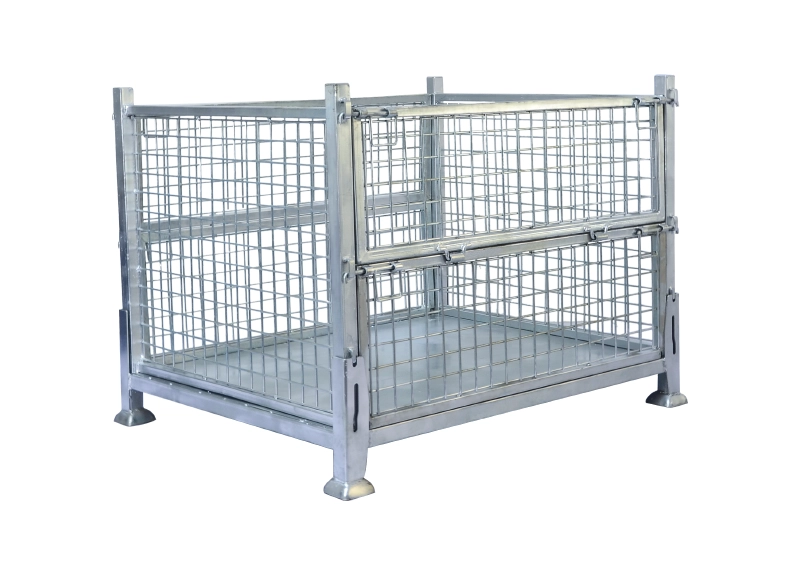
A single front door works well when access is occasional. It starts to feel slow when the same box is touched all day. A fixed opening face forces the operator to approach from the same direction every time, which creates aisle congestion, awkward reach angles, and small delays that repeat throughout the shift. In high-frequency order picking, the problem is not the door itself; it is that the door is always in the wrong place for at least part of the workflow. The galvanized container in this catalog, with stacking feet and a half-drop door, shows the basic logic clearly: the frame is built to hold shape, but the access point is still concentrated on one face.
How four-sided opening changes the workflow
Four-sided opening helps because the container adapts to the station instead of forcing the station to adapt to the container. The operator can work from the nearest side, keep the box aligned with the workbench, and reduce the need to walk around the unit just to reach a label, box, or picked part. In small-parts logistics, this matters more than dramatic capacity claims. A better picking path often beats a larger box. That is also why a four-sided open layout is often a better match for order picking, replenishment loops, and kitting cells than a fixed front-opening cage pallet.
If you want to compare product construction and workflow layout side by side, see PDP-02 for the product detail and PAGE-01 for the layout logic. The point is not to force every warehouse into a single configuration. The point is to match access to the actual pattern of movement on the floor.
Can you still pick when boxes are stacked?
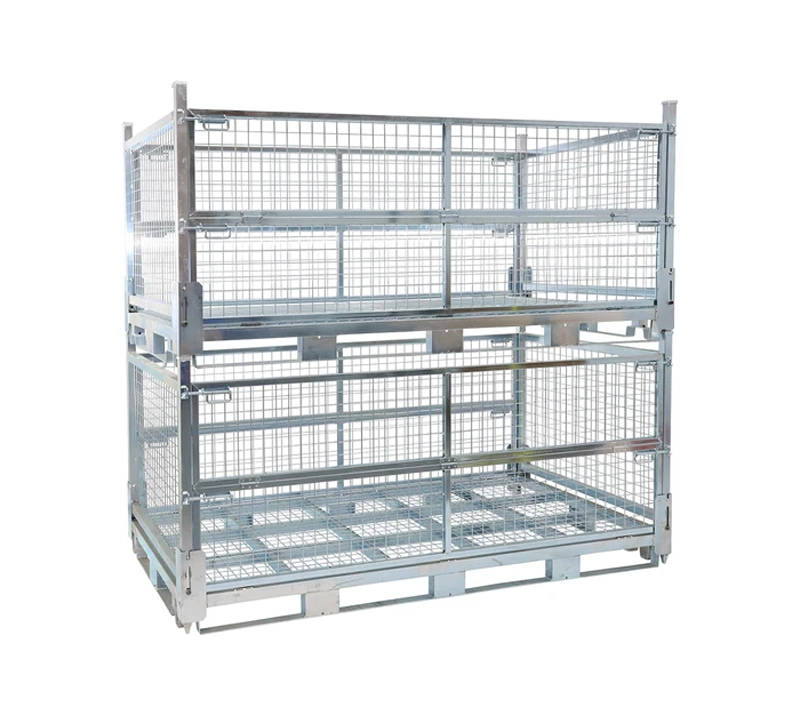
Yes, but only when stacking is planned around access. The two-level example in this catalog shows the right scenario: a low stack near the work area, with the active face still reachable. In that setup, the worker can keep picking without fully breaking down the stack. Once the container is buried in deep racks, surrounded by adjacent units, or positioned so that no working side remains open, four-sided access loses most of its value. At that point, you are no longer solving a picking problem; you are solving a storage density problem. Those are not the same thing.
This is also where the choice between an open cage and a lidded cage matters. If the priority is dust coverage, weather protection, or secure storage, a lidded Mybox is generally the better choice. If the priority is speed and frequent access, four-sided opening is the better tool.
Where it fits best and where it does not fit
The best fit is a warehouse handling spare parts, maintenance items, mixed cartons, or short-cycle kitting. These locations need the box close to the person, not hidden in a deep rack. Four-sided opening also works well when the same container moves between replenishment, picking, and delivery side by side, because each step can use the nearest face instead of a fixed front door.
It is less suited for high-density deep storage, fully sealed outdoor storage, or low-turnover bulk stock that is touched only occasionally. If the unit will live in a pallet rack for long periods, or if the environment demands strong dust or rain protection, then access speed is not the main problem. In those cases, a lidded or more enclosed configuration is generally the best answer.
Best-fit applications
- Maintenance rooms and spare parts areas with repeated small-lot picking.
- Kitting cells where operators need the nearest face, not a fixed front door.
- Short-cycle warehouse aisles that need stackable stillage handling without extra walking.
- Projects that need a layout recommendation: send your picking rate, aisle width, stack height, and handling method.
FAQ
Is four-sided opening better than a front door for all warehouses?
No. It is better when the same box is accessed many times per day and stays near a person or workstation. If the box is mainly for deep storage, low-frequency stock, or sealed outdoor retention, another configuration is usually more efficient.
What should I send to get the right configuration?
Send your picking frequency, part size, aisle width, handling route, stack height, and whether you need dust coverage or caster mobility. We will map those conditions to the correct Mybox configuration and tell you which variant is worth using.
Precisa de uma Solução de Armazenamento Personalizada?
Fale diretamente com nossos engenheiros técnicos. Oferecemos projetos estruturais gratuitos, avaliações de catálogos de alta capacidade e orçamentos rápidos para B2B.
Solicite um Orçamento Agora →