

|
Stop “Pancaking” Your Feed Bags and Flour Sacks.In the milling industry, bottom-layer compression isn’t just an annoyance—it’s direct Yield Loss. When you stack palletized soft bags of flour or feed on the floor, the bottom sacks harden or burst. When you use wooden pallets, you invite moisture, splinters, and contamination risks that violate hygiene standards. Switch to a structural steel solution that protects your product integrity from the warehouse to the bakery. |
The Hidden Cost of “Soft Stacking” in Food & Feed Mills
If you are managing a warehouse for a flour mill or animal feed plant, you know the nightmare of the “Leaning Tower of Pallets.” Unlike rigid boxes, sacks of Layer Mash or Duck Pellets are fluid. Over time, they settle. When you double or triple stack wooden pallets directly on top of soft goods, the result is inevitable: bag deformation, stock instability, and catastrophic toppling.
Furthermore, for facilities handling Bakery Ingredients or sensitive Premixes, the wooden pallet is a hygiene liability. Wood absorbs moisture (leading to mold on paper sacks), sheds nails (puncturing bags), and is impossible to sanitize effectively. The industry is moving toward metal post pallets not just for strength, but for compliance.
Solution: Structural Load Bearing vs. Product Load Bearing
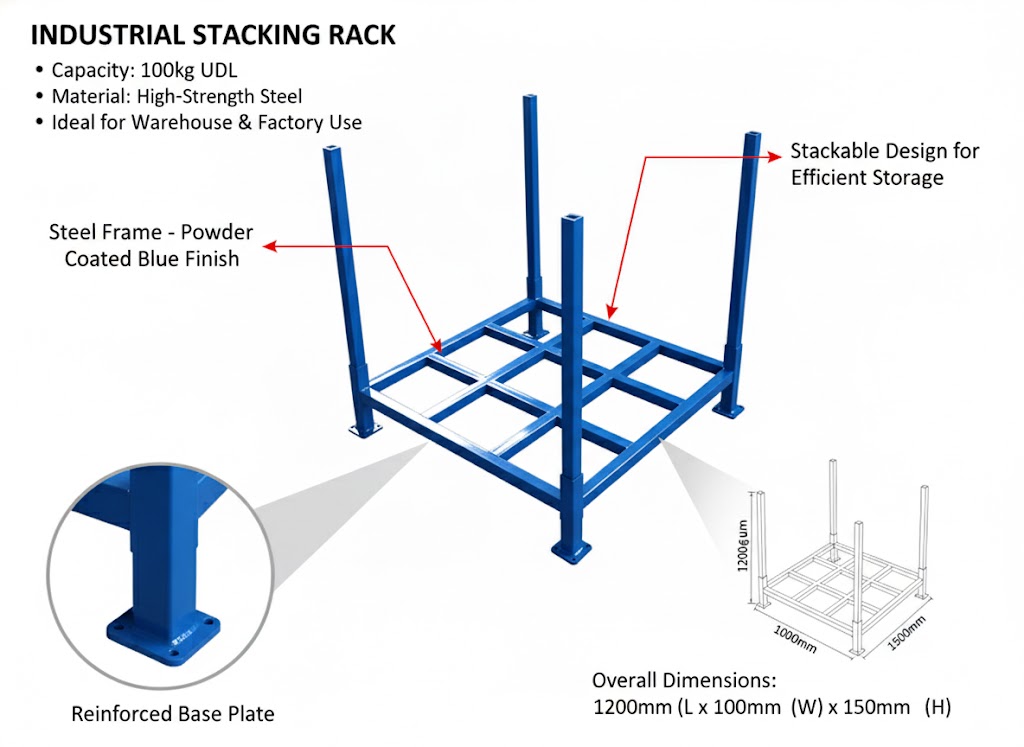
The fundamental flaw in traditional stacking is that the product bears the weight. Our Removable post pallets change the physics of your warehouse. By utilizing a steel base with four sturdy, removable posts, we transfer the overhead load through the steel frame, not through your flour bags.

Figure 1: Industrial stacking racks create independent storage layers, preventing lower-level product damage.
1. Eliminating Compression Damage
Whether you are storing 25kg sacks of Hard Wheat Flour or bulk bags of corn, the stack rack system allows you to stack 4 to 5 units high. The weight of the top tier is supported entirely by the steel posts of the tier below. Your bottom pallet of flour looks exactly the same coming out as it did going in—no caking, no hardening, and no burst seams.
2. Hygiene and Contamination Control
In the food sector, “cleanability” is non-negotiable. Our pallet stillages are Hot-Dip Galvanized. This zinc coating creates a metallurgical bond that is impervious to rust and can be steam-cleaned or pressure-washed. Unlike wood, steel does not harbor weevils, rodents, or mold spores, ensuring your Chick Booster and Soft Wheat Flour remain uncontaminated.
Flexibility: The “Accordion” Warehouse
Feed and flour demand is seasonal. During harvest or peak production runs, you need maximum density. In off-peak times, you need floor space for maintenance or cross-docking. Fixed racking bolts you to the floor—literally.
Portable stack racks offer a dynamic solution. When empty, the posts can be removed, and the bases can be nested or stacked compactly. This allows you to reclaim up to 80% of your storage space when inventory is low, or easily relocate the storage area to a different part of the plant without unbolting a single screw.

Figure 2: Empty racks can be dismantled and nested, freeing up valuable floor space for production.
Streamlined SKU Management
With hundreds of SKUs ranging from Hog Starter Feeds to specific Bakery Yeasts, digging out a specific pallet from a block stack is a labor-intensive nightmare. With portable stacking pallet racks, you can move an entire column of racks with a forklift to access the goods behind, or organize your warehouse into flexible lanes that change as your production schedule changes.
Frequently Asked Questions (FAQ)
1. Can these racks handle the weight of heavy dense products like mineral premixes?
Absolutely. Our heavy duty stack racks are engineered for high-density loads. We typically design for capacities ranging from 1000kg to 2000kg per rack, stacking 4 high, ensuring stability even for dense mineral sacks.
2. Will the metal posts tear our paper flour sacks?
No. We understand the fragility of paper packaging. Our posts are designed with smooth, rounded edges, and the base structure can be fitted with sheet metal or fine mesh decking to prevent snagging or “bag sag” between supports.
3. How do these compare to FIBC (Big Bag) usage?
They are ideal for FIBCs. Stacking Big Bags directly is dangerous as they are unstable. A metal post pallet acts as a cage that contains the bag, keeping it upright and allowing for safe vertical stacking without the bag slipping.
4. Are these racks suitable for cold storage or humid milling environments?
Yes. We recommend the Hot-Dip Galvanized finish for any food processing environment. It provides superior corrosion resistance against humidity, condensation in cold storage, and frequent wash-downs.
5. Can we use our existing wooden pallets inside these racks?
Yes, you can. The racks are sized to accommodate standard industrial wooden or plastic pallets. You can simply forklift your existing palletized goods directly into the rack, instantly upgrading your storage from “floor stacking” to “structural stacking.”
Need a Custom Storage Solution?
Speak directly with our technical engineers. We offer free structural designs, heavy-duty catalog evaluations, and quick B2B price quotations.
Request a Quote Now →