
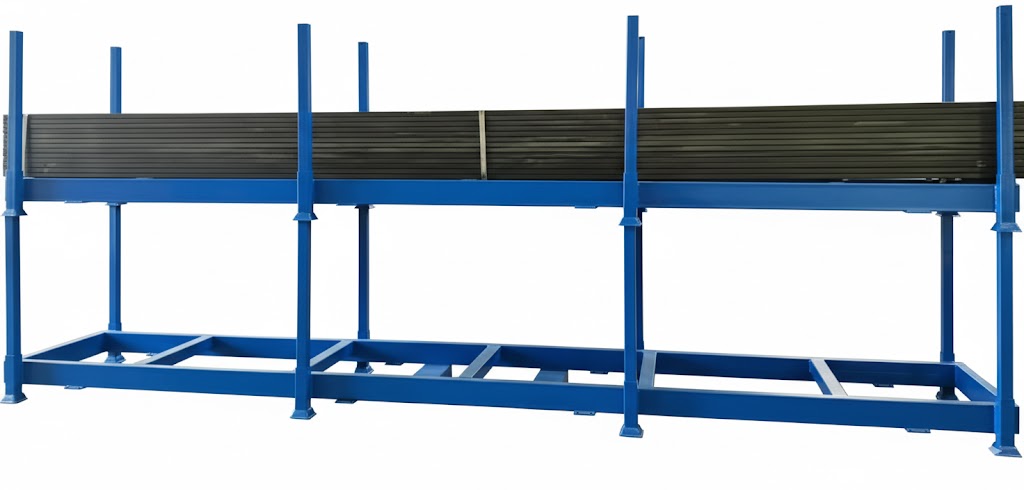

Eliminate product crushing, double your storage density, and gain perfect inventory access. Discover how portable stack racks transform warehouses that handle bagged goods like flour, seeds, or animal feed.
The Hidden Costs of Floor Stacking Bagged Goods
In warehouses managing bagged products like flour, animal feeds, or agricultural seeds, floor stacking is a common practice. However, this method introduces significant, often unmeasured, operational costs and inefficiencies. The primary challenge is that the product itself—the bag—becomes the storage structure, a role it was never designed for.
Product Damage and Direct Value Loss
When bags are stacked directly on top of each other, the bottom layers bear the entire weight of the column. This immense pressure leads to several forms of product loss. For food-grade items like flour, compression can compact the product, altering its properties and potentially leading to customer rejection. For animal feed, it can crush pellets into dust, reducing nutritional value. Furthermore, bags stored directly on concrete floors are susceptible to moisture absorption, leading to spoilage, mold, and pest infestation—a critical failure in food and feed safety protocols.
Inefficient Space Utilization and Wasted Overhead
Floor stacking inherently limits vertical storage. The height of a stack is restricted by the stability of the bags and their ability to withstand weight without collapsing. In a typical warehouse with a 6-8 meter clear height, this means the majority of the cubic space—the expensive vertical volume you pay for—remains empty. This forces businesses to either limit inventory or lease more warehouse space, both of which negatively impact the bottom line.
Labor-Intensive Handling and Poor Selectivity
The floor stack operates on a strict “Last-In, First-Out” (LIFO) basis. Accessing a specific batch or SKU from the bottom or middle of a stack requires de-stacking and re-stacking dozens or even hundreds of bags. This is not just time-consuming and physically demanding for staff, increasing labor costs and injury risks; it makes proper “First-In, First-Out” (FIFO) inventory rotation nearly impossible. For products with expiration dates, this can lead to significant waste due to expired stock.
Shifting from Product-Bearing to Structure-Bearing Storage
The solution is to decouple the product from the structural load-bearing function. This is achieved by introducing a modular, self-supporting frame: the steel post pallet. Also known as a portable stack rack or pallet stillage, this system is essentially a heavy-duty steel base with four removable posts. A full pallet of bagged goods is placed onto the base, and the posts support the weight of the next level. The goods themselves bear zero weight from the units stacked above.
This fundamental change transforms each pallet load into a robust, stackable building block. The weight is transferred directly through the steel posts to the floor, allowing for safe vertical stacking of 3, 4, or even 5 units high, instantly multiplying the storage capacity of the same floor footprint.

Transforming Your Warehouse Workflow with Portable Stack Racks
Adopting a portable stack rack system is more than an equipment upgrade; it’s a complete workflow re-engineering that delivers tangible benefits in every stage of your operation.
Gaining Vertical Space Without Construction
Instead of relying on fixed, bolted-down racking systems that lock your warehouse layout, portable stack racks create a dynamic storage environment. You can create dense storage blocks during peak seasons and then clear the area for staging or other operations during slower periods. Empty racks can have their posts removed and their bases nested together, occupying minimal space.
Protecting Product Integrity and Reducing Waste
By encasing each pallet load within a protective steel frame, you eliminate compression damage entirely. Bags are no longer crushed, and the steel base keeps them off the damp floor, protecting against moisture and pests. This results in a near-zero rate of product damage from storage, preserving the value of your inventory.
Achieving 100% Selectivity for FIFO Management
Every single stack rack unit remains individually accessible to a forklift. There is no need to move five units to get to the sixth. This complete selectivity allows for perfect FIFO inventory management, ensuring older stock is shipped first. This is not just good practice; for food and feed industries, it’s a critical component of quality control and regulatory compliance.

Streamlining Inbound and Outbound Logistics
Handling is radically simplified. Instead of moving bags individually or in unstable stacks on a standard pallet, a forklift can safely and quickly move an entire one-ton unit. This dramatically reduces loading and unloading times, decreases labor requirements, and minimizes the risk of handling-related product damage during transit within the warehouse or onto a truck.
The Financial Case: A Clear Comparison
While the initial investment in steel post pallets is higher than simply using the floor, the return on investment is rapid and multifaceted. The operational savings in space, labor, and reduced product loss far outweigh the capital expenditure. A hot-dip galvanized finish ensures a 20+ year lifespan, even in harsh or humid environments, making it a long-term asset rather than a consumable expense.
| Operational Metric | Traditional Floor Stacking | Steel Post Pallet System |
|---|---|---|
| Storage Density | Low (1-2 layers); Wasted vertical space | High (4-5 layers); Up to 400% increase |
| Product Damage Rate | High (compression, moisture, pests) | Near-Zero (load is on the steel structure) |
| Inventory Access | LIFO (Last-In, First-Out); Poor selectivity | 100% Selective; Perfect for FIFO |
| Labor Efficiency | Low; Requires significant manual handling | High; Forklift handles entire units efficiently |
| Layout Flexibility | Rigid; Moving stacks is a major project | High; Can be reconfigured in minutes |
For any business handling bagged goods, moving from floor stacking to a portable stacking rack system is a strategic decision. It is a direct investment in operational efficiency, inventory preservation, and warehouse optimization that pays dividends from day one.
Frequently Asked Questions
1. What is the main difference between a steel post pallet and a regular pallet cage?
A steel post pallet is designed primarily for vertical stacking and creating a portable rack structure. Its key feature is the strong, removable corner posts that bear the full load of the units above. A pallet cage is typically designed for containing loose or irregular items on a standard pallet and may not have the same stacking capacity or structural integrity as a dedicated post pallet system.
2. How high can you safely stack these post pallets?
This depends on the load capacity of the specific model, the weight of the goods, the flatness of the floor, and the lift height of your forklift. However, most industrial-grade systems are engineered to be safely stacked 4 to 5 units high, reaching heights of 6-8 meters.
3. Are these racks suitable for refrigerated or cold storage warehouses?
Yes, absolutely. When specified with a hot-dip galvanized finish, steel post pallets are ideal for cold and damp environments. The zinc coating provides superior, long-lasting protection against rust and corrosion caused by condensation, meeting the stringent hygiene requirements of the food and beverage industry.
4. Do we need a special type of forklift to use portable stack racks?
No. Steel post pallets are designed to work with standard counterbalance forklifts. The base of the rack includes fork pockets or guides for safe and easy lifting from all four sides, ensuring compatibility with existing material handling equipment.
5. How do demountable posts save money on return shipping?
The ability to remove the posts is a key economic advantage for returnable transport packaging (RTP). Once the posts are removed, the empty bases can be nested or stacked compactly. This allows 4 to 6 empty racks to fit into the same space as one fully assembled rack, dramatically reducing the volume and cost of shipping them back for reuse.
Need a Custom Storage Solution?
Speak directly with our technical engineers. We offer free structural designs, heavy-duty catalog evaluations, and quick B2B price quotations.
Request a Quote Now →