
Cold Storage Rerack for Frozen Food Cartons
Cold-storage rerack for frozen food cartons and ventilated boxes. Learn how the inverted Strack nestainer supports free-standing cold-room storage, carton classification, and about 100 mm fork clearance in a project sample.
Keep the insulation layer untouched while you reorganize frozen storage
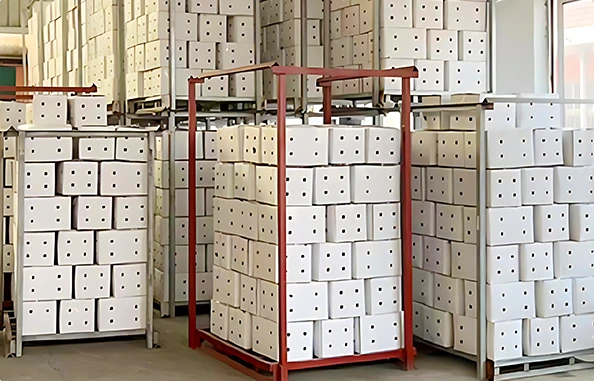
This inverted Strack configuration is a free-standing cold-room storage frame, not a wall-anchored rack. That means the storage zone can be installed without drilling the cold-room envelope, so the insulation layer stays intact while cartons, ventilated boxes, and pallet-supported loads are moved as one unit.
For cold-storage operators, frozen-food plants, and food-supply warehouses, the point is simple: replace risky floor stacking with a reusable frame, keep forklift access clear, and leave room to change the layout later. In the referenced project sample, empty racks nest with about 100 mm clearance so fork tines can pass between stacked frames when the units are compacted for return or storage.
- Inverted Rerack geometry for cold-room storage
- Ordinary deployment does not require drilling into the insulation layer
- Classify and stack frozen food cartons or ventilated boxes
- Project sample uses about 100 mm empty nesting clearance for fork tine access
- Clear difference from direct floor stacking and fixed pallet racking
Where this cold-room variant fits, and where it should not be forced
Suitable
Frozen food cartons and ventilated boxes
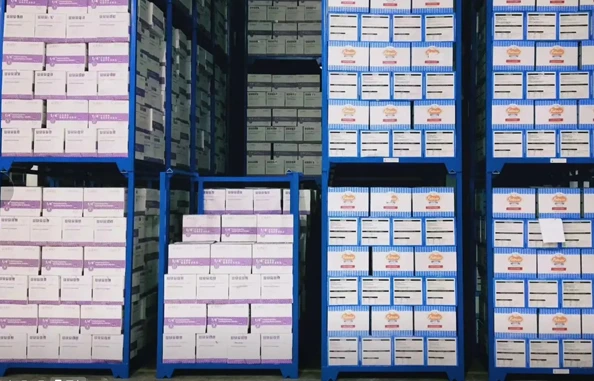
Use the inverted rack when you want carton classes to stay organized, when the lower load must be kept off the floor, and when forklift handling needs a clear entry path. This is the right fit for cold-room buffer zones and low-temperature staging.
Best when: the cargo is pallet-supported, carton-based, and handled as a unit load.
Compare
Direct floor stacking
Floor stacking can be acceptable only when bottom-crush risk is not a concern and the pile stays stable enough for your operation. If the lower cartons need protection, or if you need a repeatable handling gap, this option works against you.
Not ideal when: the warehouse needs better protection, cleaner turnover, and safer forklift access.
Compare
Fixed pallet racking
Fixed pallet racks are stronger for permanent channel layouts, but they are not the right choice when the cold-room plan must change, when empty-rack nesting matters, or when you want to avoid an anchored installation in the cold-room envelope.
Not ideal when: layout flexibility, empty return compaction, and no-drill deployment matter more than fixed access lanes.
Four reasons the inverted version is used in cold storage
No drilling into the insulation layer
The rack is presented as a free-standing storage frame, so the cold-room envelope does not need to be cut open for ordinary deployment. That helps keep the thermal layer intact.
About 100 mm fork gap in the project sample
When the empty racks are nested, the sample leaves roughly 100 mm of clearance so the fork tines can move through the stacked frames instead of forcing the rack apart.
Carton classification without floor compression
Frozen-food cartons and ventilated boxes stay inside the frame instead of being crushed by a direct floor stack. The load is carried by the rack, not by the cartons below.
Better than floor stacking when the layout must change
Compared with a fixed rack system, the inverted Strack can be moved, re-zoned, and nested again when the season changes or the cold-room plan changes.
How to check the cold-room fit before you place the order
Share the cold-room condition
Send the temperature band, carton type, pallet format, and whether the load is frozen food cartons or ventilated boxes.
Confirm the handling path
Tell us how the forklift enters, where the stack will stand, and whether you need empty-rack nesting for return transport or storage.
Validate the layout against the project sample
We compare the sample logic for the inverted version, including the fork access gap, the pallet interface, and the carton classification requirement.
Submit the cold-room condition change
Once the storage pattern is confirmed, you can request a quotation and switch the cold-room zone to the inverted rerack plan.
Common questions from cold-room operators
Does this configuration require anchoring into the cold-room wall or floor?
Ordinary deployment is treated as free-standing, so the cold-room envelope does not need to be drilled just to place the rack. If your project needs anti-movement restraint or seismic fixing, confirm the fixing plan from the drawing before order.
Why is the 100 mm gap important?
The referenced sample uses roughly 100 mm of empty nesting clearance so the fork tines can pass between racks when the units are nested. That helps with compact storage and return handling.
What cargo is it meant for?
It is a good fit for frozen food cartons, ventilated boxes, and other pallet-supported unit loads that need to stay organized in a cold-room staging area.
When should it not be used?
Do not force it into a job that needs a permanent fixed-rack aisle system, a non-forklift workflow, or cargo that is too unstable or top-heavy for the chosen containment method.
Need a different cold-room setup? Send the cargo type, pallet size, stacking height, and handling path, and we will check whether the inverted version is the right fit.
B2B Racking Structural Engineering Calculator
Input your structural guidelines below. Our math system calculates material deflection, stress bounds, and recommends optimal profiles.
Click Compute to calculate stress factors and display structural drawing recommendations.