
A practical loading guide for export teams, comparing the standard Ttrack configuration and the 2300 mm version in 40HQ and 20-foot containers.
If your team is looking for a tire shipping container or a tire shipping pallet, the real question is usually the same: how many units fit inside, how much empty space remains, and how much freight that empty space costs. With Ttrack, the loading answer changes with the base length, wheel position, and the way the pallets are oriented in the container.
This article compares the standard layout with the 2300 mm version and keeps one limit in mind: the loading figures given below are planning references. Final numbers may vary upward or downward depending on tire width, wheelbase, wrapping thickness, and how the motorcycle is secured on the pallet.
Why the base 40HQ configuration sits at 72 units
In a standard 40HQ plan, the standard Ttrack module is packed to a point where the fork pockets, wheel holders, and lashing straps still leave the clearance required for safe loading and unloading. That is why the base reference is 72 units. The number depends not only on floor area; it is also about the wasted gap at the container door, the space lost for access to lashing points, and the room needed to keep the rack stable during mechanical loading with a forklift.
For export teams, this is the first cost control point. If the loading plan leaves only a little more air between units, the container price per motorcycle shipping pallet rises immediately. If the spacing is too tight, handling time increases along with the risk of scratches or issues in tip-resistant transport. The base layout is therefore a balance between density and safe handling, not a pure cube-filling exercise.
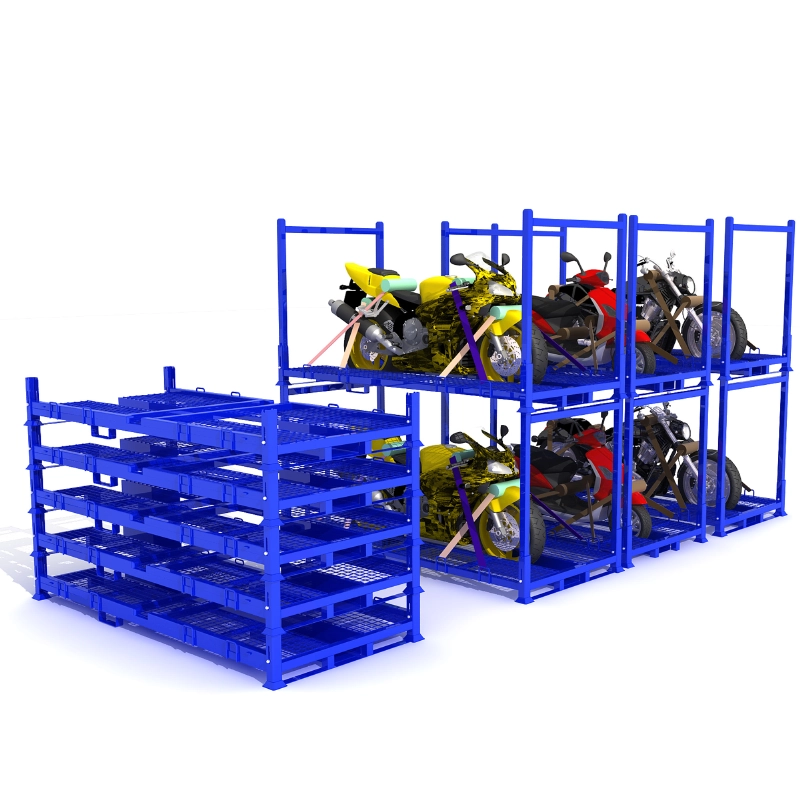
Why the 2300 mm version with horizontal loading can reach 80 units
The 2300 mm version improves density because the longer base reduces dead space between rows. When the pallet is loaded horizontally, the rack moves along the container axis instead of being turned into an awkward offset pattern. That matters. Once the frame length fits the container's internal geometry better, the loader can align the wheel holders, side guides, and lashing points in the same direction, so the container is filled with less unusable void.
This allows the same export route to shift from 72 to 80 units in a 40HQ reference plan. The gain comes from smaller side gaps, cleaner row alignment, and less overlap loss in the door area. In practice, this is the kind of improvement logistics coordinators look for when comparing motorcycle shipping pallet layouts, because every additional unit spreads the sea freight over more product.
Simply put, the 2300 mm version does not create space out of nowhere. It helps you use the space you are already paying for. If your tires are wider, the packaging is bulkier, or you need thicker protective film, the gain can shrink. But when the load is planned correctly, the longer version is the easier path to higher density.
Why a 20-foot container is closer to 35 units
A 20-foot container has a shorter usable length, so the same module logic does not scale linearly. The door opening, internal length, and loader rhythm compress the pattern. For this reason, a practical 20-foot plan in this reference setup comes to about 35 units. Export teams use this figure when they need a smaller batch, a pilot shipment, or a route where the customer does not yet want a full 40HQ.
The freight logic is simple. Freight per unit equals total container cost divided by the number of units loaded. If a 40HQ carries 72 units and the 2300 mm version carries 80, then the 80-unit plan lowers container freight per pallet by about 10% compared to the 72-unit plan, assuming the same route costs. The 20-foot container will always have higher freight per unit than the 40HQ, but it can still be the right choice when order volume is lower or handling at the destination is limited.
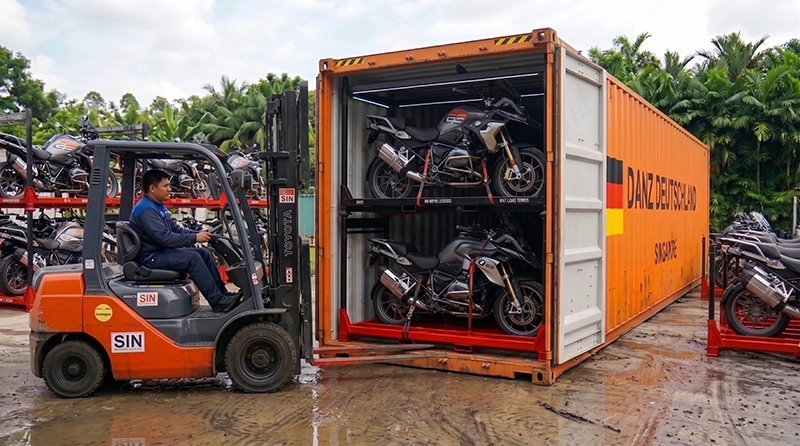
How to calculate density before booking freight
Start with the container cost and divide it by the planned load quantity. Then test the loading pattern against the actual packaging profile. If the motorcycle is shipped with wide handlebars, thick foam, extra film, or a higher top profile, density drops. If the same unit is packed with a cleaner wheel holder position and a tighter strap system, the count improves. That is why Ttrack is a reusable metal pallet and not a one-way crate: the rigid frame grid gives logistics teams repeatable geometry, and repeatable geometry yields repeatable freight math.
For export managers, it is not just about unit count. It is about the ratio between unit count, damage prevention, and lower handling costs. A cheaper freight bill is useless if the motorcycles arrive scratched or unloading the container takes too long. Ttrack is designed to support both sides of the equation: higher loading density and controlled handling.
Where this loading plan fits best
- 40HQ export programs where the goal is the highest possible unit count per shipment.
- 20-foot pilot shipments when a distributor wants a smaller, lower-risk initial order.
- Dealer warehouse staging where motorcycle stack storage keeps inventory off the floor.
- Returns logistics loops where empty pallets must come back with minimal backhaul waste.
FAQ
Is the 2300 mm version always better than the base version?
No. It is better when the longer footprint reduces dead space without forcing a poor fit. If the tires are wider, the wrapping is thicker, or the loading sequence changes, the base version may actually be safer or easier to handle. The best choice is the one that matches your actual container loading pattern, not just the headline number.
Can I treat the numbers 72 / 80 / 35 as a firm promise?
No. Treat them as planning references. The final count changes with tire size, motorcycle model, packaging method, and loading discipline. The value of the reference is that it gives your team a realistic starting point before freight booking, not a rigid guarantee.
Benötigen Sie eine individuelle Lagerlösung?
Sprechen Sie direkt mit unseren technischen Ingenieuren. Wir bieten kostenlose Strukturplanungen, Bewertungen von Hochlast-Katalogen und schnelle B2B-Preisangebote.
Jetzt Angebot anfordern →