
A practical loading guide for export teams comparing the standard Ttrack setup and the 2300mm version in 40HQ and 20ft containers.
If your team searches for a tire shipping container or tire shipping pallet, the real question is usually the same: how many units fit, how much empty space remains, and how much freight that empty space costs. For Ttrack, the loading answer changes with the base length, the wheel position, and the way the pallets are oriented inside the box.
This article compares the standard layout against the 2300mm version and keeps one boundary in mind: the loading counts below are planning references. Final numbers can move up or down with tire width, wheelbase, wrap thickness, and the way the motorcycle is secured on the pallet.
Why the base 40HQ configuration lands at 72 units
In a normal 40HQ plan, the standard Ttrack module is packed to a point where the fork pockets, wheel chocks, and tie-down loops still leave the clearance needed for safe stuffing and unloading. That is why the base reference sits at 72 units. The count is not only about floor area; it is about the wasted gap at the container door, the space lost to tie-down access, and the room needed to keep the rack stable during forklift mechanical loading.
For export teams, this is the first cost control checkpoint. If the loading plan leaves just a little more air between units, the container cost per motorcycle shipping pallet rises immediately. If the spacing is too tight, handling time rises and the risk of scuffing or anti-tip secure transport problems goes up. The base layout is therefore a balance between density and safe handling, not a pure cube-fill exercise.
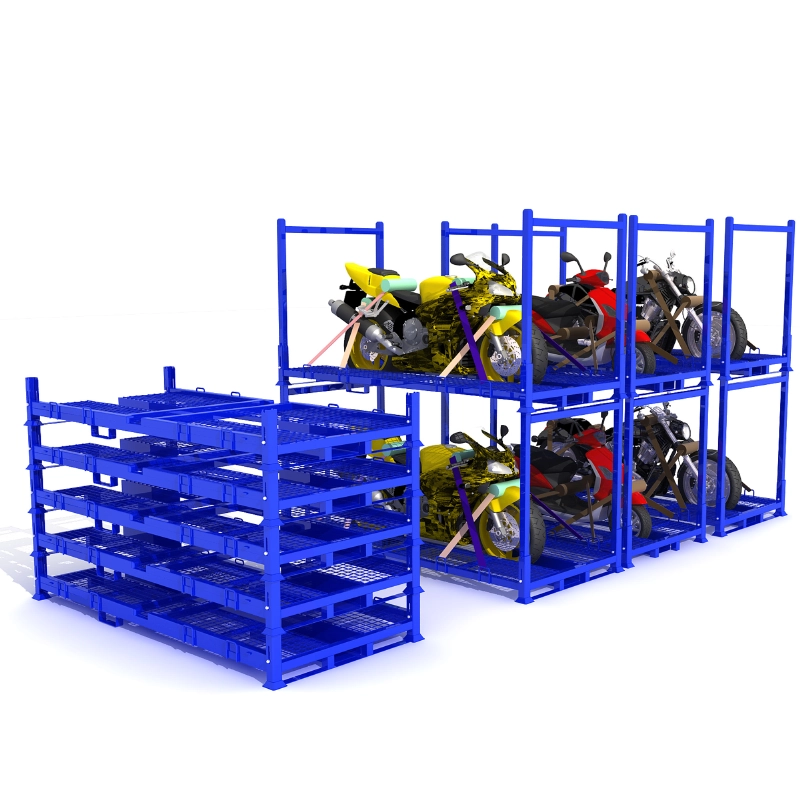
Why the 2300mm version can reach 80 units with horizontal loading
The 2300mm version improves density because the longer base reduces dead space between rows. When the pallet is loaded horizontally, the rack moves along the container axis instead of being turned into an awkward offset pattern. That matters. Once the frame length better matches the internal geometry of the box, the loader can keep the wheel chocks, side rails, and lashing points aligned with the same direction, so the container is stuffed with less unusable void.
That is how the same export lane can move from 72 to 80 units in a 40HQ reference plan. The gain comes from smaller side gaps, cleaner row alignment, and less overlap loss at the door area. In practice, this is the kind of improvement logistics coordinators look for when they compare motorcycle shipping pallet layouts, because every extra unit spreads the ocean freight across more product.
Put simply: the 2300mm version does not create space out of thin air. It helps you use the space you already pay for. If your tires are wider, the packaging is bulkier, or you need thicker protective wrap, the gain can shrink. But when the load is planned correctly, the longer version is the easier route to higher density.
Why a 20ft container is closer to 35 units
A 20ft container has a shorter usable length, so the same modular logic does not scale linearly. The door opening, internal length, and loading rhythm all compress the pattern. For that reason, a practical 20ft plan lands around 35 units in this reference setup. This is the number export teams use when they need a smaller batch, a pilot shipment, or a lane where the customer does not yet want a full 40HQ.
The freight logic is straightforward. Per-unit freight equals total container cost divided by the number of loaded units. If a 40HQ moves 72 units and the 2300mm version moves 80, then the 80-unit plan lowers container freight per pallet by about 10% versus the 72-unit plan, assuming the same lane cost. The 20ft box will always show a higher per-unit freight than the 40HQ, but it can still be the right choice when order volume is lower or destination handling is constrained.
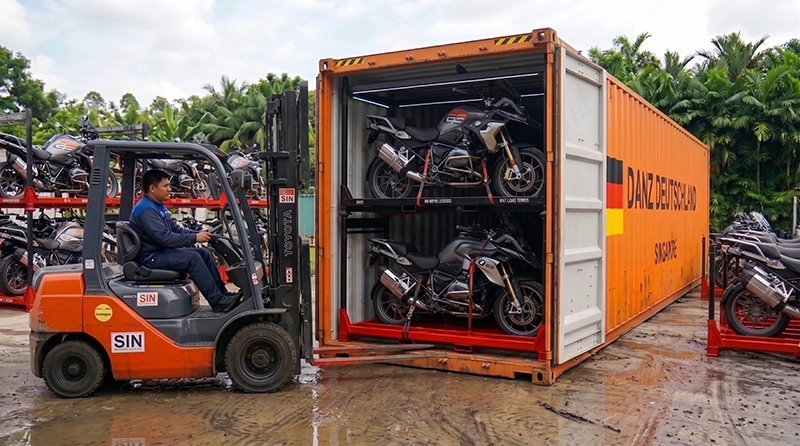
How to calculate density before you book freight
Start with the container cost, then divide by the planned loaded quantity. After that, test the loading pattern against the real packaging profile. If the motorcycle is shipped with wide bars, thick foam, extra wrap, or a taller top profile, the density drops. If the same unit is packed with a cleaner wheel chock position and a tighter strap path, the count improves. This is why Ttrack is a returnable metal pallet rather than a one-time crate: the rigid frame grid matrix gives logistics teams repeatable geometry, and repeatable geometry gives repeatable freight math.
For export managers, the important part is not only the unit count. It is the relationship between unit count, damage prevention, and turnaround cost reduction. A cheaper freight bill is useless if the bikes arrive scuffed or the container unload takes too long. Ttrack is built to help with both sides of the equation: higher load density and controlled handling.
Where this loading plan fits best
- 40HQ export programs where the target is the highest possible unit count per shipment.
- 20ft pilot shipments when a distributor wants a smaller, lower-risk first order.
- Dealer warehouse staging where motorcycle stacking storage keeps inventory off the floor.
- Return logistics loops where empty pallets must come back with minimal reverse freight waste.
FAQ
Is the 2300mm version always better than the base version?
No. It is better when the longer footprint reduces dead space without forcing a bad fit. If the tires are wider, the wrapping is thicker, or the loading sequence changes, the base version may actually be safer or easier to handle. The best choice is the one that fits your actual container loading pattern, not just the headline count.
Can I treat the 72 / 80 / 35 numbers as a fixed promise?
No. Treat them as planning references. The final count changes with tire size, motorcycle model, packaging method, and loading discipline. The value of the reference is that it gives your team a realistic starting point before booking freight, not a rigid guarantee.
Need a Custom Storage Solution?
Speak directly with our technical engineers. We offer free structural designs, heavy-duty catalog evaluations, and quick B2B price quotations.
Request a Quote Now →