
Loose small parts can turn a useful wire mesh container into a cleanliness problem. When parts fall through openings, rub against the steel mesh, or pick up dust from the surrounding process, the first reaction is often: "Add a liner." That is not always the right first step.
For a collapsible Stbox wire mesh container, the decision usually comes down to two paths: add a PP hollow-core board liner as a flexible protective accessory, or review the mesh specification so the opening suits the smallest part. The right choice depends on the smallest component, its surface sensitivity, cleaning requirements, handling method, and how quickly the container must be delivered. The 3-second rule is simple: before adding a liner, compare a finer mesh specification with a PP liner.
Start with the smallest part - not the average part
Measure the smallest dimension that could pass through an opening, including the orientation in which the part may be placed or shaken during movement by forklift, pallet jack, or manually. Then check the part geometry: a round pin, a thin stamped part, a loose fastener, and an irregular casting do not behave the same way. A nominal 50 x 50 mm mesh is documented for many industrial components, but should not be treated as a universal limit for containment. Stbox projects use different dimensions, wire and load combinations, so the final drawing must confirm the selected specification.
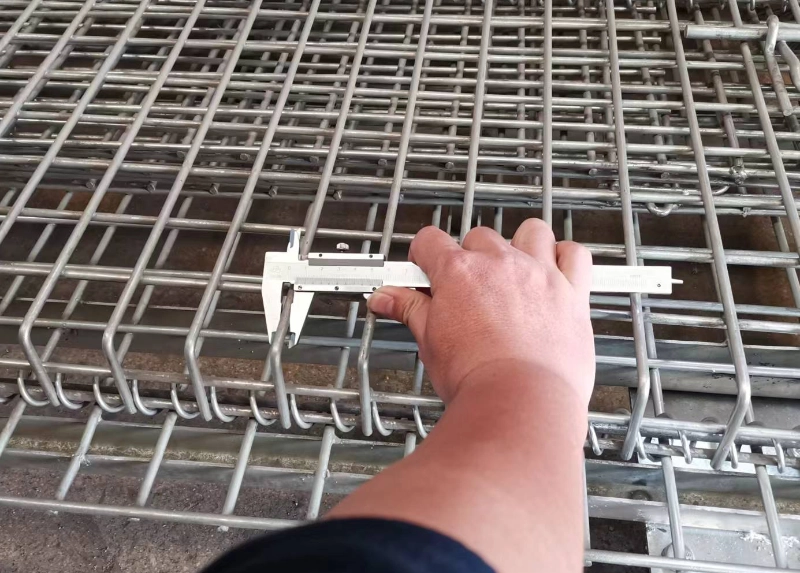
Path A: PP hollow-core board liner for flexible protection
A PP liner creates a physical barrier between the parts and the wire mesh. The indexed Stbox examples show black and light green hollow-core board liners for holding small parts, reducing scratches, and separating dust. This path makes sense when the same container is to hold different part families, when the current container geometry is otherwise suitable, or when protection requirements may change between production lines.
But "add a liner" is not a complete specification. Confirm the board thickness, whether the liner covers only the bottom or bottom plus four sides, how the edges are protected, and how the board is secured during loading and unloading. The available product brief lists PP hollow-core boards as an option, but does not confirm a standard thickness, a fixed number of covered surfaces, a fastening method, or an operating temperature range. These points must remain open until engineering and purchasing have agreed on them. A removable or replaceable liner can be practical for mixed parts; more comprehensive enclosure may be preferable when both dust ingress and side abrasion are critical.
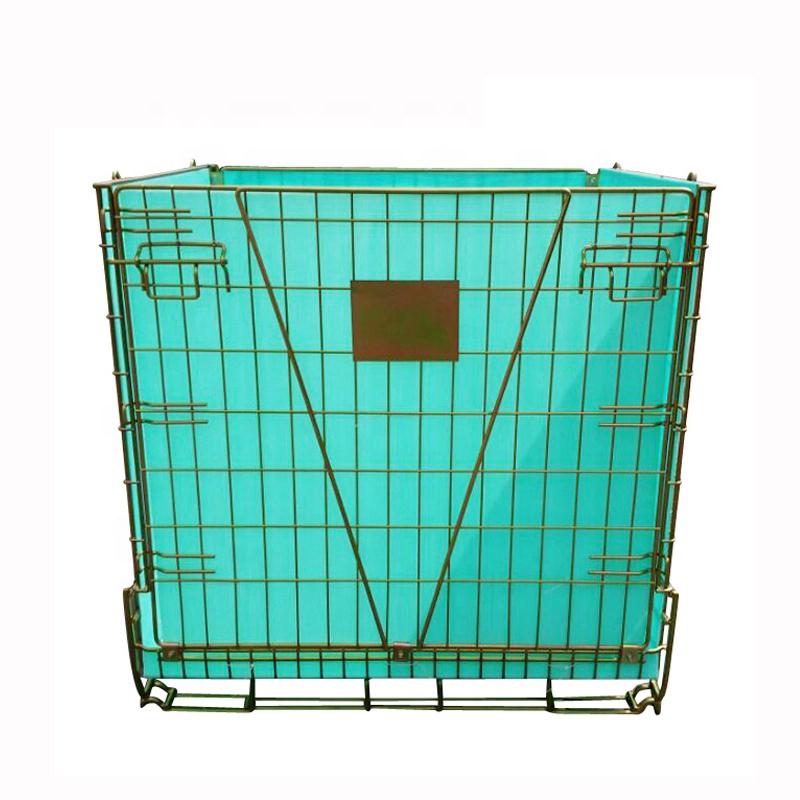
Path B: Review the mesh specification
A finer mesh addresses the loss problem at the container structure instead of adding an internal accessory. It may be the cleaner path when small parts consistently fall below the existing opening size, when operators need an unobstructed mesh interior, or when a liner would hinder drainage, cleaning, visual inspection, or return logistics. The trade-off is that changing the mesh is a custom specification review - not a promise that every finer opening is a standard option. The supplier should review the minimum part dimension, wire diameter, panel strength, weld pattern, weight, coating, tooling, cost, and lead time together.
For precision parts, a finer mesh alone may still leave a risk of rubbing. Conversely, a liner can stop contact and dust but add inspection and maintenance effort. Stbox's welded Q235 structure, formed stacking feet, and U-steel bottom reinforcement support industrial handling, but do not eliminate the need to validate the containment and surface protection concept for the actual part.
Use this decision tree before requesting a quote
- Can the smallest part pass through the current opening? If yes, first request a mesh review against the measured minimum dimension. If no, continue with the surface and process questions.
- Is the main risk loss, abrasion, dust, or a combination? Loss points to a finer mesh; abrasion or dust points to a PP liner; combined risks may require both to be evaluated.
- Will part families, cleaning methods, or line layouts change? If yes, a replaceable liner can offer more flexibility. Confirm its thickness, covered surfaces, fastening, and temperature suitability.
- Will the container be stacked and moved when loaded? Confirm the project load plan, stacking height, foot engagement, and forklift or pallet jack interface. Do not transfer one project's load or stacking limit to another Stbox variant.
Questions for the purchasing specification
What is the minimum part size?
Specify the smallest dimension, shape, orientation, and movement conditions - not just the average size of the part. Include a sample part or drawing if possible.
Should we choose a liner or a finer mesh?
Choose a liner when flexibility and surface separation are the priority; request a review of the finer mesh fabric when capture through the opening is the primary failure criterion. If both loss and scratches are unacceptable, ask for a combined comparison with impact on cost and lead time.
How should the liner be defined?
Specify the required plate thickness, the surfaces to be coated, the edge treatment, the fastening method, the removal frequency, the cleaning method, and the temperature exposure. Stbox can discuss PP liner variants, but these details are not confirmed standard values and must be offered application-specifically.
Are small parts escaping from your wire mesh container? Send the minimum part dimension, the surface requirements, the handling path, the cleaning conditions, and the expected quantity. Steel Pallet can compare the PP liner solution with a finer mesh specification and then return a decision recommendation with the points that still require confirmation by drawing, cost, and lead time.
Benötigen Sie eine individuelle Lagerlösung?
Sprechen Sie direkt mit unseren technischen Ingenieuren. Wir bieten kostenlose Strukturplanungen, Bewertungen von Hochlast-Katalogen und schnelle B2B-Preisangebote.
Jetzt Angebot anfordern →