
A single drum plan can easily cover a diameter range of 2.7×. In a documented cable distribution project, 22 drum types from Ø737 mm to Ø2,007 mm were listed, with drum weights of approximately 500–3,000 kg and drum widths within a specified range of 610–1,118 mm. A shelf that accommodates each drum on a fixed level cannot serve this list: if the level is designed for the Ø2,007 mm drum, most of the volume above the small drums is dead space; if it is designed for the Ø737 mm drum, the large drum cannot be stored at all.
The arrangement used in this project was not one shelf height but two shelf groups from the same frame family—a division into diameter bands. Below: how the drums were grouped, what changes between a two-level band and a one-level band, why an auxiliary frame is not a free-standing shelf, and how the 100 mm hole spacing on the upright is used to determine the drum support height. Every number given here is a reference value of this one documented design, not a general Carack classification.
Why one shelf height cannot cover the drum list from 737 mm to 2,007 mm
A cable drum requires vertical space equal to its own diameter, plus the clearance a forklift needs to place the drum on the drum support and lift it off again. Between Ø737 mm and Ø2,007 mm, the space requirement shifts by about 1,270 mm, which is more than an entire usable level in a shelf of this class. That is why the documented project did not standardize a uniform level height: the drum list was divided first, and the support positions were then determined per group. Two other columns of the same list are just as important as the diameter. The drum weight—approximately 500–3,000 kg across the entire list—determines the selection of the support and the base. The drum width—610–1,118 mm in the specified range—determines how much of the frame depth a drum occupies and how close two positions can be to each other.
How to group cable drums into diameter bands
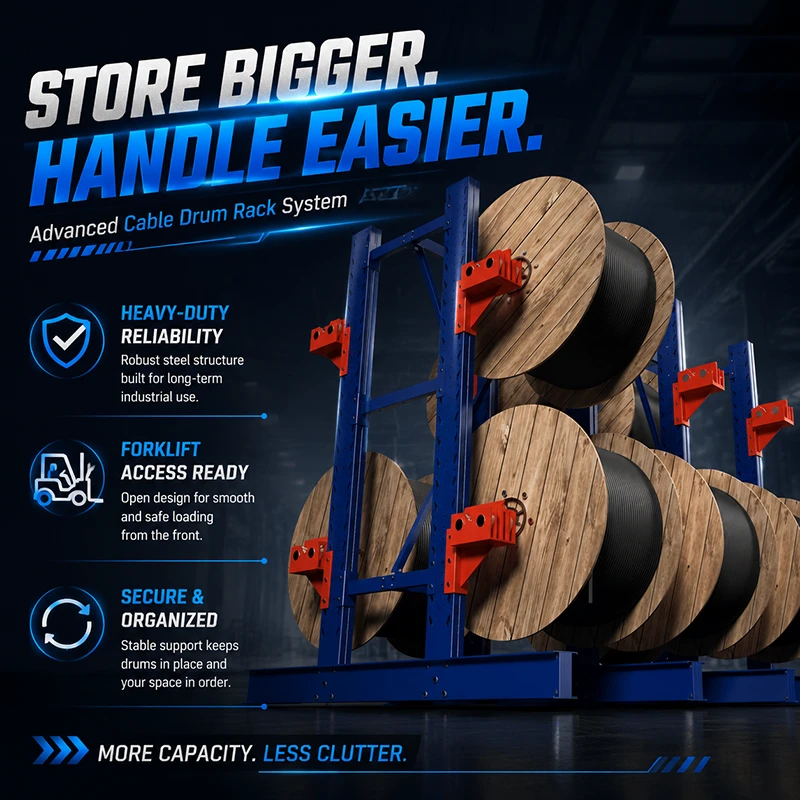
The grouping begins with the drum list sorted by diameter, with weight and width carried along. The working rule is simple: a band is valid if every drum in it can sit with the same support spacing, the same forklift access, and without interference from the level above. If a drum in a band forces the level higher or the position wider, that drum belongs in the band above. With the documented list of 22 drums, the division produced two groups. The two-level group carried four drum positions per frame element for the smaller diameters. The one-level group carried two drum positions per frame element for the larger diameters. Both reference designs were approximately 3,002 mm high. The reference weights of the main and auxiliary frames were 638 kg and 368 kg for one group, 690 kg and 360 kg for the other. These numbers describe the two designs of this project; a different drum list leads to different bands, different positions per frame element, and different frame weights.
What changes between a two-level band and a one-level band?
The two-level band is the space-saving side of the division: smaller drums are stacked, four positions per frame element in the documented design, and the frame height is used twice. The one-level band gives the large drum the full level—two positions per frame element, no upper support that obstructs loading, and no attempt to squeeze a second level under the top edge of the frame. Note what does not change: the one-level group is not a taller shelf. Both reference groups were approximately 3,002 mm high, so the support arrangement changed at the same frame height, not the frame height itself. When comparing the two groups, compare the positions per frame element and the aisle the forklift requires, not the external dimensions of the shelf.
Why an auxiliary frame cannot be set up independently
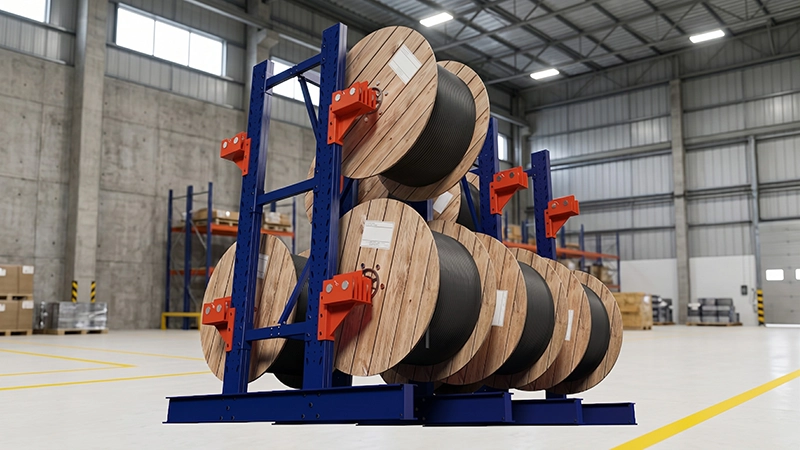
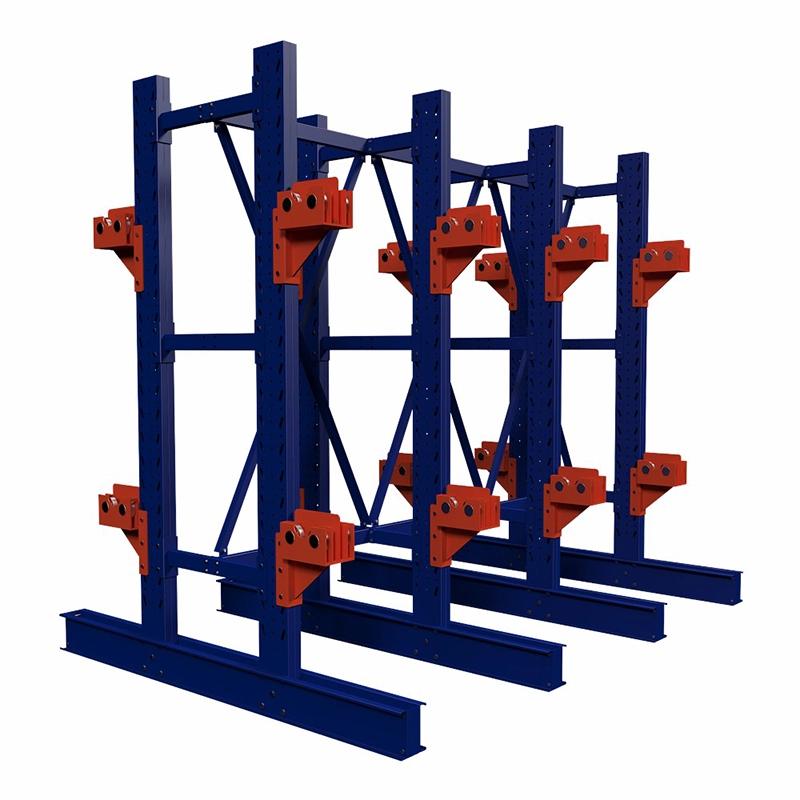
A Carack bay consists of a main frame and optional auxiliary frames. In this arrangement, the auxiliary frame has no independent support: it rests on the upright of the main frame and is integrated into the same braced assembly. In the documented multi-bay design, one main frame and two auxiliary frames formed the shelf; the auxiliary frames added drum positions, they did not form a free-standing support. Two practical consequences follow from this. An auxiliary frame cannot be offered as a standalone shelf for a separate storage island—that island requires its own main frame. And the position, base connection, and bracing of the auxiliary frame must be designed together with the main frame, not added later to the standing shelf. The reference frame weights point in the same direction: in the documented designs, the main frame weighed approximately 638 kg and 690 kg, the auxiliary frame approximately 368 kg and 360 kg.
How to use the 100 mm hole spacing on the upright
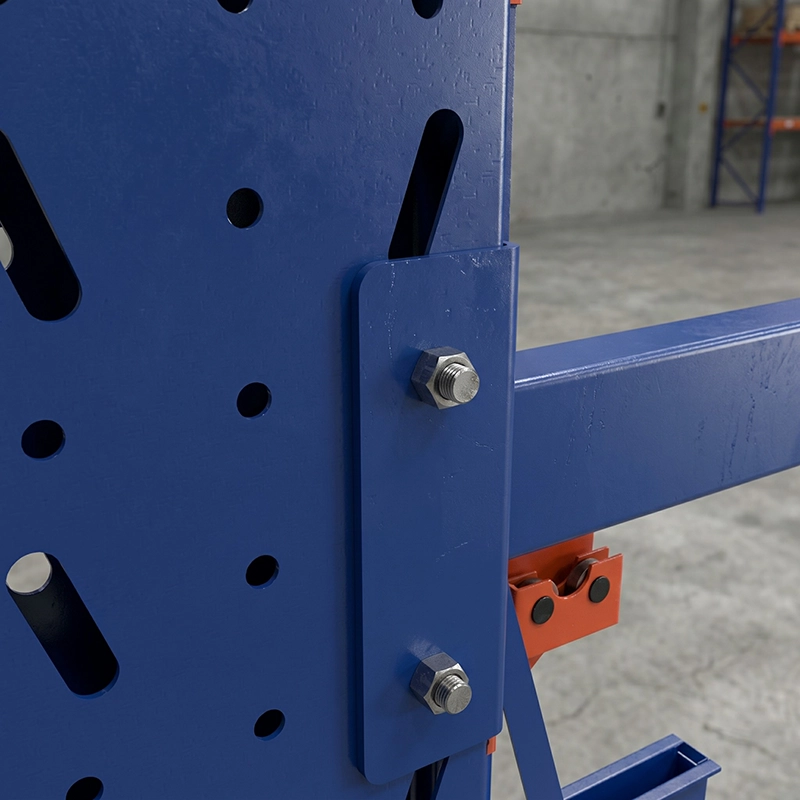
Das dedizierte Stützenprofil ist in Abständen von 100 mm mit Montagelöchern versehen, und dieser Abstand ist die Einstellschrittweite für die Trommelauflagehöhe. Die Reihenfolge ist: zuerst das Durchmesserband festlegen; das unterste Loch finden, das der größten Trommel des Bandes den erforderlichen Durchmesserfreiraum und die Gabelstaplereinfahrt bietet; dann dieselbe Position für jede Stellplatzebene in diesem Band einstellen, damit die Gruppe waagerecht bleibt. Das Raster ist ein fester 100-mm-Abstand, keine stufenlose Verstellung, sodass eine Auflage auf dem nächstgelegenen gültigen Loch landet und nicht auf einem exakt berechneten Millimeterwert. Das ist normalerweise ausreichend, weil die Ebene auf ein Band und nicht auf eine einzelne Trommel ausgelegt ist. Dieselbe Stütze trägt auch beide Ebenen eines zweistöckigen Bandes, weshalb der Lochabstand eine Rahmen-Eigenschaft und kein Zubehör ist. Wenn sich die Trommelliste ändert, können die Auflagen an derselben Stütze neu eingestellt werden; der Rahmen muss nicht ausgetauscht werden.
Wo der Durchmesserband-Ansatz nicht gilt
Die oben beschriebene Aufteilung ist eine Planungsmethode mit klaren Grenzen, und es lohnt sich, diese zu nennen, bevor eine Trommelliste zur Angebotserstellung gesendet wird.
- Bänder werden aus einer Liste heraus aufgebaut. Wenn sich der Bestand alle paar Wochen umschlägt, werden die Bänder veraltet und müssen vor der Bestellung erneut geprüft werden.
- Wenn Kabel direkt von der Trommel abgewickelt werden müssen, ist das eine Entscheidung für eine Wälzlagerauflage mit eigener Freiraumanforderung, getrennt von der Bandaufteilung. Carack ist eine feste Stahllagerstruktur, kein automatisiertes Kabelkarussell, keine Kabelwickelmaschine und kein Ausfahr-Kragarmregal.
- Wenn eine Trommel aus dem Regal entnommen und auf einen mobilen Wagen umgesetzt werden soll, müssen die Gabelstaplerfreiräume und die Auflagegeometrie für diese Bewegung bestätigt und nicht vorausgesetzt werden.
- Für die Lagerung im Freien ist eine mit dem Angebot vereinbarte Korrosionsschutzbeschichtung sowie eine betriebliche Entscheidung zur Regenbelastung erforderlich; das Regal ist nicht automatisch ein Produkt für den Außenbereich.
- Aus diesem Artikel dürfen keine universelle Tragfähigkeit, Stahlgüte, Sicherheitsfaktor oder Verankerungsanforderung abgeleitet werden. Tragfähigkeit, Oberflächenbehandlung und Verankerung werden für die jeweilige Konfiguration im Angebot oder in der Zeichnung bestätigt.
Wo diese Regalanordnung passt
- Kabelverteilzentrum, dessen Trommelliste kleine und große Durchmesser mischt
- Pufferlager im Kabelwerk zwischen Produktion, Prüfung und Versand
- Lager für Energie- und Elektroausrüstung mit definierter Trommelliste und Gabelstaplerzugang
- Lange Lagerreihe, in der ein Hauptrahmen mit Hilfsrahmen verlängert wird
- Kabelplatz im Freien, bei dem eine Korrosionsschutzbeschichtung für die jeweilige Konfiguration festgelegt ist
Häufig gestellte Fragen
Wie erkenne ich, wie viele Durchmesserbänder meine Trommelliste benötigt?
Sortieren Sie die Liste nach Durchmesser, und prüfen Sie dann zwei Grenzen: was zwischen zwei Auflageebenen passt und was eine eigene Ebene benötigt. Bei der dokumentierten Liste mit 737–2.007 mm ergaben sich genau zwei Bänder – ein zweistöckiges Band mit vier Stellplätzen pro Rahmen-Einheit und ein einstöckiges Band mit zwei Stellplätzen pro Rahmen-Einheit. Die Bandanzahl folgt der Liste; es gibt keine feste Anzahl. Die Prüfung für jedes Band ist, ob die größte Trommel noch die Auflage darüber freihält und noch eine nutzbare Gabelstaplereinfahrt vorhanden ist.
Kann ich nur den Hilfsrahmen bestellen und ihn als separates Regal nutzen?
Nein. Der Hilfsrahmen stützt sich auf die Stütze des Hauptrahmens und ist Teil derselben ausgesteiften Baugruppe, daher ist er eine Erweiterung eines Hauptrahmens und keine eigenständige Einheit. Wenn Sie eine zweite, separate Lagerinsel benötigen, kalkulieren Sie diese Insel mit einem eigenen Hauptrahmen.
Does the 100 mm hole spacing allow me to change the support height by 100 mm at any time?
The support positions are set in 100 mm increments because this is the spacing of the mounting holes. This is sufficient to define a level for a defined diameter range and to readjust it later when the drum list changes, but it is not a stepless adjustment and does not automatically guarantee sufficient clearance. Drum diameter, drum width, support geometry and forklift access must still be checked for the respective configuration.
Send the drum list – diameter, weight and width of each drum – together with the handling device and the available aisle, then the belt distribution, parking positions per frame unit and frame combination can be developed for your location instead of being adopted from the above-mentioned reference design.
Benötigen Sie eine individuelle Lagerlösung?
Sprechen Sie direkt mit unseren technischen Ingenieuren. Wir bieten kostenlose Strukturplanungen, Bewertungen von Hochlast-Katalogen und schnelle B2B-Preisangebote.
Jetzt Angebot anfordern →